
Pulp Fiction, 1916 · page 84 of 220
The Argosy, April 1916 — page 84: what you’re looking at
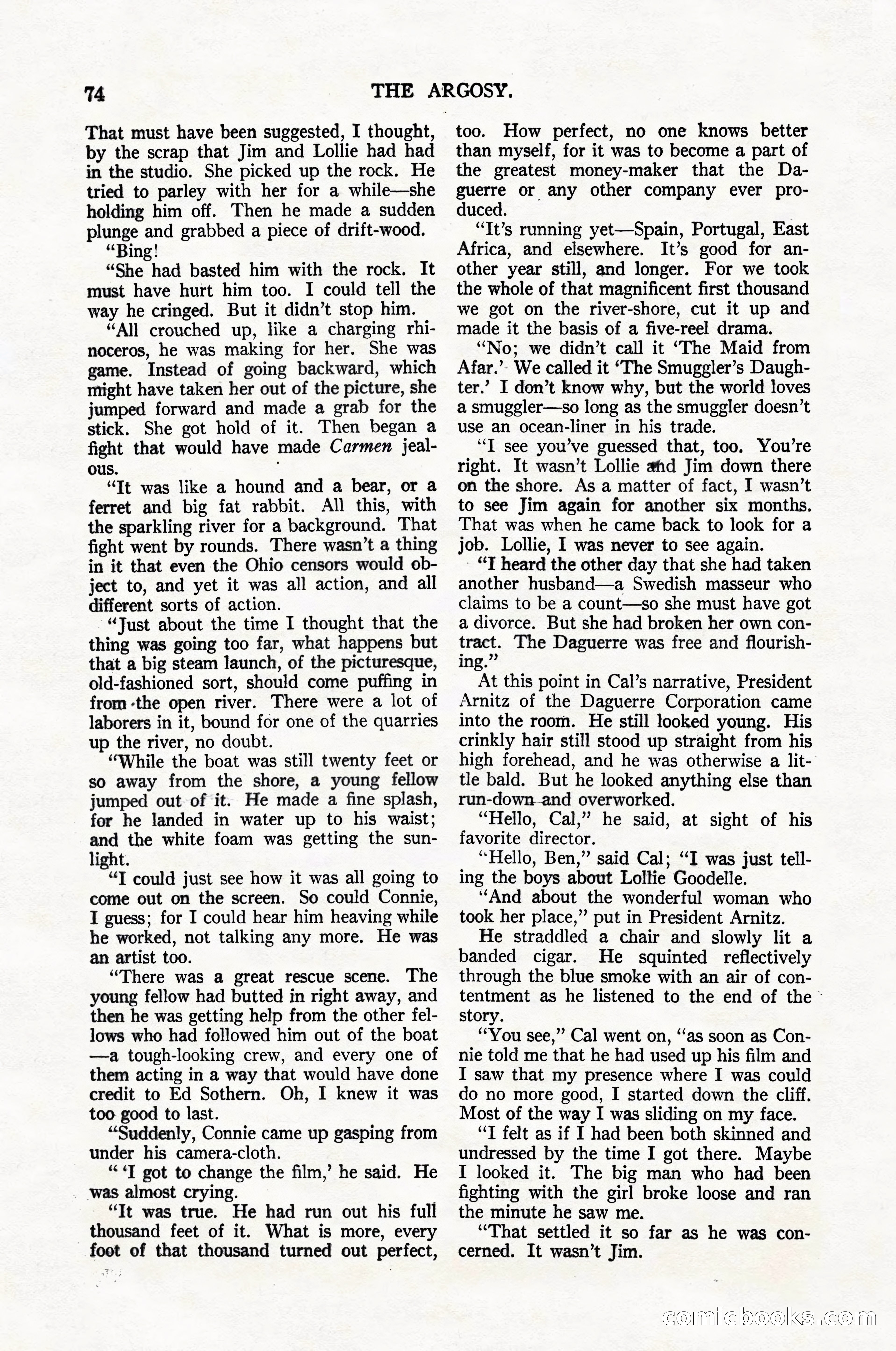
A restored page from Pulp Fiction, 1916. Page through the whole issue in the reader above.
📄 Transcribed text from this page (OCR, searchable)
Machine-transcribed from the original scan — historical spelling and the odd misread are preserved.
74 That must have been suggested, I thought, by the scrap that Jim and Lollie had had in the studio. She picked up the rock. He tried to parley with her for a while—she holding him off. Then he made a sudden plunge and grabbed a piece of drift-wood. “Bing! “She had basted him with the rock. It must have hurt him too. I could tell the way he cringed. But it didn’t stop him. “All crouched up, like a charging rhi- noceros, he was making for her. She was game. Instead of going backward, which might have taken her out of the picture, she jumped forward and made a grab for the stick. She got hold of it. Then began a fight that would have made Carmen jeal- ous. “Tt was like a hound and a bear, or a ferret and big fat rabbit. All this, with the sparkling river for a background. That fight went by rounds. There wasn’t a thing in it that even the Ohio censors would ob- ject to, and yet it was all action, and all different sorts of action. “Just about the time I thought that the thing was going too far, what happens but that a big steam launch, of the picturesque, old-fashioned sort, should come puffing in from -the open river. There were a lot of laborers in it, bound for one of the quarries up the river, no doubt. ‘While the boat was still twenty feet or so away from the shore, a young fellow jumped out of it. He made a fine splash, for he landed in water up to his waist; and the white foam was getting the sun- light. “T could just see how it was all going to come out on the screen. So could Connie, I guess; for I could hear him heaving while he worked, not talking any more. He was an artist too. “There was a great rescue scene. The young fellow had butted in right away, and then he was getting help from the other fel- lows who had followed him out of the boat —a tough-looking crew, and every one of them acting in a way that would have done credit to Ed Sothern. Oh, I knew it was too good to last. “Suddenly, Connie came up gasping from under his camera-cloth. ““*T got to change the film,’ he said. He was almost crying. “It was true. He had run out his full thousand feet of it. What is more, every foot of that thousand turned out perfect, THE ARGOSY. too. How perfect, no one knows better than myself, for it was to become a part of the greatest money-maker that the Da- guerre or any other company ever pro- duced. “Tt’s running yet—Spain, Portugal, East Africa, and elsewhere. It’s good for an- other year still, and longer. For we took the whole of that magnificent first thousand we got on the river-shore, cut it up and made it the basis of a five-reel drama. “No; we didn’t call it ‘The Maid from Afar.’- We called it “The Smuggler’s Daugh- ter.’ I don’t know why, but the world loves a smuggler—so long as the smuggler doesn’t use an ocean-liner in his trade. ‘“T see you’ve guessed that, too. You’re right. It wasn’t Lollie ahd Jim down there on the shore. As a matter of fact, I wasn’t to see Jim again for another six months. That was when he came back to look for a job. Lollie, I was never to see again. - “T heard the other day that she had taken another husband—a Swedish masseur who claims to be a count—so she must have got a divorce. But she had broken her own con- tract. The Daguerre was free and flourish- ing. At this point in Cal’s narrative, President Arnitz of the Daguerre Corporation came into the room. He still looked young. His crinkly hair still stood up straight from his high forehead, and he was otherwise a lit- tle bald. But he looked anything else than run-downand overworked. ‘Hello, Cal,” he said, at sight of his favorite director. ‘Hello, Ben,” said Cal; “I was just tell- ing the boys about Loltie Goodelle. ‘‘And about the wonderful woman who took her place,” put in President Arnitz. He straddled a chair and slowly lit a banded cigar. He squinted reflectively through the blue smoke with an air of con- tentment as he listened to the end of the © story. “You see,”’ Cal went on, ‘‘as soon as Con- nie told me that he had used up his film and I saw that my presence where I was could do no more good, I started down the cliff. Most of the way I was sliding on my face. “T felt as if I had been both skinned and undressed by the time I got there. Maybe I looked it. The big man who had been fighting with the girl broke loose and ran the minute he saw me. ‘That settled it so far as he was con- cerned. It wasn’t Jim. MICLOOOK (©