
Pulp Fiction, 1916 · page 72 of 220
The Argosy, April 1916 — page 72: what you’re looking at
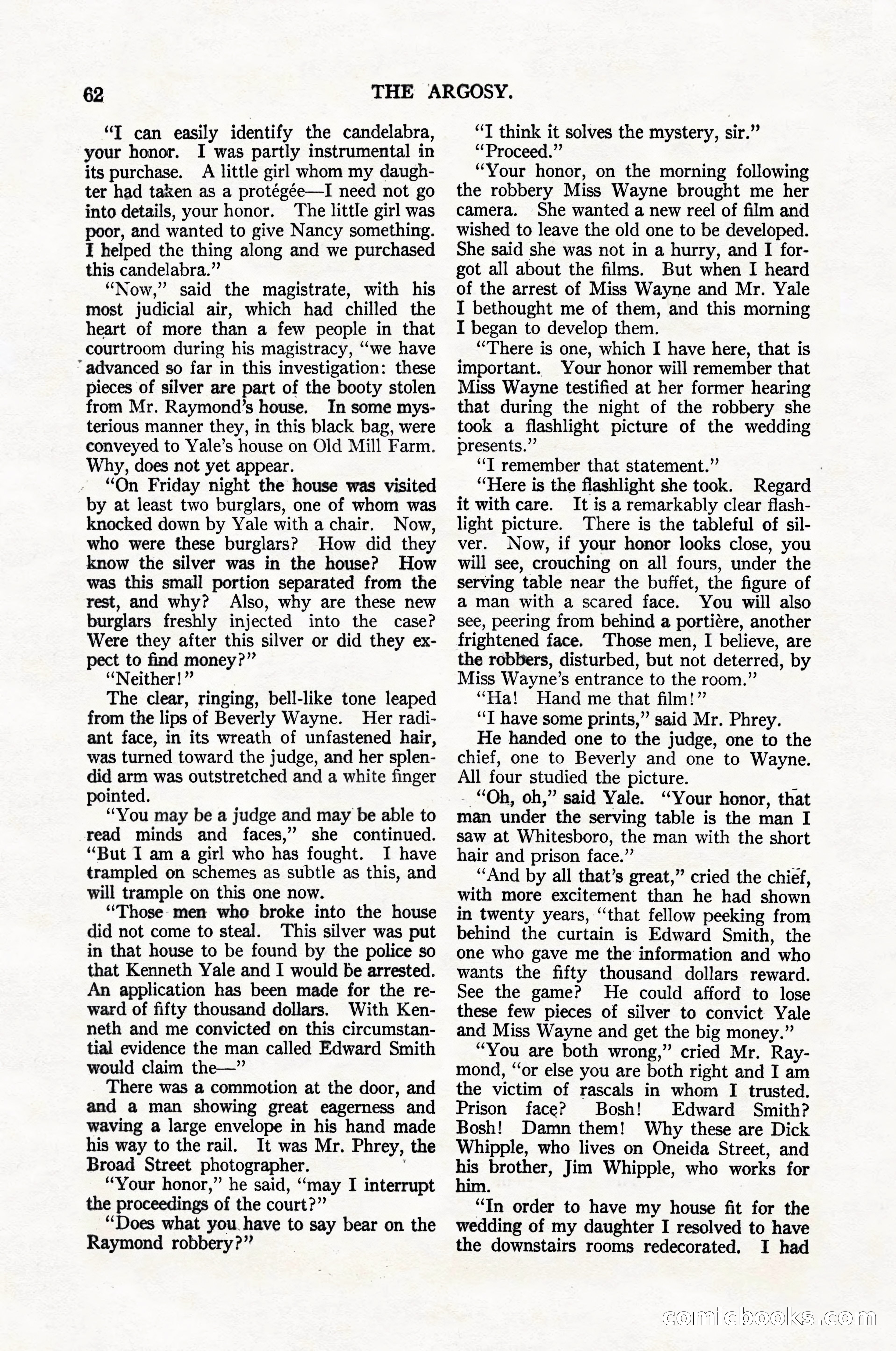
A restored page from Pulp Fiction, 1916. Page through the whole issue in the reader above.
📄 Transcribed text from this page (OCR, searchable)
Machine-transcribed from the original scan — historical spelling and the odd misread are preserved.
62 “T can easily identify the candelabra, your honor. I was partly instrumental in its purchase. A little girl whom my daugh- ter had taken as a protégée—I need not go into details, your honor. The little girl was poor, and wanted to give Nancy something. I helped the thing along and we purchased this candelabra.” “Now,” said the magistrate, with his most judicial air, which had chilled the heart of more than a few people in that courtroom during his magistracy, “‘we have ‘advanced so far in this investigation: these pieces of silver are part of the booty stolen from Mr. Raymond’s house. In some mys- terious manner they, in this black bag, were conveyed to Yale’s house on Old Mill Farm. Why, does not yet appear. “On Friday night the house was visited by at least two burglars, one of whom was knocked down by Yale with a chair. Now, who were these burglars? How did they know the silver was in the house? How was this small portion separated from the rest, and why? Also, why are these new burglars freshly injected into the case? Were they after this silver or did they ex- pect to find money?” “Neither! ” | The clear, ringing, bell-like tone leaped from the lips of Beverly Wayne. Her radi- ant face, in its wreath of unfastened hair, was turned toward the judge, and her splen- did arm was outstretched and a white finger pointed. “You may be a judge and may be able to read minds and faces,” she continued. “But I am a girl who has fought. I have trampled on schemes as subtle as this, and will trample on this one now. “Those men who broke into the house did not come to steal. This silver was put in that house to be found by the police so that Kenneth Yale and I would be arrested. An application has been made for the re- ward of fifty thousand dollars. With Ken- neth and me convicted on this circumstan- tial evidence the man called Edward Smith would claim the—”’ There was a commotion at the door, and and a man showing great eagerness and waving a large envelope in his hand made his way to the rail. It was Mr. Phrey, the Broad Street photographer. : “Your honor,” he said, “may I interrupt the proceedings of the court?” “Does what you. have to say bear on the Raymond robbery?” THE ARGOSY. “T think it solves the mystery, sir.” “Proceed.” “Your honor, on the morning following the robbery Miss Wayne brought me her camera. She wanted a new reel of film and wished to leave the old one to be developed. She said she was not in a hurry, and I for- got all about the films. But when I heard of the arrest of Miss Wayne and Mr. Yale I bethought me of them, and this morning I began to develop them. “There is one, which I have here, that is important. Your honor will remember that Miss Wayne testified at her former hearing that during the night of the robbery she took a flashlight picture of the wedding presents.”’ “T remember that statement.” “Here is the flashlight she took. Regard it with care. It is a remarkably clear flash- light picture. There is the tableful of sil- ver. Now, if your honor looks close, you will see, crouching on all fours, under the serving table near the buffet, the figure of a man with a scared face. You will also see, peering from behind a portiére, another frightened face. ‘Those men, I believe, are the robbers, disturbed, but not deterred, by Miss Wayne’s entrance to the room.”’ “Ha! Hand me that film!” ‘IT have some prints,” said Mr. Phrey. He handed one to the judge, one to the chief, one to Beverly and one to Wayne. All four studied the picture. ‘ _ “Oh, oh,” said Yale. “Your honor, that man under the serving table is the man I saw at Whitesboro, the man with the short hair and prison face.” ‘‘And by all that’s great,” cried the chief, with more excitement than he had shown in twenty years, “that fellow peeking from behind the curtain is Edward Smith, the one who gave me the information and who wants the fifty thousand dollars reward. See the game? He could afford to lose these few pieces of silver to convict Yale and Miss Wayne and get the big money.” “You are both wrong,” cried Mr. Ray- mond, “or else you are both right and I am the victim of rascals in whom I trusted. Prison face? Bosh! Edward Smith? Bosh! Damn them! Why these are Dick Whipple, who lives on Oneida Street, and aS ae Jim Whipple, who works for ‘In order to have my house fit for the wedding of my daughter I resolved to have the downstairs rooms redecorated. I had MICLOOOK (C@