
Pulp Fiction, 1916 · page 33 of 220
The Argosy, April 1916 — page 33: what you’re looking at
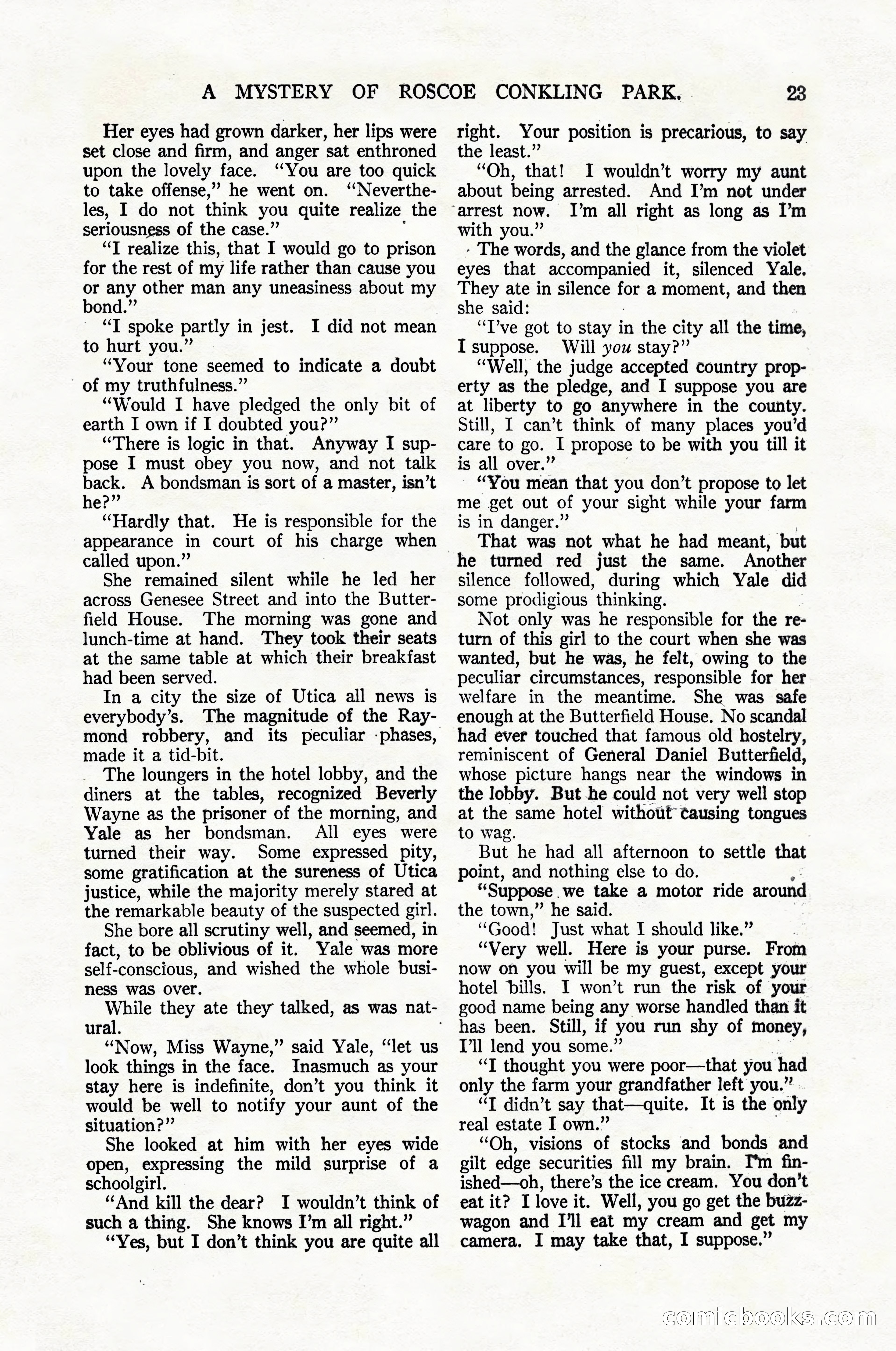
A restored page from Pulp Fiction, 1916. Page through the whole issue in the reader above.
📄 Transcribed text from this page (OCR, searchable)
Machine-transcribed from the original scan — historical spelling and the odd misread are preserved.
A MYSTERY OF ROSCOE CONKLING PARK. . Her eyes had grown darker, her lips were set close and firm, and anger sat enthroned upon the lovely face. ‘You are too quick to take offense,”’ he went on. ‘‘Neverthe- les, I do not think you quite realize the seriousness of the case.”’ “T realize this, that I would go to prison for the rest of my life rather than cause you or any other man any uneasiness about my bond.” “T spoke partly in jest. to hurt you.” “Your tone seemed to indicate a doubt of my truthfulness.” ‘“‘Would I have pledged the only bit of earth I own if I doubted you?” “There is logic in that. Anyway I sup- pose I must obey you now, and not talk back. A bondsman is sort of a master, isn’t he?” “Hardly that. He is responsible for the appearance in court of his charge when called upon.” She remained silent while he led her across Genesee Street and into the Butter- field House. The morning was gone and lunch-time at hand. They took their seats at the same table at which their breakfast had been served. In a city the size of Utica all news is everybody’s. The magnitude of the Ray- I did not mean mond robbery, and its peculiar -phases, made it a tid-bit. The loungers in the hotel lobby, and the diners at the tables, recognized Beverly Wayne as the prisoner of the morning, and Yale as her bondsman. All eyes were turned their way. Some expressed pity, some gratification at the sureness of Utica justice, while the majority merely stared at the remarkable beauty of the suspected girl. She bore all scrutiny well, and seemed, in fact, to be oblivious of it. Yale was more self-conscious, and wished the whole busi- ness was over. ural. “Now, Miss Wayne,” said Yale, “let us look things in the face. Inasmuch as your stay here is indefinite, don’t you think it would be well to notify your aunt of the situation?” She looked at him with her eyes wide open, expressing the mild surprise of a schoolgirl. “And kill the dear? I wouldn’t think of such a thing. She knows I’m all right.” “Yes, but I don’t think you are quite all While they ate they talked, as was nat- 23 right. Your position is precarious, to say the least.” “Oh, that! I wouldn’t worry my aunt about being arrested. And I’m not under ‘arrest now. I’m all right as long as I’m with you.” - The words, and the glance from the violet eyes that accompanied it, silenced Yale. They ate in silence a: a moment, and then she said: “T’ve got to stay in the city all the time, I suppose. Will you stay?” “Well, the judge accepted country prop- erty as the pledge, and I suppose you are at liberty to go anywhere in the county. Still, I can’t think of many places you'd care to gO. i propose to be with you till it is all over.’ ~ “You mean that you don’t propose to let me get out of your sight while your farm is in danger.” That was not what he had meant, ‘but he turned red just the same. Another silence followed, during which Yale did some prodigious ‘thinking. Not only was he responsible for the re- turn of this girl to the court when she was wanted, but he was, he felt, owing to the peculiar circumstances, responsible for her welfare in the meantime. She was safe enough at the Butterfield House. No scandal had ever touched that famous old hostelry, reminiscent of General Daniel Butterfield, whose picture hangs near the windows in the lobby. But he could not very well stop at the same hotel without causing tongues to wag But he had all afternoon to settle that point, and nothing else to do. “Suppose we take a motor ride around the town,” he said. “Good! Just what I should like.” “Very well. Here is your purse. From now on you will be my guest, except your hotel bills. I won’t run the risk of your good name being any worse handled than it has been. Still, if you run shy of money, I'll lend you some.’ “I thought you were poor—that you had only the farm your grandfather left you.” - “T didn’t say that—quite. It is the only real estate I own.’ “Oh, visions of stocks and bonds and gilt edge securities fill my brain. I’m fin- ished—oh, there’s the ice cream. You don’t eat it? I love it. Well, you go get the buzz- wagon and I'll eat my cream and get my camera. I may take that, I suppose.’ MICLOOOK C@