
Pulp Fiction, 1916 · page 27 of 220
The Argosy, April 1916 — page 27: what you’re looking at
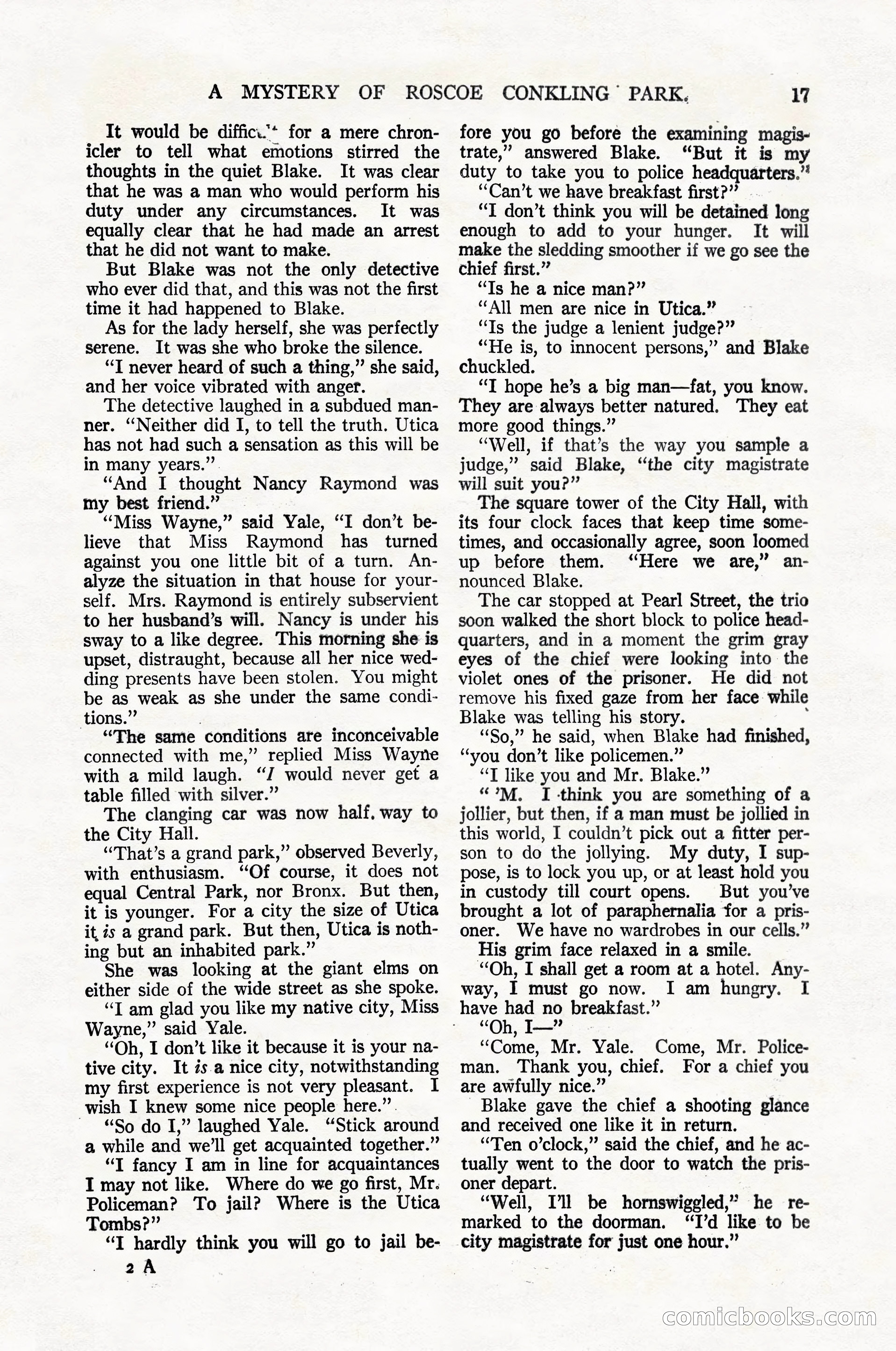
A restored page from Pulp Fiction, 1916. Page through the whole issue in the reader above.
📄 Transcribed text from this page (OCR, searchable)
Machine-transcribed from the original scan — historical spelling and the odd misread are preserved.
A MYSTERY OF ROSCOE CONKLING’ PARK. It would be diffic.."* for a mere chron- icler to tell what emotions stirred the thoughts in the quiet Blake. It was clear that he was a man who would perform his duty under any circumstances. It was equally clear that he had made an arrest that he did not want to make. But Blake was not the only detective who ever did that, and this was not the first time it had happened to Blake. As for the lady herself, she was perfectly serene. It was she who broke the silence. “T never heard of such a thing,” she said, and her voice vibrated with anger. The detective laughed in a subdued man- ner. ‘Neither did I, to tell the truth. Utica has not had such a sensation as this will be in many years.” “And I thought Nancy Raymond was my best friend.” “Miss Wayne,” said Yale, ‘I don’t be- lieve that Miss Raymond has _ turned against you one little bit of a turn. An- alyze the situation in that house for your- self. Mrs. Raymond is entirely subservient to her husband’s will. Nancy is under his sway to a like degree. This morning she is upset, distraught, because all her nice wed- ding presents have been stolen. You might be as weak as she under the same condi- tions.”’ | _ “The same conditions are inconceivable connected with me,” replied Miss Wayne with a mild laugh. “J would never get a table filled with silver.” The clanging car was now half, way to the City Hall. ‘“That’s a grand park,” observed Beverly, with enthusiasm. “Of course, it does not equal Central Park, nor Bronx. But then, it is younger. For a city the size of Utica it is a grand park. But then, Utica is noth- ing but an inhabited park.” She was looking at the giant elms on either side of the wide street as she spoke. “T am glad you like my native city, Miss Wayne,” said Yale. “Oh, I don’t like it because it is your na- tive city. It is.a nice city, notwithstanding my first experience is not very pleasant. I wish I knew some nice people here.”’. ~ “So do I,” laughed Yale. “Stick around a while and we'll get acquainted together.” “TI fancy I am in line for acquaintances I may not like. Where do we go first, Mr. Policeman? To jail? Where is the Utica Tombs?” “T hardly think you will go to jail be- 2A 17 fore you go before the examining magis- trate,” answered Blake. “But it is my duty to take you to police headquarters.” ‘“‘Can’t we have breakfast first?” “TI don’t think you will be detained long enough to add to your hunger. It will make the sledding smoother if we go see the chief first.” “Is he a nice man?” ‘“‘All men are nice in Utica.” “Is the judge a lenient judge?” “He is, to innocent persons,” and Blake chuckled. “T hope he’s a big man—fat, you know. They are always better natured. They eat more good things.”’ “Well, if that’s the way you sample a judge,” said Blake, “the city magistrate will suit you?” The square tower of the City Hall, with its four clock faces that keep time some- times, and occasionally agree, soon loomed up before them. “Here we are,” an- nounced Blake. 2 The car stopped at Pearl Street, the trio soon walked the short block to police head- quarters, and in a moment the grim gray eyes of the chief were looking into the violet ones of the prisoner. He did not remove his fixed gaze from her face while Blake was telling his story. “So,” he said, when Blake had finished, “vou don’t like policemen.” “T like you and Mr. Blake.” “?M. I -think you are something of a jollier, but then, if a man must be jollied in this world, I couldn’t pick out a fitter per- son to do the jollying. My duty, I sup- pose, is to lock you up, or at least hold you in custody till court opens. But you’ve brought a lot of paraphernalia for a pris- oner. We have no wardrobes in our cells.” His grim face relaxed in a smile. “Oh, I shall get a room at a hotel. Any- way, I must go now. I am hungry. I have had no breakfast.” “Oh, 1.2? ; “Come, Mr. Yale. Come, Mr. Police- man. Thank you, chief. For a chief you are awfully nice.” 3 Blake gave the chief a shooting glance and received one like it in return. “Ten o’clock,” said the chief, and he ac- tually went to the door to watch the pris- oner depart. : “Well, Il be hornswiggled,” he re- marked to the doorman. “I’d like to be city magistrate for just one hour.” OOOLK C@