
Pulp Fiction, 1916 · page 25 of 220
The Argosy, April 1916 — page 25: what you’re looking at
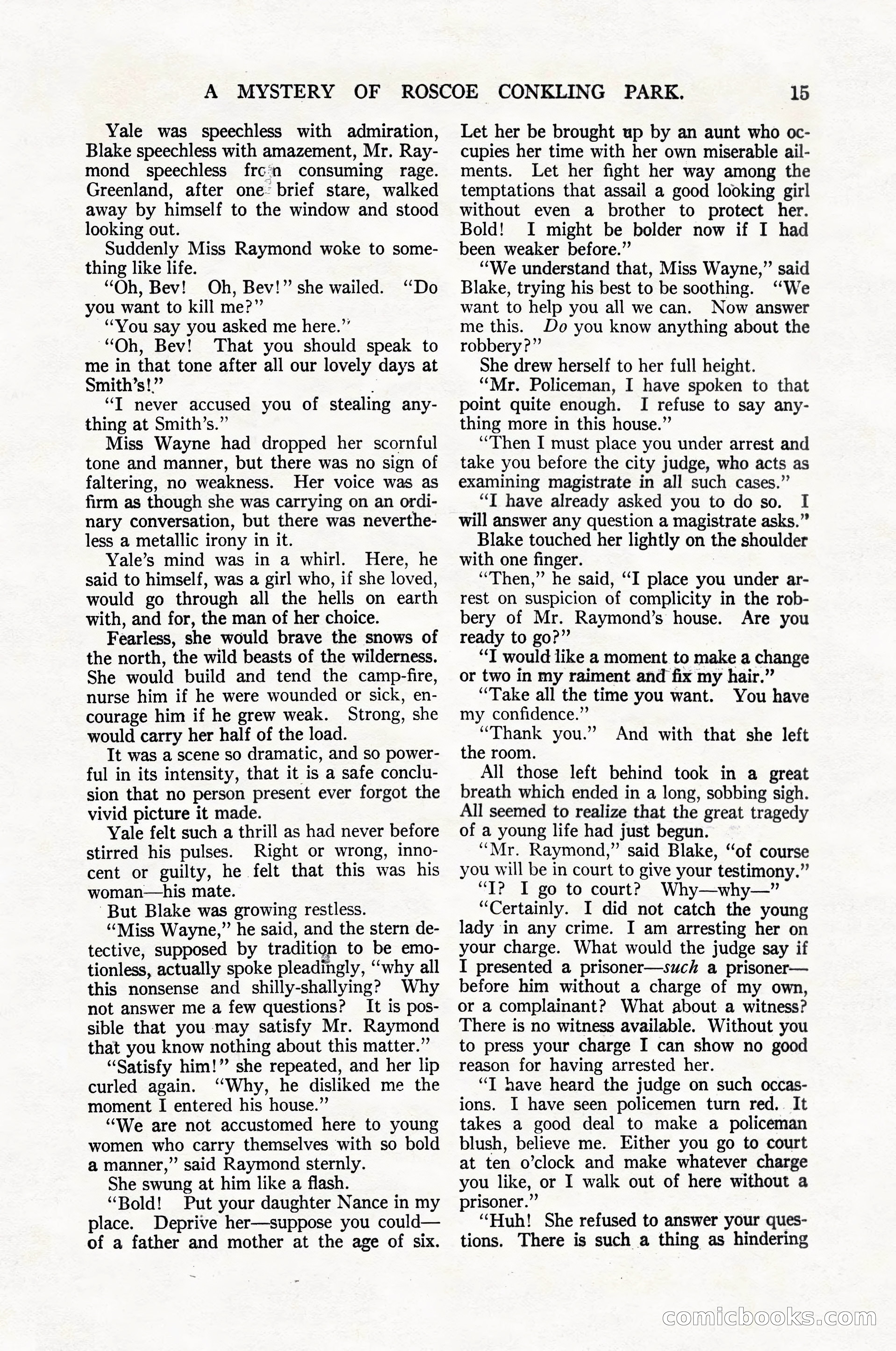
A restored page from Pulp Fiction, 1916. Page through the whole issue in the reader above.
📄 Transcribed text from this page (OCR, searchable)
Machine-transcribed from the original scan — historical spelling and the odd misread are preserved.
A MYSTERY OF ROSCOE CONKLING PARK. Yale was speechless with admiration, Blake speechless with amazement, Mr. Ray- mond speechless frc'n consuming rage. Greenland, after one: brief stare, walked away by himself to the window and stood looking out. Suddenly Miss Raymond woke to some- thing like life. “Oh, Bev! Oh, Bev!” she wailed. you want to kill me?” “You say you asked me here.”’ “Oh, Bev! That you should speak to me in that tone after all our lovely days at Smith’s!.” “T never accused you of stealing any- thing at Smith’s.”’ Miss Wayne had dropped her scornful tone and manner, but there was no sign of faltering, no weakness. Her voice was as firm as though she was carrying on an ordi- nary conversation, but there was neverthe- less a metallic irony in it. Yale’s mind was in a whirl. Here, he said to himself, was a girl who, if she loved, would go through all the hells on earth with, and for, the man of her choice. Fearless, she would brave the snows of the north, the wild beasts of the wilderness. She would build and tend the camp-fire, nurse him if he were wounded or sick, en- courage him if he grew weak. Strong, she would carry her half of the load. It was a scene so dramatic, and so power- ful in its intensity, that it is a safe conclu- sion that no person present ever forgot the vivid picture it made. Yale felt such a thrill as had never before stirred his pulses. Right or wrong, inno- cent or guilty, he felt that this was his woman—his mate. But Blake was growing restless. “Miss Wayne,” he said, and the stern de- tective, supposed by tradition to be emo- tionless, actually spoke pleadingly, ‘‘why all this nonsense and shilly-shallying? Why not answer me a few questions? It is pos- sible that you may satisfy Mr. Raymond that you know nothing about this matter.” “Satisfy him!’’ she repeated, and her lip curled again. “Why, he disliked me the moment I entered his house.” ‘“‘We are not accustomed here to young women who carry themselves with so bold a manner,” said Raymond sternly. She swung at him like a flash. “Bold! Put your daughter Nance in my place. Deprive her—suppose you could— of a father and mother at the age of six. “Do 15 Let her be brought up by an aunt who oc- cupies her time with her own miserable ail- ments. Let her fight her way among the temptations that assail a good looking girl without even a brother to protect her. Bold! I might be bolder now if I had been weaker before.” “We understand that, Miss Wayne,” said Blake, trying his best to be soothing. ‘“‘We want to help you all we can. Now answer me this. Do you know anything about the robbery?” She drew herself to her full height. “Mr. Policeman, I have spoken to that point quite enough. I refuse to say any- thing more in this house.” “Then I must place you under arrest and take you before the city judge, who acts as examining magistrate in all such cases,” “I have already asked you to do so. I will answer any question a magistrate asks.” Blake touched her lightly on the shoulder with one finger. “Then,” he said, “I place you under ar- rest on suspicion of complicity in the rob- bery of Mr. Raymond’s house. Are you ready to go?” “I would like a moment to make a change or two in my raiment and fix my hair.” ‘Take all the time you want. You have my confidence.” “Thank you.” the room. All those left behind took in a great breath which ended in a long, sobbing sigh. All seemed to realize that the great tragedy of a young life had just begun. “Mr. Raymond,” said Blake, “of course you will be in court to give your ‘testimony. x “I? I go to court? Why—why—” “Certainly. I did not catch the young lady in any crime. I am arresting her on your charge. What would the judge say if I presented a prisoner—such a prisoner— before him without a charge of my own, or a complainant? What about a witness? There is no witness available. Without you to press your charge I can show no good reason for having arrested her. “T have heard the judge on such occas- ions. I have seen policemen turn red. It takes a good deal to make a policeman blush, believe me. Either you go to court at ten o'clock and make whatever charge you like, or I walk out of here without a prisoner.” “Huh! She refused to answer your ques- tions. There is such a thing as hindering And with that she left MICLOOOLK C@