
Pulp Fiction, 1916 · page 194 of 220
The Argosy, April 1916 — page 194: what you’re looking at
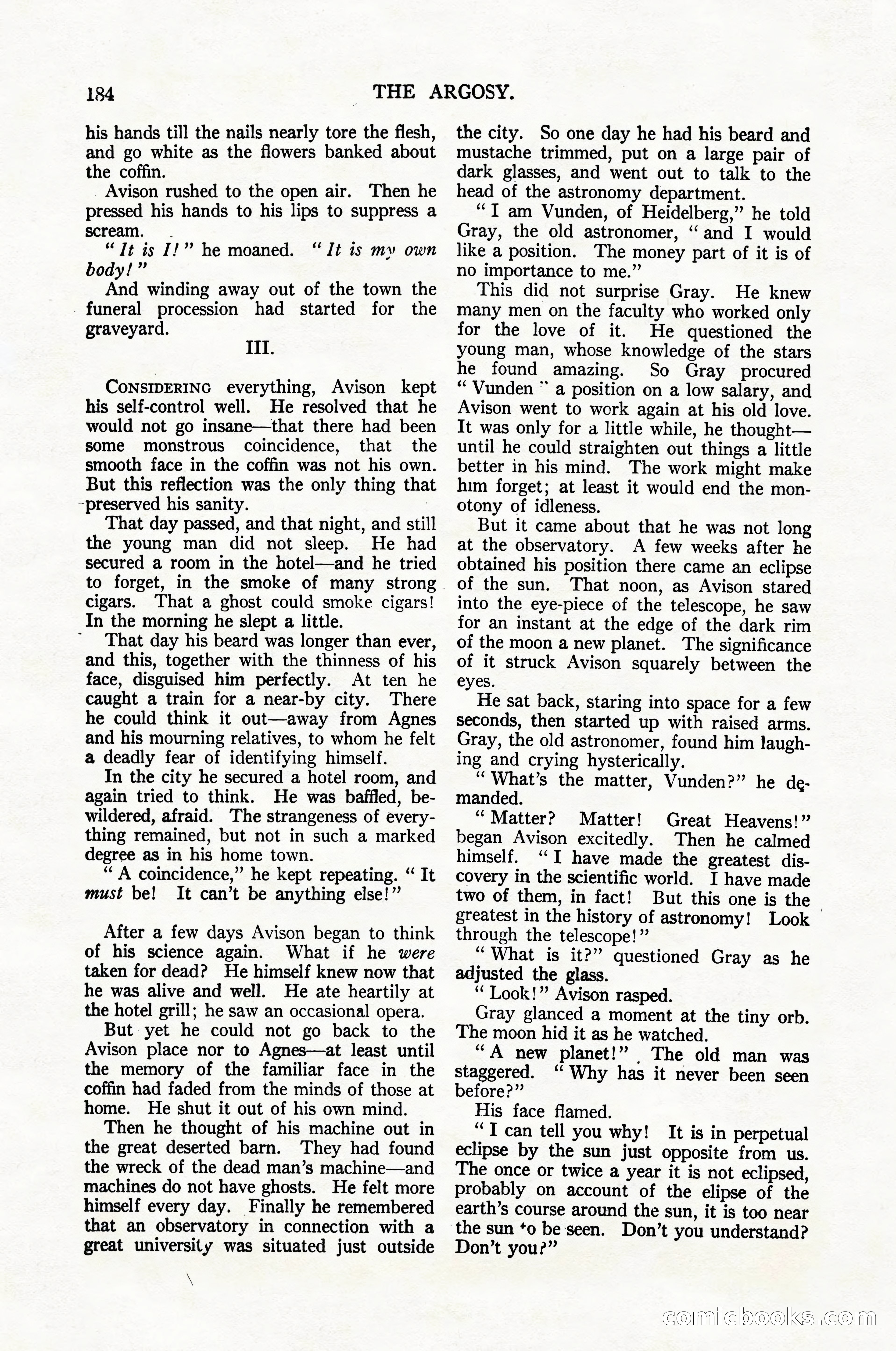
A restored page from Pulp Fiction, 1916. Page through the whole issue in the reader above.
📄 Transcribed text from this page (OCR, searchable)
Machine-transcribed from the original scan — historical spelling and the odd misread are preserved.
184 his hands till the nails nearly tore the flesh, and go white as the flowers banked about the coffin. _ Avison rushed to the open air. Then he pressed his hands to his lips to suppress a scream. . “It is I!” he moaned. body!” And winding away out of the town the _ funeral procession had started for the graveyard. “Tt is my own IIT. CONSIDERING everything, Avison kept his self-control well. He resolved that he would not go insane—that there had been some monstrous coincidence, that the smooth face in the coffin was not his own. But this reflection was the only thing tha -preserved his sanity. : That day passed, and that night, and still the young man did not sleep. He had secured a room in the hotel—and he tried to forget, in the smoke of many strong. cigars. That a ghost could smoke cigars! In the morning he slept a little. ' That day his beard was longer than ever, and this, together with the thinness of his face, disguised him perfectly. At ten he caught a train for a near-by city. There he could think it out—away from Agnes and his mourning relatives, to whom he felt a deadly fear of identifying himself. In the city he secured a hotel room, and again tried to think. He was baffled, be- wildered, afraid. The strangeness of every- thing remained, but not in such a marked degree as in his home town. ‘A coincidence,” he kept repeating. “ It must be! It can’t be anything else!” After a few days Avison began to think of his science again. What if he were taken for dead? He himself knew now that he was alive and well. He ate heartily at the hotel grill; he saw an occasional opera. But yet he could not go back to the Avison place nor to Agnes—at least until the memory of the familiar face in the coffin had faded from the minds of those at home. He shut it out of his own mind. Then he thought of his machine out in the great deserted barn. They had found the wreck of the dead man’s machine—and machines do not have ghosts. He felt more himself every day. Finally he remembered that an observatory in connection with a great university was situated just outside \ _ THE ARGOSY. the city. So one day he had his beard and mustache trimmed, put on a large pair of dark glasses, and went out to talk to the head of the astronomy department. “I am Vunden, of Heidelberg,” he told Gray, the old astronomer, “and I would like a position. The money part of it is of no importance to me.” This did not surprise Gray. He knew many men on the faculty who worked only for the love of it. He questioned the young man, whose knowledge of the stars he found amazing. So Gray procured “Vunden ™ a position on a low salary, and Avison went to work again at his old love. It was only for a little while, he thought— until he could straighten out things a little better in his mind. The work might make him forget; at least it would end the mon- otony of idleness. But it came about that he was not long at the observatory. A few weeks after he obtained his position there came an eclipse of the sun. That noon, as Avison stared into the eye-piece of the telescope, he saw for an instant at the edge of the dark rim of the moon a new planet. The significance of it struck Avison squarely between the eyes. He sat back, staring into space for a few seconds, then started up with raised arms. Gray, the old astronomer, found him laugh- ing and crying hysterically. ‘What’s the matter, Vunden?” he de- manded. “Matter? Matter! Great Heavens!” began Avison excitedly. Then he calmed himself. ‘I have made the greatest dis- covery in the scientific world. I have made two of them, in fact! But this one is the greatest in the history of astronomy! Look — through the telescope!” ‘What is it?” questioned Gray as he adjusted the glass. ‘ Look!” Avison rasped. Gray glanced a moment at the tiny orb. The moon hid it as he watched. “A new planet!” The old man was Staggered. ‘“ Why has it never been seen before?” His face flamed. “T can tell you why! It is in perpetual eclipse by the sun just opposite from us. The once or twice a year it is not eclipsed, probably on account of the elipse of the earth’s course around the sun, it is too near the sun to be seen. Don’t you understand? Don’t your” Ccomicloool (C@