
Pulp Fiction, 1916 · page 191 of 220
The Argosy, April 1916 — page 191: what you’re looking at
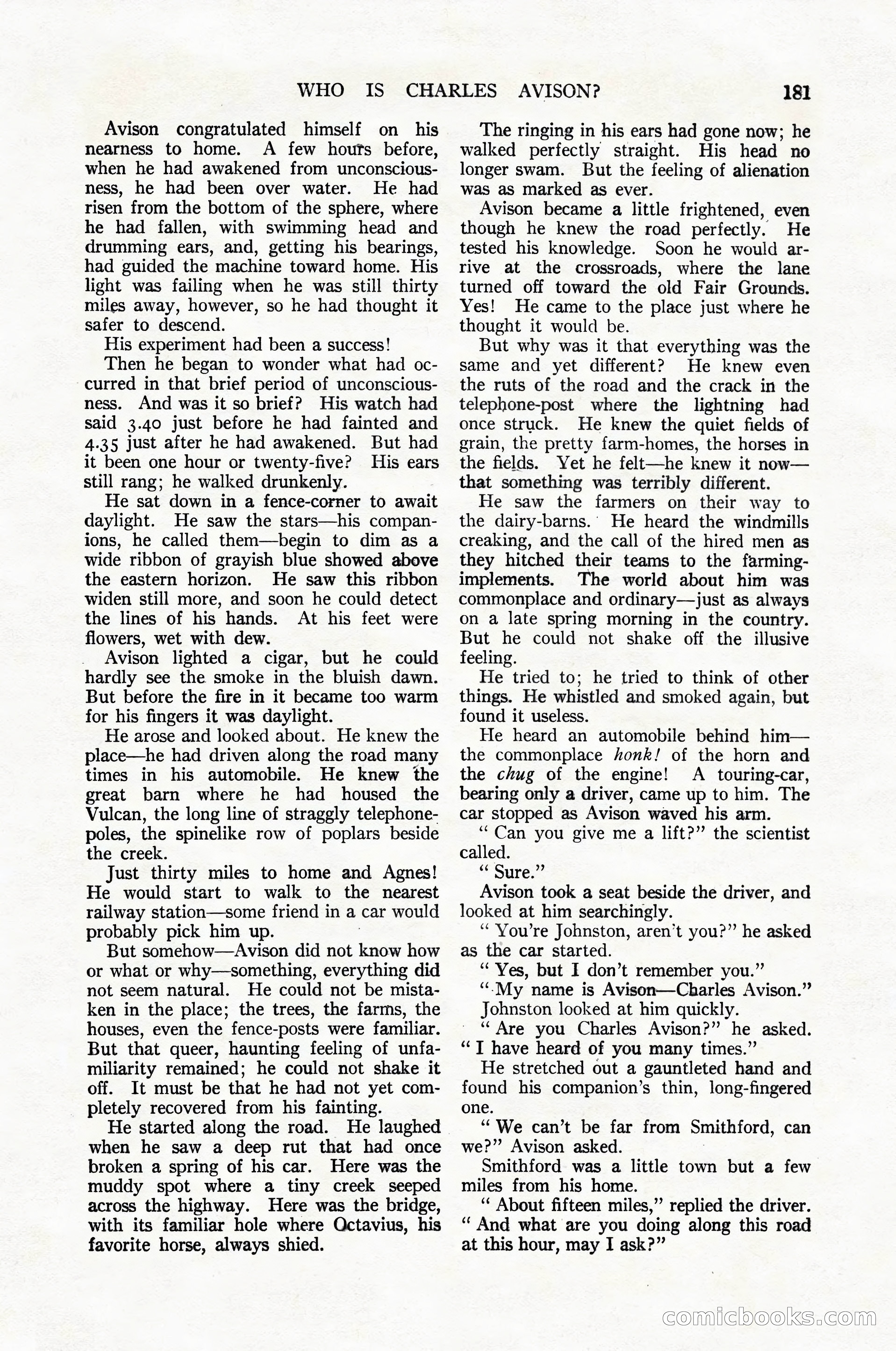
A restored page from Pulp Fiction, 1916. Page through the whole issue in the reader above.
📄 Transcribed text from this page (OCR, searchable)
Machine-transcribed from the original scan — historical spelling and the odd misread are preserved.
WHO IS CHARLES AVISON? Avison congratulated himself on _ his nearness to home. A few houts before, when he had awakened from unconscious- ness, he had been over water. He had risen from the bottom of the sphere, where he had fallen, with swimming head and drumming ears, and, getting his bearings, had guided the machine toward home. His light was failing when he was still thirty miles away, however, so he had thought it safer to descend. His experiment had been a success! Then he began to wonder what had oc- curred in that brief period of unconscious- ness. And was it so brief? His watch had said 3.40 just before he had fainted and 4.35 just after he had awakened. But had it been one hour or twenty-five? His ears still rang; he walked drunkenly. He sat down in a fence-corner to await daylight. He saw the stars—his compan- ions, he called them—begin to dim as a wide ribbon of grayish blue showed above the eastern horizon. He saw this ribbon widen still more, and soon he could detect the lines of his hands. At his feet were flowers, wet with dew. _ Avison lighted a cigar, but he could hardly see the smoke in the bluish dawn. But before the fire in it became too warm for his fingers it was daylight. He arose and looked about. He knew the place—he had driven along the road many times in his automobile. He knew the great barn where he had housed the Vulcan, the long line of straggly telephone- poles, the spinelike row of poplars beside the creek. Just thirty miles to home and Agnes! He would start to walk to the nearest railway station—some friend in a car would probably pick him up. : But somehow—Avison did not know how or what or why—something, everything did not seem natural. He could not be mista- ken in the place; the trees, the farms, the houses, even the fence-posts were familiar. But that queer, haunting feeling of unfa- miliarity remained; he could not shake it off. It must be that he had not yet com- pletely recovered from his fainting. He started along the road. He laughed | when he saw a deep rut that had once broken a spring of his car. Here was the muddy spot where a tiny creek seeped across the highway. Here was the bridge, with its familiar hole where Octavius, his favorite horse, always shied. 181 The ringing in his ears had gone now; he walked perfectly straight. His head no longer swam. But the feeling of alienation was as marked as ever. Avison became a little frightened, even though he knew the road perfectly. He tested his knowledge. Soon he would ar- rive at the crossroads, where the lane turned off toward the old Fair Grounds. Yes! He came to the place just where he thought it would be. But why was it that everything was the same and yet different? He knew even the ruts of the road and the crack in the telephone-post where the lightning had once struck. He knew the quiet fields of grain, the pretty farm-homes, the horses in the fields. Yet he felt—he knew it now— that something was terribly different. He saw the farmers on their way to the dairy-barns.’ He heard the windmills creaking, and the call of the hired men as they hitched their teams to the farming- implements. The world about him was commonplace and ordinary—just as always on a late spring morning in the country. But he could not shake off the illusive feeling. He tried to; he tried to think of other things. He whistled and smoked again, but found it useless. He heard an automobile behind him— the commonplace fonk! of the horn and the chug of the engine! A _ touring-car, bearing only a driver, came up to him. The car stopped as Avison waved his arm. ‘“Can you give me a lift?” the scientist called. “* Sure.” Avison took a seat beside the driver, and looked at him searchingly. ‘*’Yow’re Johnston, aren’t you?” he asked as the car started. ‘Yes, but I don’t remember you.” ‘““.My name is Avison—Charles Avison.” Johnston looked at him quickly. ‘“Are you Charles Avison?” he asked. ‘“‘T have heard of you many times.” He stretched out a gauntleted hand and found his companion’s thin, long-fingered one. “We can’t be far from Smithford, can we?” Avison asked. : Smithford was a little town but a few miles from his home. ‘‘ About fifteen miles,” replied the driver. ‘“‘ And what are you doing along this road at this hour, may I ask?” MICLOOOLK C@