
Pulp Fiction, 1916 · page 189 of 220
The Argosy, April 1916 — page 189: what you’re looking at
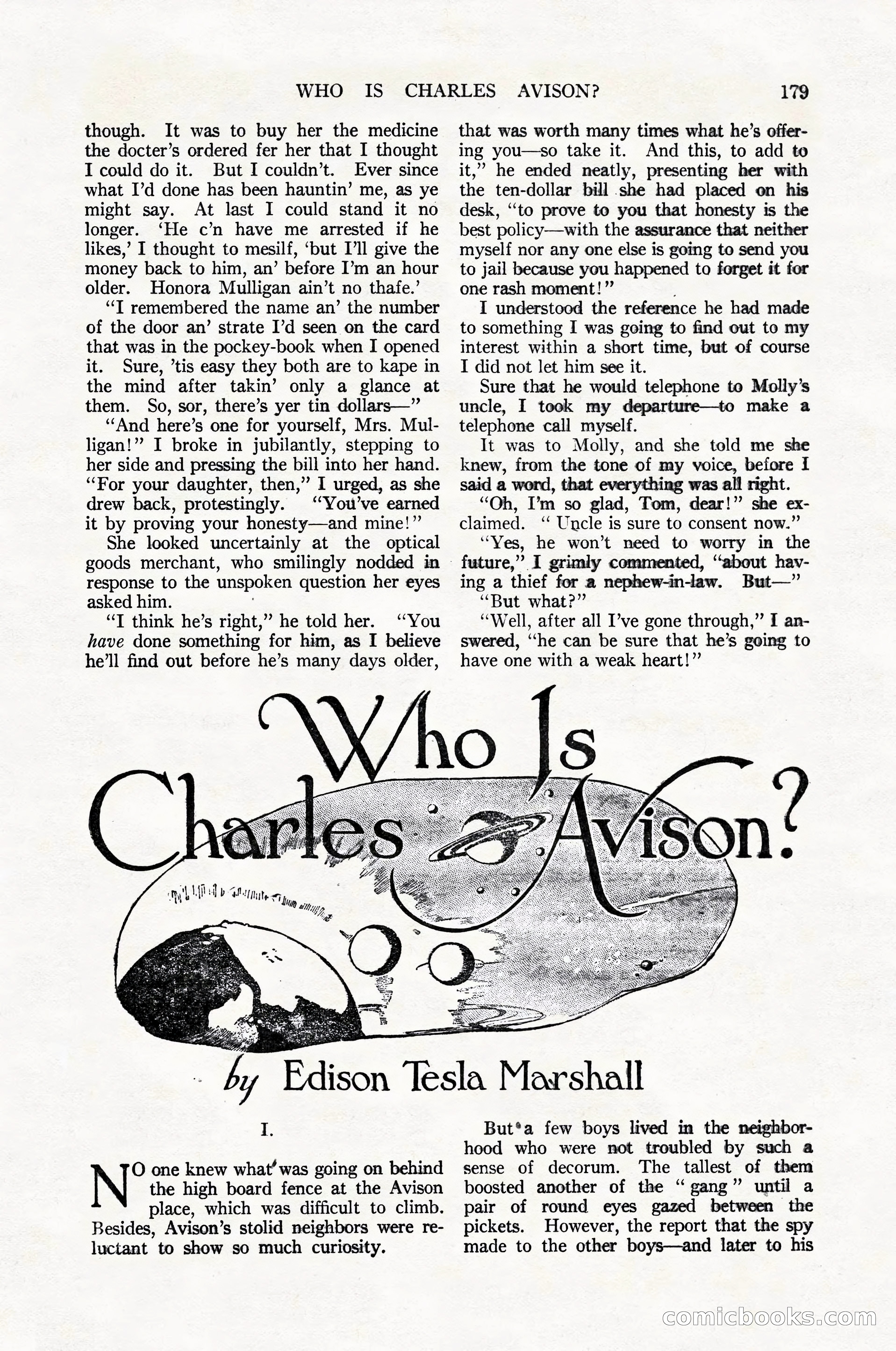
A restored page from Pulp Fiction, 1916. Page through the whole issue in the reader above.
📄 Transcribed text from this page (OCR, searchable)
Machine-transcribed from the original scan — historical spelling and the odd misread are preserved.
WHO IS CHARLES AVISON? though. It was to buy her the medicine the docter’s ordered fer her that I thought I could do it. But I couldn’t. Ever since what I’d done has been hauntin’ me, as ye might say. At last I could stand it no longer. ‘He c’n have me arrested if he likes,’ I thought to mesilf, ‘but Ill give the money back to him, an’ before I’m an hour older. Honora Mulligan ain’t no thafe.’ “T remembered the name an’ the number of the door an’ strate I’d seen on the card that was in the pockey-book when I opened it. Sure, ’tis easy they both are to kape in the mind after takin’ only a glance at them. So, sor, there’s yer tin dollars—” ‘“‘And here’s one for yourself, Mrs. Mul- ligan!”? I broke in jubilantly, stepping to her side and pressing the bill into her hand. “For your daughter, then,” I urged, as she drew back, protestingly. ‘You’ve earned it by proving your honesty—and mine!”’ She looked uncertainly at the optical goods merchant, who smilingly nodded in response to the unspoken question her eyes asked him. “T think he’s right,” he told her. ‘You have done something for him, as I believe he’ll find out before he’s many days older, 179 that was worth many times what he’s offer- ing you—so take it. And this, to add to it,” he ended neatly, presenting her with the ten-dollar bill she had placed on his desk, ‘‘to prove to you that honesty is the best policy—with the assurance that neither myself nor any one else is going to send you to jail because you happened to forget it for one rash moment!” I understood the reference he had made to something I was going to find out to my interest within a short time, but of course I did not let him see it. Sure that he would telephone to Molly’s uncle, I took my departure—to make a telephone call myself. It was to Molly, and she told me she knew, from the tone of my voice, before I said a word, that everything was all right. “Oh, I’m so glad, Tom, dear!” she ex- claimed. ‘‘ Uncle is sure to consent now.” “Yes, he won’t need to worry in the - future,” I grimly commented, “about hav- ing a thief for a nephew-inlaw. But—”’ “But what?” “Well, after all I’ve gone through,” [ an- swered, ‘‘he can be sure that he’s going to have one with a weak heart!” ho |s mh Nb etiity aig, ay if the high board fence at the Avison place, which was difficult to climb. Resides, Avison’s stolid neighbors were re- luctant to show so much curiosity. N one knew what’ was going on behind But*a few boys lived in the neighbor- hood who were not troubled by such a sense of decorum. The tallest of them boosted another of the “gang” until a pair of round eyes gazed between the pickets. However, the report that the spy made to the other boys—and later to his Co 1OOOLK C@