
Pulp Fiction, 1916 · page 162 of 220
The Argosy, April 1916 — page 162: what you’re looking at
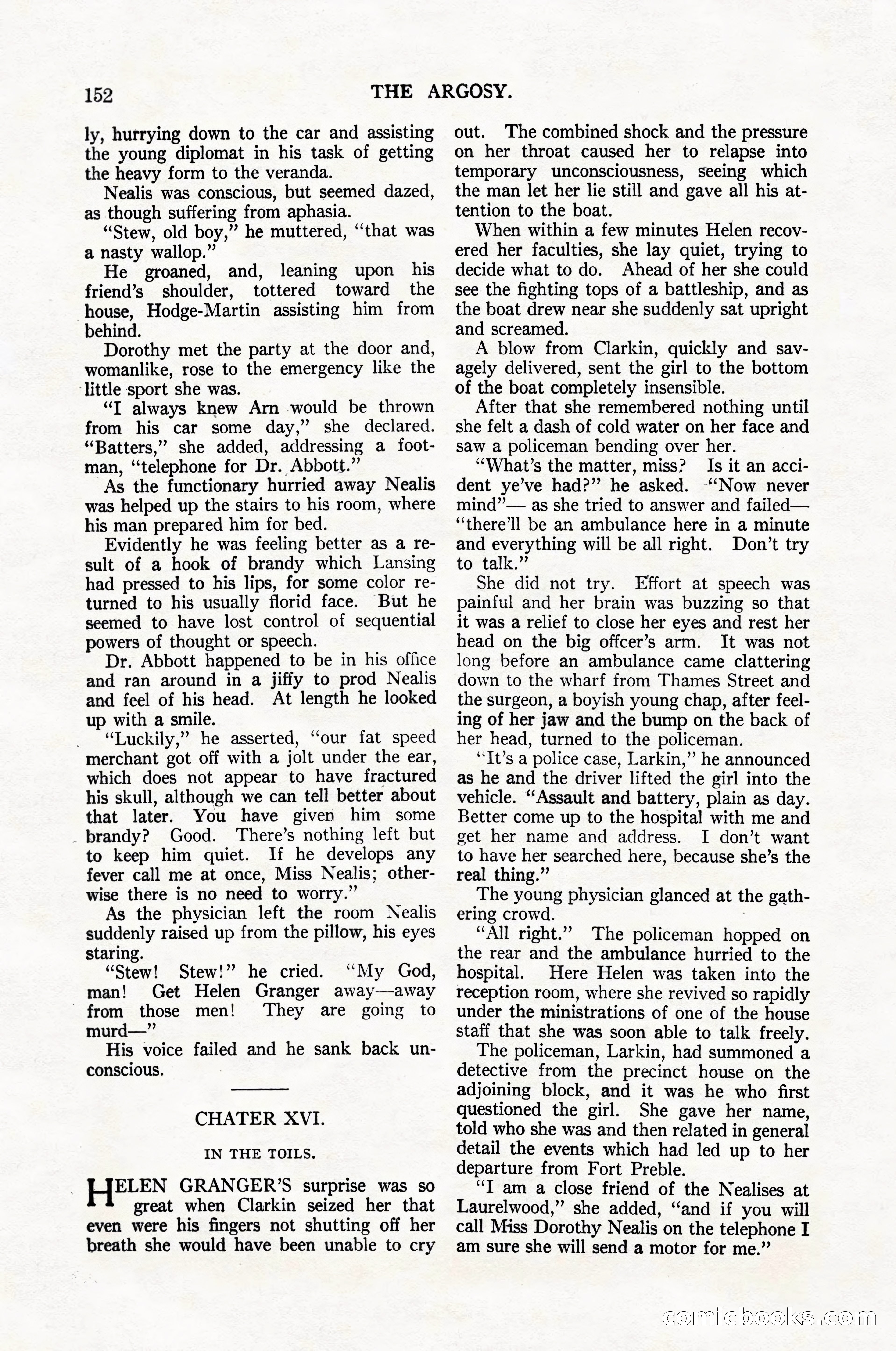
A restored page from Pulp Fiction, 1916. Page through the whole issue in the reader above.
📄 Transcribed text from this page (OCR, searchable)
Machine-transcribed from the original scan — historical spelling and the odd misread are preserved.
152 THE ly, hurrying down to the car and assisting the young diplomat in his task of getting the heavy form to the veranda. Nealis was conscious, but seemed dazed, as though suffering from aphasia. “Stew, old boy,” he muttered, “that was a nasty wallop.” He groaned, and, leaning upon his friend’s shoulder, tottered toward the house, Hodge-Martin assisting him from behind. Dorothy met the party at the door and, womanlike, rose to the emergency like the ‘little sport she was. “T always knew Arn would be thrown from his car some day,” she declared. “Batters,” she added, addressing a foot- man, ‘‘telephone for Dr. Abbott.” As the functionary hurried away Nealis was helped up the stairs to his room, where his man prepared him for bed. Evidently he was feeling better as a re- sult of a hook of brandy which Lansing had pressed to his lips, for some color re- turned to his usually florid face. But he seemed to have lost control of sequential powers of thought or speech. Dr. Abbott happened to be in his office and ran around in a jiffy to prod Nealis and feel of his head. At length he looked up with a smile. “Luckily,” he asserted, “‘our fat speed merchant got off with a jolt under the ear, which does not appear to have fractured his skull, although we can tell better about that later. You have given him some brandy? Good. There’s nothing left but to keep him quiet. If he develops any fever call me at once, Miss Nealis; other- wise there is no need to worry.” As the physician left the room Nealis suddenly raised up from the pillow, his eyes staring. “Stew! Stew!” he cried. ‘My God, man! Get Helen Granger away—away from those men! They are going to murd—”’ His voice failed and he sank back un- conscious. CHATER XVI. IN THE TOILS. _TELEN GRANGER’S surprise was so great when Clarkin seized her that even were his fingers not shutting off her breath she would have been unable to cry ARGOSY. out. The combined shock and the pressure on her throat caused her to relapse into temporary unconsciousness, seeing which the man let her lie still and gave all his at- tention to the boat. When within a few minutes Helen recov- ered her faculties, she lay quiet, trying to decide what to do. Ahead of her she could see the fighting tops of a battleship, and as the boat drew near she suddenly sat upright and screamed. A blow from Clarkin, quickly and sav- agely delivered, sent the girl to the bottom of the boat completely insensible. After that she remembered nothing until she felt a dash of cold water on her face and saw a policeman bending over her. ‘““What’s the matter, miss? Is it an acci- dent ye’ve had?” he asked. ‘Now never mind’’— as she tried to answer and failed— ‘‘there’ll be an ambulance here in a minute and everything will be all right. Don’t try to talk.” She did not try. Effort at speech was painful and her brain was buzzing so that it was a relief to close her eyes and rest her head on the big offcer’s arm. It was not long before an ambulance came clattering down to the wharf from Thames Street and the surgeon, a boyish young chap, after feel- ing of her jaw and the bump on the back of her head, turned to the policeman. ‘It’s a police case, Larkin,”’ he announced as he and the driver lifted the girl into the vehicle. “Assault and battery, plain as day. Better come up to the hospital with me and get her name and address. I don’t want to have her searched here, because she’s the real thing.” The young physician glanced at the gath- ering crowd. . “All right.” The policeman hopped on the rear and the ambulance hurried to the hospital. Here Helen was taken into the reception room, where she revived so rapidly under the ministrations of one of the house staff that she was soon able to talk freely. The policeman, Larkin, had summoned a detective from the precinct house on the adjoining block, and it was he who first questioned the girl. She gave her name, told who she was and then related in general detail the events which had led up to her departure from Fort Preble. ‘I am a close friend of the Nealises at Laurelwood,” she added, “and if you will call Miss Dorothy Nealis on the telephone I am sure she will send a motor for me.” MICLOOOK C@