
Pulp Fiction, 1916 · page 157 of 220
The Argosy, April 1916 — page 157: what you’re looking at
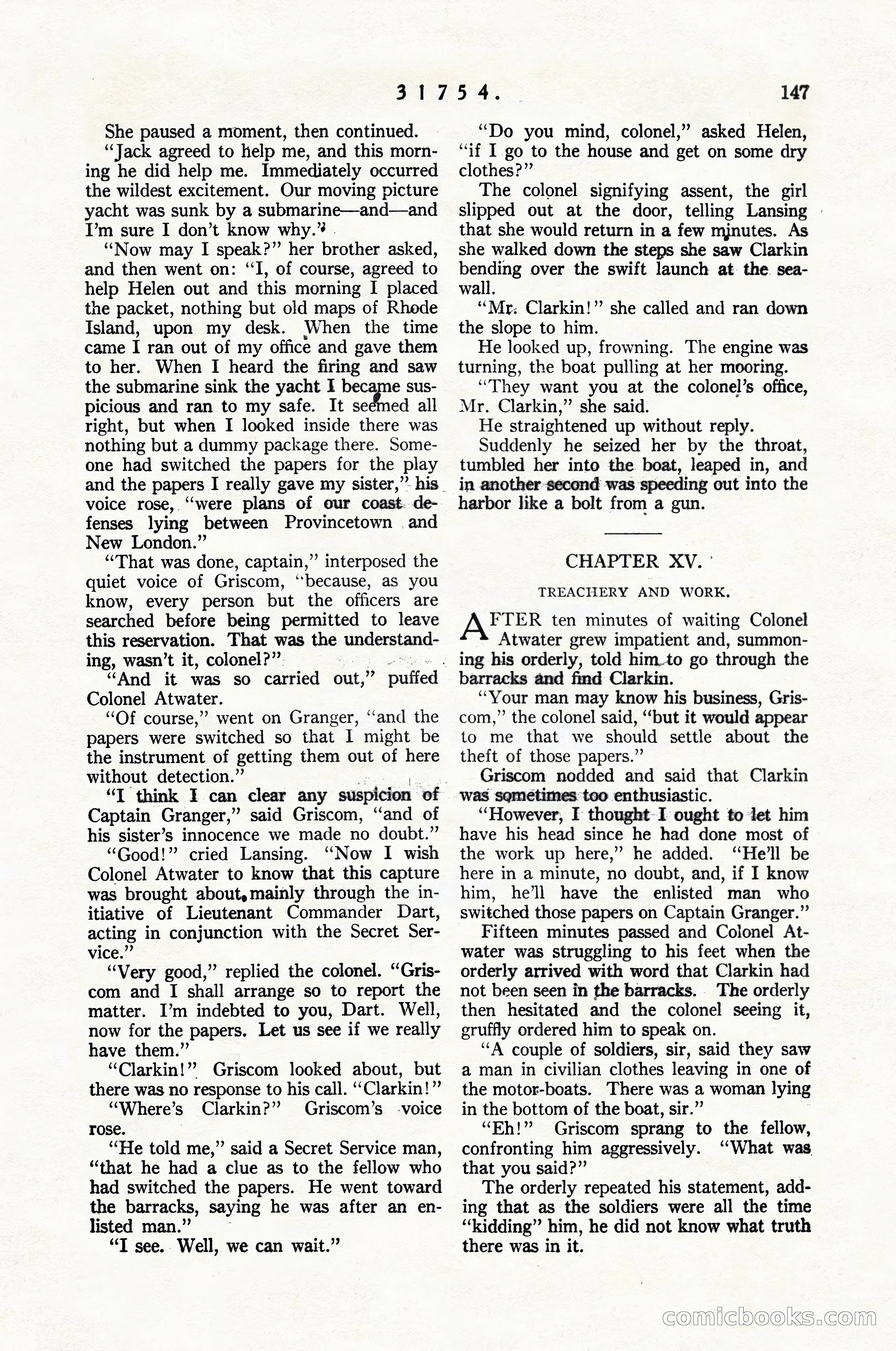
A restored page from Pulp Fiction, 1916. Page through the whole issue in the reader above.
📄 Transcribed text from this page (OCR, searchable)
Machine-transcribed from the original scan — historical spelling and the odd misread are preserved.
= Se ES oie ee, She paused a moment, then continued. “Jack agreed to help me, and this morn- ing he did help me. Immediately occurred the wildest excitement. Our moving picture yacht was sunk by a submarine—and—and I’m sure I don’t know why.’ . ‘“‘Now may I speak?” her brother asked, and then went on: “I, of course, agreed to help Helen out and this morning I placed the packet, nothing but old maps of Rhede Island, upon my desk. When the time came I ran out of my office and gave them to her. When I heard the firing and saw the submarine sink the yacht I became sus- picious and ran to my safe. It seemed all right, but when I looked inside there was nothing but a dummy package there. Some- one had switched the papers for the play and the papers I really gave my sister,’’ his" voice rose, ‘“‘were plans of our coast. de- fenses lying between Provincetown . and New London.” “That was done, captain,’ interposed the quiet voice of Griscom, ‘because, as you know, every person but the officers are searched before being permitted to leave this reservation. That was the understand- ing, wasn’t it, colonel?”’. “And it was so carried out, zy nuited Colonel Atwater. “Of course,’’ went on Granger, ‘‘and the papers were switched so that I might be the instrument of getting them out of here without detection.” “TI think I can clear any suspicion of Captain Granger,” said Griscom, “and of his sister’s innocence we made no doubt.” “Good!” cried Lansing. ‘Now I wish Colonel Atwater to know that this capture was brought about, mainly through the in- itiative of Lieutenant Commander Dart, acting in conjunction with the Secret Ser- vice.’ “Very good,” replied the colonel. “Gris- com and I shall arrange so to report the matter. I’m indebted to you, Dart. Well, now for the papers. Let us see if we really have them.” “Clarkin!” Griscom looked about, but there was no response to his call. ‘‘Clarkin!”’ ‘Where’ s Clarkin?” Griscom’s -voice rose. ‘“‘He told me,” said a Secret Service man, “that he had a clue as to the fellow who had switched the papers. He went toward the barracks, saying he was after an en- listed man.” “T see. Well, we can wait.” 147 “Do you mind, colonel,” asked Helen, “if I go to the house and get on some dry clothes?” The colonel signifying assent, the girl slipped out at the door, telling Lansing | that she would return in a few mjnutes. As she walked down the steps she saw Clarkin bending over the swift launch at. the sea- wall. “Mr: Clarkin!’ she called and ran down the slope to him. He looked up, frowning. The engine was turning, the boat pulling at her mooring. ‘They want you at the colonel’s office, Mr. Clarkin,” she said. He straightened up without reply. Suddenly he seized her by the throat, tumbled her into the boat, leaped in, and in another second was speeding cut into the harbor like a bolt from a gun. CHAPTER XV. ' TREACHERY AND WORK. na ten minutes of waiting Colonel Atwater grew impatient and, summon- . Ing his orderly, told him_to go through the barracks and find Clarkin. “Your man may know his business, Gris- com,” the colonel said, “‘but it would appear to me that we should settle about the theft of those papers.” Griscom nodded and said that Clarkin was sgmetimes too enthusiastic. “However, I thought I ought to let him have his head since he had done most of the work up here,” he added. ‘He'll be here in a minute, no doubt, and, if I know him, he'll have the enlisted man who switched those papers on Captain Granger.” Fifteen minutes passed and Colonel At- water was struggling to his feet when the orderly arrived with word that Clarkin had not been seen in the barracks. The orderly then hesitated and the colonel seeing it, gruffly ordered him to speak on. “A couple of soldiers, sir, said they saw a man in civilian clothes leaving in one of the motor-boats. There was a woman lying in the bottom of the boat, sir.’ “Eh!” Griscom sprang to the fellow, confronting him aggressively. ‘‘What was that you said?” The orderly repeated his statement, add- ing that as the soldiers were all the time “kidding” him, he did not know what truth there was in it. MICLOOOK C@