
Pulp Fiction, 1916 · page 152 of 220
The Argosy, April 1916 — page 152: what you’re looking at
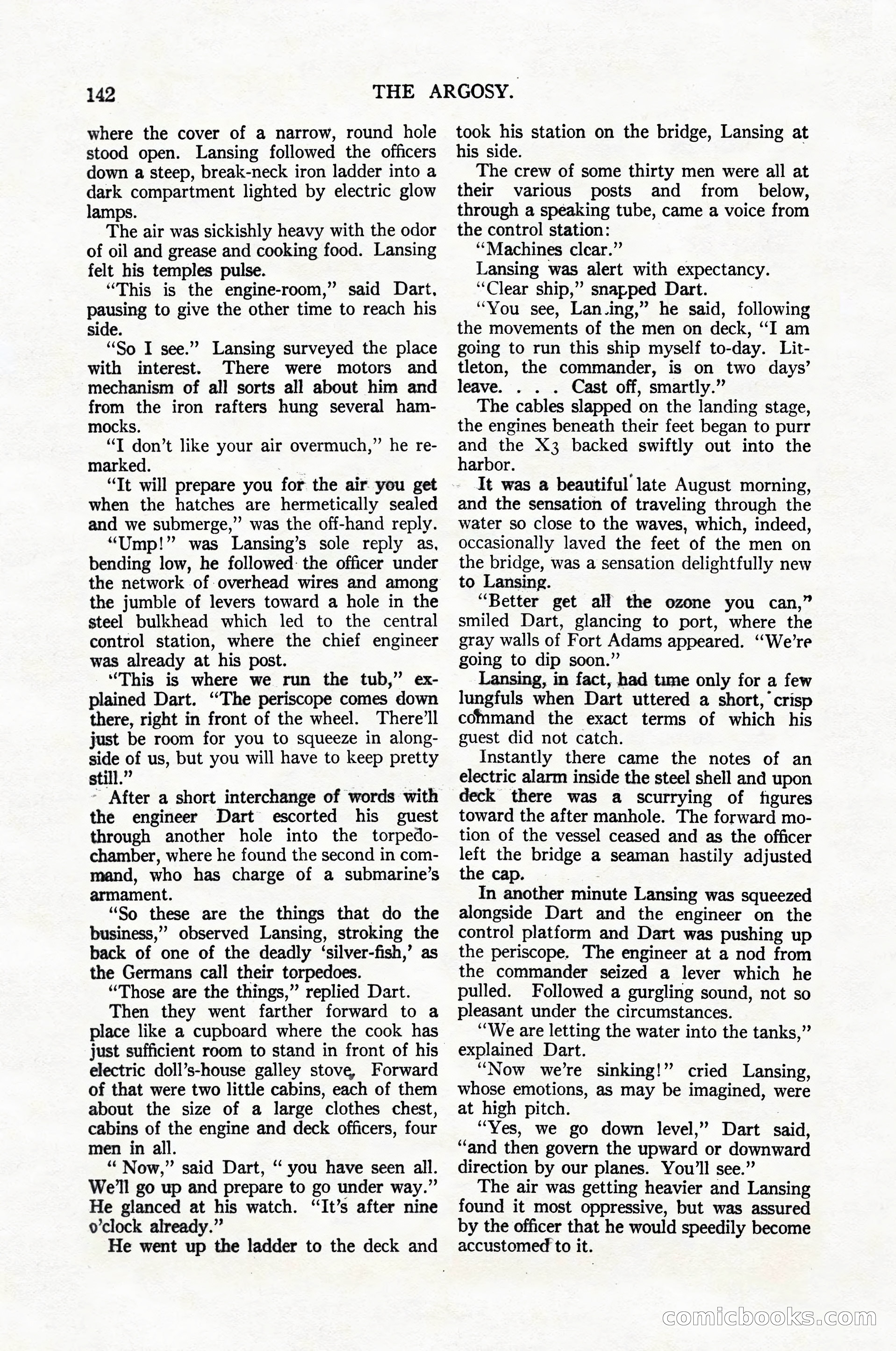
A restored page from Pulp Fiction, 1916. Page through the whole issue in the reader above.
📄 Transcribed text from this page (OCR, searchable)
Machine-transcribed from the original scan — historical spelling and the odd misread are preserved.
142 where the cover of a narrow, round hole stood open. Lansing followed the officers down a steep, break-neck iron ladder into a dark compartment lighted by electric glow lamps. The air was sickishly heavy with the odor of oil and grease and cooking food. Lansing felt his temples pulse. “This is the engine-room,” said Dart, pausing to give the other time to reach his side. “So I see.”? Lansing surveyed the place with interest. There were motors and mechanism of all sorts all about him and from the iron rafters hung several ham- mocks. “T don’t like your air overmuch,” he re- marked. : “Tt will prepare you for the air you get when the hatches are hermetically sealed and we submerge,” was the off-hand reply. “Ump!”? was Lansing’s sole reply as, bending low, he followed: the officer under the network of overhead wires and among the jumble of levers toward a hole in the steel bulkhead which led to the central control station, where the chief engineer was already at his post. “This is where we run the tub,” ex- plained Dart. “The periscope comes down there, right in front of the wheel. There'll just be room for you to squeeze in along- side of us, but you will have to keep pretty still.” - After a short interchange of words with the engineer Dart escorted his guest through another hole into the torpedo- chamber, where he found the second in com- mand, who has charge of a submarine’s armament. “So these are the things that do the business,’ observed Lansing, stroking the back of one of the deadly ‘silver-fish,’ as the Germans call their torpedoes. “Those are the things,” replied Dart. Then they went farther forward to a place like a cupboard where the cook has just sufficient room to stand in front of his” electric doll’s-house galley stove, Forward of that were two little cabins, each of them about the size of a large clothes chest, cabins of the engine and deck officers, four men in all. ‘““'Now,” said Dart, ‘‘ you have seen all. We'll go up and prepare to go under way.” He glanced at his watch. “It’s after nine o’clock already.” He went up the ladder to the deck and THE ARGOSY. took his station on the bridge, Lansing at his side. The crew of some thirty men were all at their various posts and from _ below, through a speaking tube, came a voice from the control station: ‘“Machines clear.” Lansing was alert with expectancy. ‘Clear ship,” snapped Dart. “You see, Lan.ing,” he said, following the movements of the men on deck, “I am going to run this ship myself to-day. Lit- tleton, the commander, is on two days’ leave. . . . Cast off, smartly.” The cables slapped on the landing stage, the engines beneath their feet began to purr and the X3 backed swiftly out into the harbor. It was a beautiful late August morning, and the sensation of traveling through the water so close to the waves, which, indeed, occasionally laved the feet of the men on the bridge, was a sensation delightfully new to Lansing. “Better get all the ozone you can,” smiled Dart, glancing to port, where the gray walls of Fort Adams appeared. ‘“‘We’re going to dip soon.” Lansing, in fact, had time only for a few lungfuls when Dart uttered a short, crisp command the exact terms of which his guest did not catch. Instantly there came the notes of an electric alarm inside the steel shell and upon deck there was a scurrying of figures toward the after manhole. The forward mo- tion of the vessel ceased and as the officer left the bridge a seaman hastily adjusted the cap. In another minute Lansing was squeezed alongside Dart and the engineer on the control platform and Dart was pushing up the periscope. The engineer at a nod from the commander seized a lever which he pulled. Followed a gurgling sound, not so pleasant under the circumstances. ‘We are letting the water into the tanks,” explained Dart. ‘Now we're sinking!” cried Lansing, whose emotions, as may be imagined, were at high pitch. , “Yes, we go down level,” Dart said, ‘and then govern the upward or downward direction by our planes. Youll see.” The air was getting heavier and Lansing found it most oppressive, but was assured by the officer that he would speedily become accustomed to it. MICLOOOK C@