
Pulp Fiction, 1916 · page 14 of 220
The Argosy, April 1916 — page 14: what you’re looking at
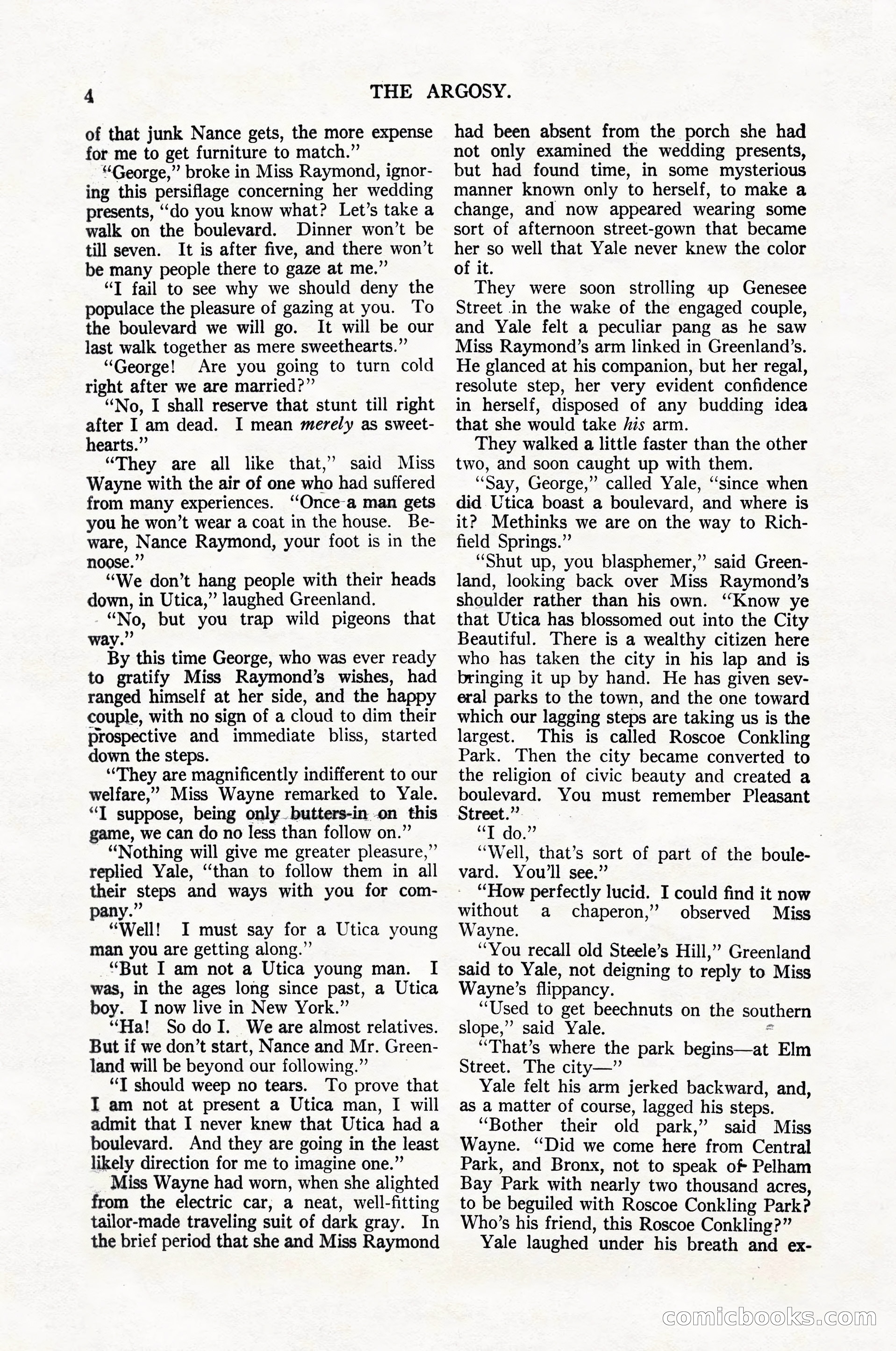
A restored page from Pulp Fiction, 1916. Page through the whole issue in the reader above.
📄 Transcribed text from this page (OCR, searchable)
Machine-transcribed from the original scan — historical spelling and the odd misread are preserved.
4 THE ARGOSY. of that junk Nance gets, the more expense for me to get furniture to match.” “George,” broke in Miss Raymond, ignor- ing this persiflage concerning her wedding presents, “do you know what? Let’s take a walk on the boulevard. Dinner won’t be till seven. It is after five, and there won’t be many people there to gaze at me.”’ “T fail to see why we should deny the populace the pleasure of gazing at you. To the boulevard we will go. It will be our last walk together as mere sweethearts.” “George! Are you going to turn cold right after we are married?” “No, I shall reserve that stunt till right after I am dead. I mean merely as sweet- hearts.” “They are all like that,” said Miss Wayne with the air of one who had suffered from many experiences. “Once-a man gets you he won’t wear a coat in the house. Be- ware, Nance Raymond, your foot is in the noose.” “We don’t hang people with their heads down, in Utica,” laughed Greenland. “No, but you trap wild pigeons that way.” By this time George, who was ever ready to gratify Miss Raymond’s wishes, had ranged himself at her side, and the happy couple, with no sign of a cloud to dim their prospective and immediate bliss, started down the steps. ‘They are magnificently indifferent to our welfare,” Miss Wayne remarked to Yale. “I suppose, being only_butters-in on this game, we can do no less than follow on.” “Nothing will give me greater pleasure,” replied Yale, “than to follow them in all their steps and ways with you for com- v. “Well! I must say for a Utica young man you are getting along.” “But I am not a Utica young man. I was, in the ages long since past, a Utica boy. I now live in New York.” “Ha! SodolI. Weare almost relatives. But if we don’t start, Nance and Mr. Green- land will be beyond our following.” “I should weep no tears. To prove that I am not at present a Utica man, I will admit that I never knew that Utica had a boulevard. And they are going in the least likely direction for me to imagine one.” _ Miss Wayne had worn, when she alighted from the electric car; a neat, well-fitting tailor-made traveling suit of dark gray. In the brief period that she and Miss Raymond had been absent from the porch she had not only examined the wedding presents, but had found time, in some mysterious manner known only to herself, to make a change, and now appeared wearing some sort of afternoon street-gown that became her so well that Yale never knew the color of it. They were soon strolling up Genesee Street in the wake of the engaged couple, and Yale felt a peculiar pang as he saw — Miss Raymond’s arm linked in Greenland’s. He glanced at his companion, but her regal, resolute step, her very evident confidence in herself, disposed of any budding idea that she would take /zs arm. They walked a little faster than the other two, and soon caught up with them. “Say, George,” called Yale, “‘since when did Utica boast a boulevard, and where is it? Methinks we are on the way to Rich- field Springs.” “Shut up, you blasphemer,” said Green- land, looking back over Miss Raymond’s shoulder rather than his own. ‘Know ye that Utica has blossomed out into the City Beautiful. There is a wealthy citizen here who has taken the city in his lap and is bringing it up by hand. He has given sev- eral parks to the town, and the one toward which our lagging steps are taking us is the largest. This is called Roscoe Conkling Park. Then the city became converted to the religion of civic beauty and created a boulevard. You must remember Pleasant Street.” a | do.”’ “Well, that’s sort of part of the boule- vard. You'll see.” “How perfectly lucid. I could find it now without a chaperon,” observed Miss Wayne. “You recall old Steele’s Hill,’’ Greenland said to Yale, not deigning to reply to Miss Wayne’s flippancy. ‘Used to get beechnuts on the southern slope,” said Yale. £ ‘“That’s where the park begins—at Elm Street. The city—”’ Yale felt his arm jerked backward, and, as a matter of course, lagged his steps. “Bother their old park,” said Miss Wayne. “Did we come here from Central Park, and Bronx, not to speak of Pelham Bay Park with nearly two thousand acres, to be beguiled with Roscoe Conkling Park? Who’s his friend, this Roscoe Conkling?” Yale laughed under his breath and ex- COMmicloo Cc SS C@