
Pulp Fiction, 1916 · page 124 of 220
The Argosy, April 1916 — page 124: what you’re looking at
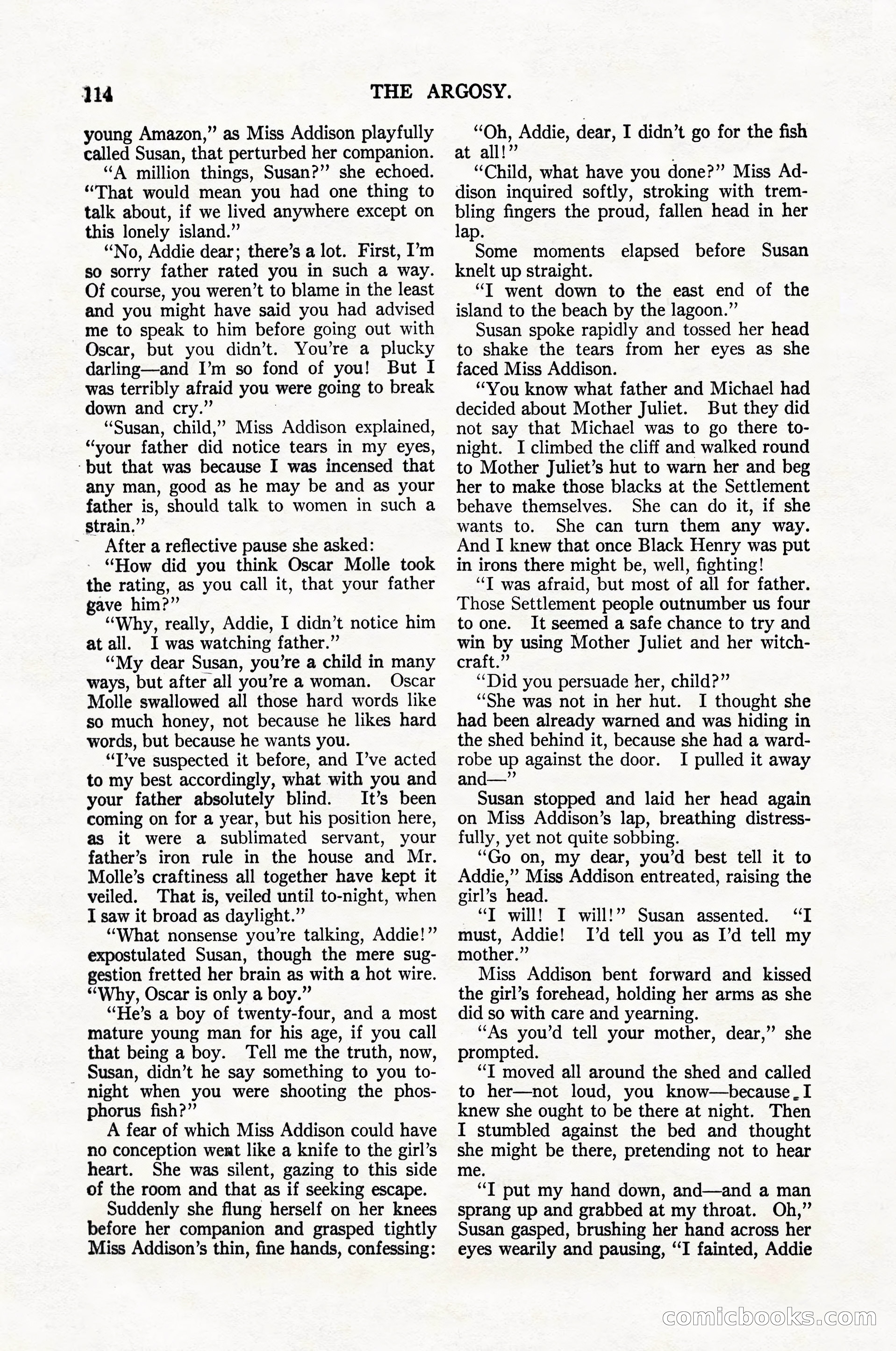
A restored page from Pulp Fiction, 1916. Page through the whole issue in the reader above.
📄 Transcribed text from this page (OCR, searchable)
Machine-transcribed from the original scan — historical spelling and the odd misread are preserved.
114 young Amazon,” as Miss Addison playfully called Susan, that perturbed her companion. “A million things, Susan?”’ she echoed. “That would mean you had one thing to talk about, if we lived anywhere except on this lonely island.” “No, Addie dear; there’s a lot. First, I’m so sorry father rated you in such a way. Of course, you weren’t to blame in the least and you might have said you had advised me to speak to him before going out with Oscar, but you didn’t. You’re a plucky darling —and I’m so fond of you! But I was terribly afraid you were going to break down and cry.” “Susan, child,’”’ Miss Addison explained, “vour father did notice tears in my eyes, ‘but that was because I was incensed that any man, good as he may be and as your father is, should talk to women in such a strain.” After a reflective pause she asked: “How did you think Oscar Molle took the rating, as you call it, that your father gave him?” “Why, really, Addie, I didn’t notice him at all. I was watching father.” “My dear Susan, you ’re a child in many ways, but after all you’re a woman. Oscar Molle swallowed all those hard words like so much honey, not because he likes hard words, but because he wants you. “T’ve suspected it before, and I’ve acted to my best accordingly, what with you and your father absolutely blind. It’s been coming on for a year, but his position here, as it were a sublimated servant, your father’s iron rule in the house and Mr. Molle’s craftiness all together have kept it veiled. That is, veiled until to-night, when I saw it broad as daylight.” “What nonsense yow’re talking, Addie!” expostulated Susan, though the mere sug- gestion fretted her brain as with a hot wire. “Why, Oscar is only a boy.” “He’s a boy of twenty-four, and a most mature young man for his age, if you call that being a boy. Tell me the truth, now, _ Susan, didn’t he say something to you to- night when you were shooting the phos- phorus fish?” A fear of which Miss Addison could have no conception went like a knife to the girl’s heart. She was silent, gazing to this side of the room and that as if seeking escape. Suddenly she flung herself on her knees before her companion and grasped tightly Miss Addison’s thin, fine hands, confessing: THE ARGOSY. “Oh, Addie, dear, I didn’t go for the fish at all!” : “Child, what have you done?” Miss Ad- dison inquired softly, stroking with trem- bling fingers the proud, fallen head in her lap. Some moments elapsed before Susan knelt up straight. “T went down to the east end of the island to the beach by the lagoon.” Susan spoke rapidly and tossed her head to shake the tears from her eyes as she faced Miss Addison. ‘Vou know what father and Michael had decided about Mother Juliet. But they did not say that Michael was to go there to- night. I climbed the cliff and walked round to Mother Juliet’s hut to warn her and beg her to make those blacks at the Settlement behave themselves. She can do it, if she wants to. She can turn them any way. And I knew that once Black Henry was put in irons there might be, well, fighting! “YT was afraid, but most of all for father. Those Settlement people outnumber us four to one. It seemed a safe chance to try and win by using Mother Juliet and her witch- craft.” “Did you persuade her, child?” “She was not in her hut. I thought she had been already warned and was hiding in the shed behind it, because she had a ward- robe up against the door. I pulled it away and—’’ Susan stopped and laid her head again on Miss Addison’s lap, breathing distress- fully, yet not quite sobbing. “Go on, my dear, you’d best tell it to Addie,”’ Miss Addison entreated, raising the girl’s head. “T will! I will!” Susan assented. must, Addie! mother.”’ Miss Addison bent forward and kissed the girl’s forehead, holding her arms as she did so with care and yearning. ‘“‘As you’d tell your mother, dear,” she prompted. “I moved all around the shed and called to her—not loud, you know—because, I knew she ought to be there at night. Then I stumbled against the bed and thought she might be there, pretending not to hear me. “TI put my hand down, and—and a man sprang up and grabbed at my throat. Oh,” Susan gasped, brushing her hand across her eyes wearily and pausing, “I fainted, Addie oil I'd tell you as I’d tell my COmiclboo S C@