
Pulp Fiction, 1916 · page 116 of 220
The Argosy, April 1916 — page 116: what you’re looking at
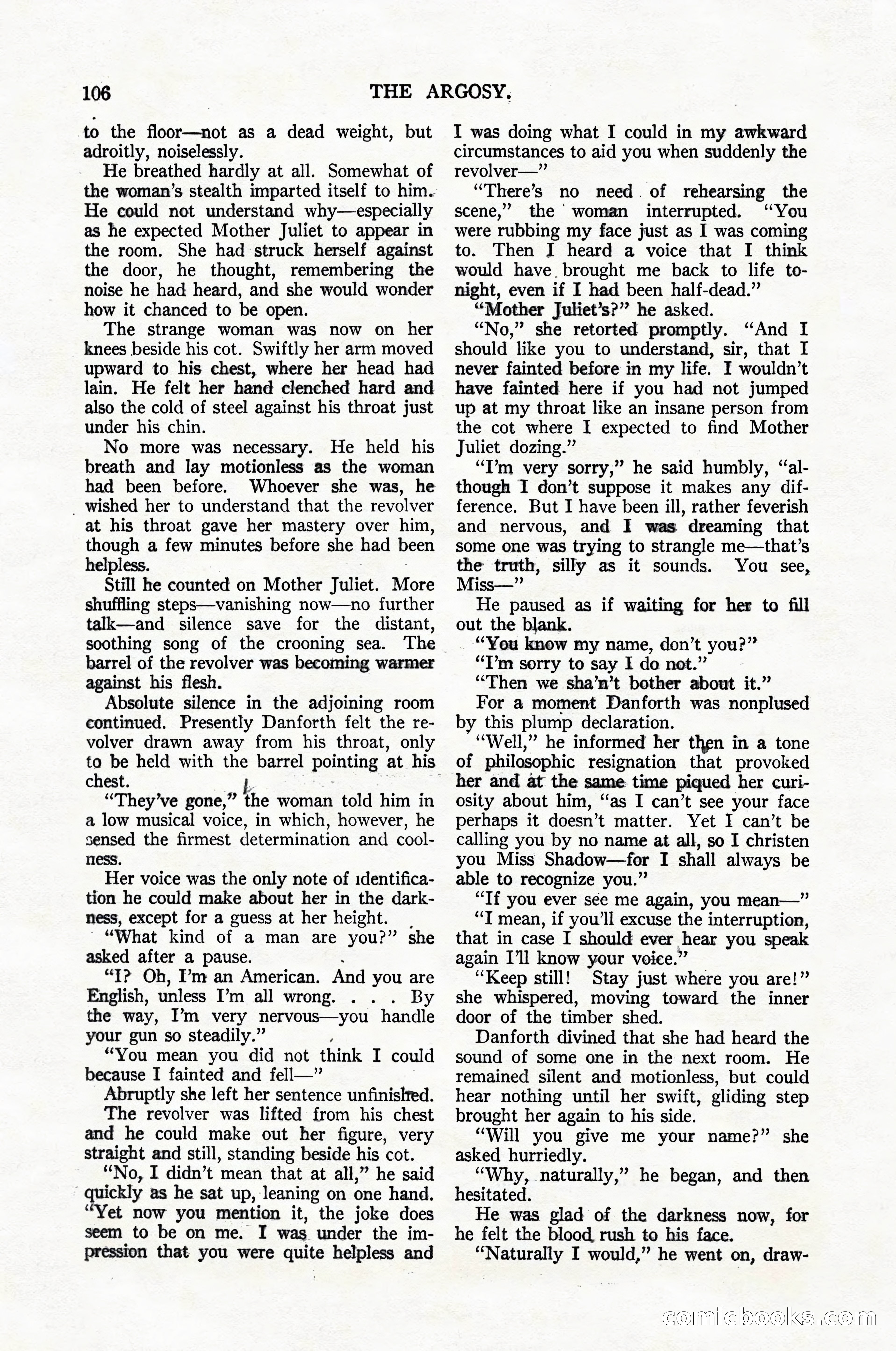
A restored page from Pulp Fiction, 1916. Page through the whole issue in the reader above.
📄 Transcribed text from this page (OCR, searchable)
Machine-transcribed from the original scan — historical spelling and the odd misread are preserved.
106 to the floor—not as a dead weight, but adroitly, noiselessly. He breathed hardly at all. Somewhat of the woman’s stealth imparted itself to him. He could not understand why—especially as he expected Mother Juliet to appear in the room. She had struck herself against the door, he thought, remembering the noise he had heard, and she would wonder how it chanced to be open. The strange woman was now on her knees beside his cot. Swiftly her arm moved upward to his chest, where her head had lain. He felt her hand clenched hard and also the cold of steel against his throat just under his chin. No more was necessary. He held his breath and lay motionless as the woman had been before. Whoever she was, he _ wished her to understand that the revolver at his throat gave her mastery over him, though a few minutes before she had been helpless. Still he counted on Mother Juliet. More shuffling steps—vanishing now—no further talk—and silence save for the distant, soothing song of the crooning sea. The barrel of the revolver was becoming warmer against his flesh. Absolute silence in the adjoining room continued. Presently Danforth felt the re- volver drawn away from his throat, only ta be held with the barrel pemlng at his chest. i “They’ve gone, ” the woman told him in a low musical voice, in which, however, he sensed the firmest determination and cool- ness. Her voice was the only note of identifica- tion he could make about her in the dark- ness, except for a guess at her height. | _“What kind of a man are you?” she asked after a pause. “Y? Oh, I’m an American. And you are English, unless I’m all wrong. nee oY the way, I’m very nervous—you handle your gun so steadily.” “You mean you did not think I could because I fainted and fell— Abruptly she left her sentence unfinislted. The revolver was lifted from his chest and he could make out her figure, very straight and still, standing beside his cot. “No, I didn’t mean that at all,” he said quickly as he sat up, leaning on one hand. “Yet now you mention it, the joke does seem to be on me. I was under the im- pression that you were quite helpless and THE ARGOSY. I was doing what I could in my awkward circumstances to aid you when suddenly the revolver—”’ ‘“There’s no need. of rehearsing the scene,” the woman interrupted. ‘You were rubbing my face just as I was coming to. Then I heard a voice that I think would have brought me back to life to- night, even if I had been half-dead.” “Mother Juliet’s?” he asked. “No,” she retorted promptly. ‘And I should like you to understand, sir, that I never fainted before in my life. I wouldn’t have fainted here if you had not jumped up at my throat like an insane person from the cot where I expected to find Mother Juliet dozing.” “I’m very sorry,” he said humbly, ‘“‘al- though I don’t suppose it makes any dif- ference. But I have been ill, rather feverish and nervous, and I was dreaming that some one was trying to strangle me—that’s the truth, silly as it sounds. You see, Miss—” He paused as if waiting for her to fill out the blank. “You know my name, don’t you?” “Y’m sorry to say I do not.” ‘“‘Then we sha’n’t bother about it.” For a moment Danforth was nonplused by this plump declaration. “Well,” he informed her then in a tone of philosophic resignation that provoked her and at the same time piqued her curi- osity about him, ‘‘as I can’t see your face perhaps it doesn’t matter. Yet I can’t be calling you by no name at all, so I christen you Miss Shadow—for I shall always be able to recognize you.” “Tf you ever see me again, you mean—” “T mean, if you'll excuse the interruption, that in case I should ever hear you speak again I’ll know your voice.” ‘‘Keep still! Stay just where you are!” she whispered, moving toward the inner door of the timber shed. Danforth divined that she had heard the sound of some one in the next room. He remained silent and motionless, but could hear nothing until her swift, gliding step brought her again to his side. “Will you give me your name?” she asked hurriedly. “Why, naturally,” he began, and then hesitated. He was glad of the darkness now, for he felt the blood rush to his face. “Naturally I would,” he went on, draw- COMmiclboo S (©