
Pulp Fiction, 1916 · page 109 of 220
The Argosy, April 1916 — page 109: what you’re looking at
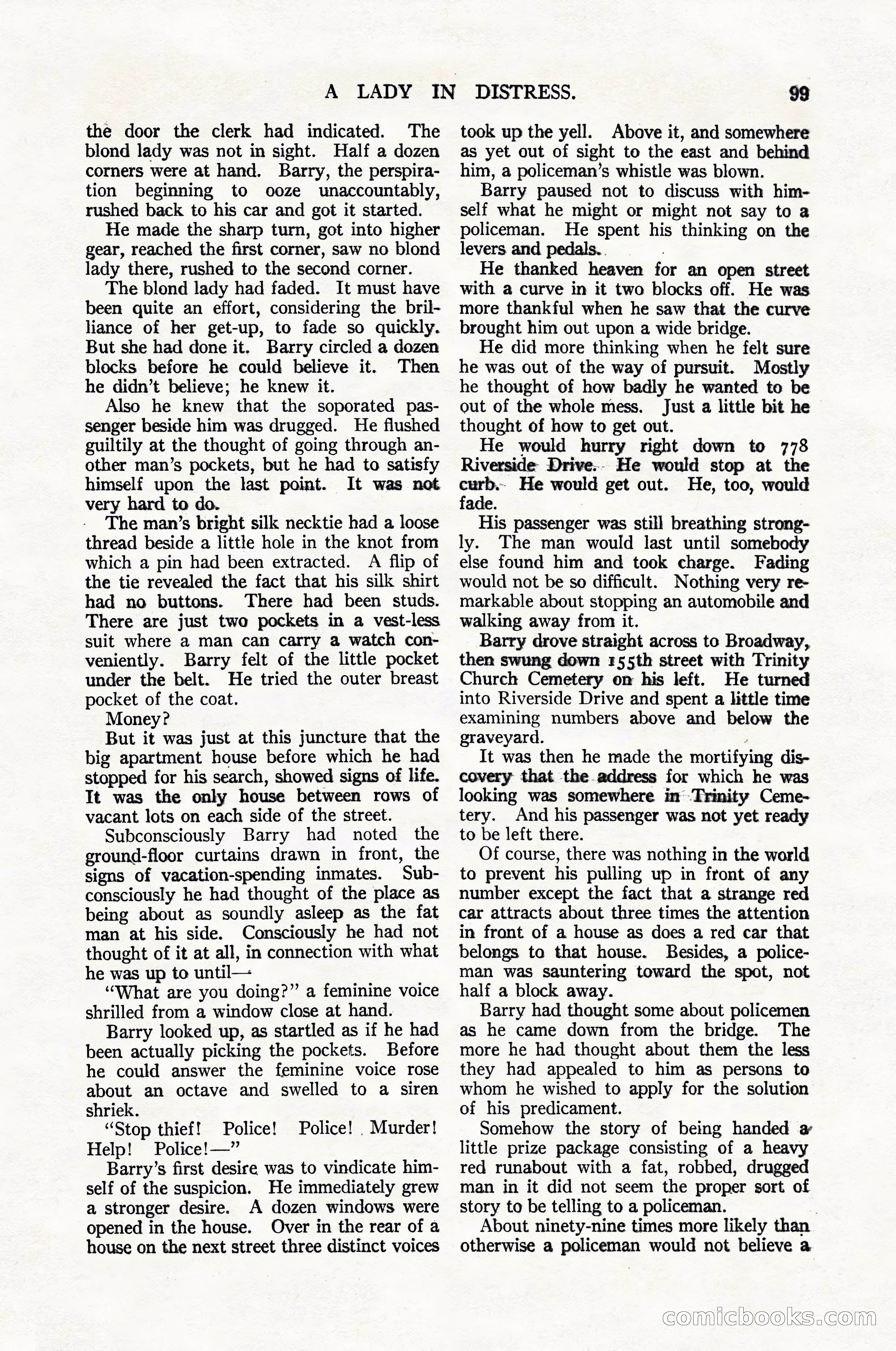
A restored page from Pulp Fiction, 1916. Page through the whole issue in the reader above.
📄 Transcribed text from this page (OCR, searchable)
Machine-transcribed from the original scan — historical spelling and the odd misread are preserved.
A LADY IN DISTRESS. the door the clerk had indicated. The blond lady was not in sight. Half a dozen corners were at hand. Barry, the perspira- tion beginning to ooze unaccountably, rushed back to his car and got it started. He made the sharp turn, got into higher gear, reached the first corner, saw no blond lady there, rushed to the second corner. The blond lady had faded. It must have been quite an effort, considering the bril- liance of her get-up, to fade so quickly. But she had done it. Barry circled a dozen blocks before he could believe it. Then he didn’t believe; he knew it. Also he knew that the soporated pas- senger beside him was drugged. He flushed guiltily at the thought of going through an- other man’s pockets, but he had to satisfy himself upon the last point. It was not very hard to do. The man’s bright silk necktie had a loose thread beside a little hole in the knot from which a pin had been extracted. A flip of the tie revealed the fact that his silk shirt had no buttons. There had been studs. There are just two pockets in a vest-less suit where a man can carry a watch con- veniently. Barry felt of the little pocket under the belt. He tried the outer breast pocket of the coat. Moneye But it was just at this juncture that the big apartment house before which he had stopped for his search, showed signs of life. It was the only house between rows of vacant lots on each side of the street. Subconsciously Barry had noted the ground-floor curtains drawn in front, the signs of vacation-spending inmates. Sub- consciously he had thought of the place as being about as soundly asleep as the fat man at his side. Consciously he had not thought of it at all, in connection with what he was up to until— ‘What are you doing?” a feminine voice shrilled from a window close at hand. Barry looked up, as startled as if he had been actually picking the pockets. Before he could answer the feminine voice rose about an octave and swelled to a siren shriek. “Stop thief! Police! Help! Police!—” Barry’s first desire was to vindicate him- self of the suspicion. He immediately grew a stronger desire. A dozen windows were opened in the house. Over in the rear of a house on the next street three distinct voices Police! . Murder! 99 took up the yell. Above it, and somewhere as yet out of sight to the east and behind him, a policeman’s whistle was blown. Barry paused not to discuss with him- self what he might or might not say to a policeman. He spent his thinking on the levers and pedals... Si. He thanked heaven for an open street with a curve in it two blocks off. He was more thankful when he saw that the curve brought him out upon a wide bridge. He did more thinking when he felt sure he was out of the way of pursuit. Mostly he thought of how badly he wanted to be out of the whole mess. Just a little bit he thought of how to get out. He would hurry right down to 778 Riverside Drive.- He would stop at the rahe He would get out. He, too, would ade. His passenger was still breathing strong- ly. The man would last until somebody else found him and took charge. Fading would not be so difficult. Nothing very re- markable about stopping an automobile and walking away from it. Barry drove straight across to Broadway, then swung down 155th street with Trinity Church Cemetery on his left. He turned into Riverside Drive and spent a little time examining numbers above and below the graveyard. ; It was then he made the mortifying dis- covery that the address for which he was looking was somewhere in’ :Trinity Ceme- tery. And his passenger was not yet ready to be left there. Of course, there was nothing in the world to prevent his pulling up in front of any number except the fact that a strange red car attracts about three times the attention in front of a house as does a red car that belongs to that house. Besides, a police- man was sauntering toward the spot, not half a block away. Barry had thought some about policemen as he came down from the bridge. The more he had thought about them the less they had appealed to him as persons to whom he wished to apply for the solution of his predicament. Somehow the story of being handed & little prize package consisting of a heavy red runabout with a fat, robbed, drugged man in it did not seem the proper sort of story to be telling to a policeman. About ninety-nine times more likely than 3 otherwise a policeman would not believe a cConmicoooks Cc C@