
Pulp Fiction, 1914 · page 95 of 266
The Argosy, Vol. 76, No. 3 — page 95: what you’re looking at
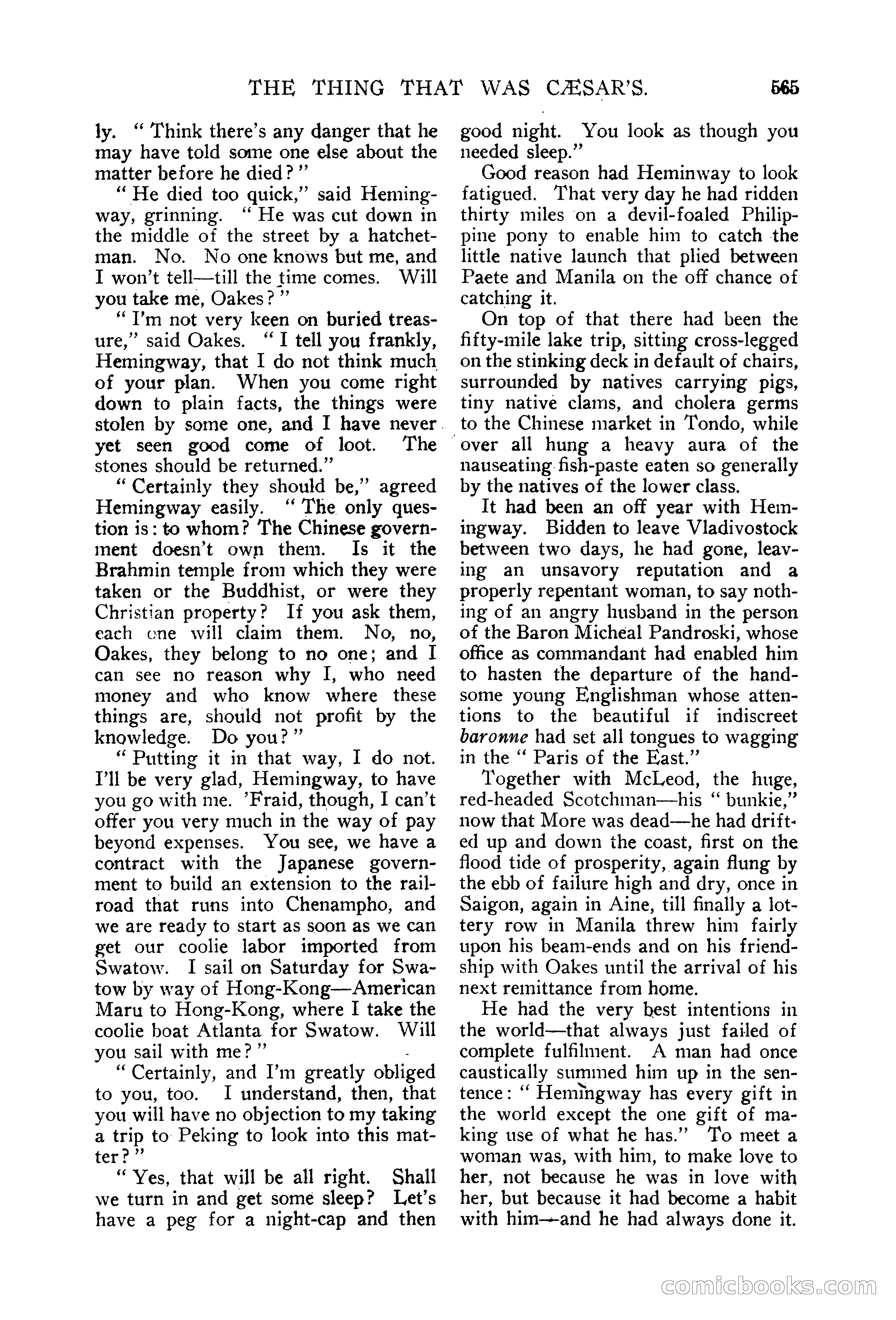
A restored page from Pulp Fiction, 1914. Page through the whole issue in the reader above.
📄 Transcribed text from this page (OCR, searchable)
Machine-transcribed from the original scan — historical spelling and the odd misread are preserved.
THE THING THAT WAS CZSAR’S. ly. “ Think there’s any danger that he may have told some one else about the matter before he died?” ““ He died too quick,” said Heming- way, grinning. “ He was cut down in the middle of the street by a hatchet- man. No. No one knows but me, and I won’t tell—till the time comes. Will you take me, Oakes? ™ “T’m not very keen on buried treas- ure,” said Oakes. “I tell you frankly, Hemingway, that I do not think much of your plan. When you come right down to plain facts, the things were stolen by some one, and I have never. yet seen good come of loot. The stones should be returned.”’ “Certainly they should be,” agreed Hemingway easily. ‘‘ The only ques- tion is: to whom? The Chinese govern- ment doesn’t own them. Is it the Brahmin temple from which they were taken or the Buddhist, or were they Christian property? If you ask them, each cne will claim them. No, no, Oakes, they belong to no one; and I can see no reason why I, who need money and who know where these things are, should not profit by the knowledge. Do you?” “ Putting it in that way, I do not. I'll be very glad, Hemingway, to have you go with me. ’Fraid, though, I can’t offer you very much in the way of pay beyond expenses. You see, we have a contract with the Japanese govern- ment to build an extension to the rail- road that runs into Chenampho, and we are ready to start as soon as we can get our coolie labor imported from Swatow. I sail on Saturday for Swa- tow by way of Hong-Kong—American Maru to Hong-Kong, where I take the coolie boat Atlanta for Swatow. Will you sail with me?” “Certainly, and I’m greatly obliged to you, too. I understand, then, that you will have no objection to my taking a trip to Peking to look into this mat- ter?” “Yes, that will be all right. Shall we turn in and get some sleep? Let’s have a peg for a night-cap and then 565 good night. You look as though you needed sleep.”’ Good reason had Heminway to look fatigued. That very day he had ridden thirty miles on a devil-foaled Philip- pine pony to enable him to catch the little native launch that plied between Paete and Manila on the off chance of catching it. On top of that there had been the fifty-mile lake trip, sitting cross-legged on the stinking deck in default of chairs, surrounded by natives carrying pigs, tiny native clams, and cholera germs to the Chinese market in Tondo, while over all hung a heavy aura of the nauseating fish-paste eaten so generally by the natives of the lower class. It had been an off year with Hem- ingway. Buidden to leave Viadivostock between two days, he had gone, leav- ing) an umsavory reputation and a properly repentant woman, to say noth- ing of an angry husband in the person of the Baron Micheal Pandroski, whose office as commandant had enabled him to hasten the departure of the hand- some young Englishman whose atten- tions to the beautiful if indiscreet baronne had set all tongues to wagging in the “‘ Paris of the East.” Together with McLeod, the huge, red-headed Scotchman—his “ bunkie,” now that More was dead—he had drift- ed up and down the coast, first on the flood tide of prosperity, again flung by the ebb of failure high and dry, once in Saigon, again in Aine, till finally a lot- tery row in Manila threw him fairly upon his beam-ends and on his friend- ship with Oakes until the arrival of his next remittance from home. He had the very best intentions in the world—that always just failed of complete fulfilment. A man had once caustically sumined him up in the sen- tence: “ Hemingway has every gift in the world except the one gift of ma- king use of what he has.” ‘To meet a woman was, with him, to make love to her, not because he was in love with her, but because it had become a habit with him—and he had always done it. COMicdoo S CO@