
Pulp Fiction, 1914 · page 43 of 266
The Argosy, Vol. 76, No. 3 — page 43: what you’re looking at
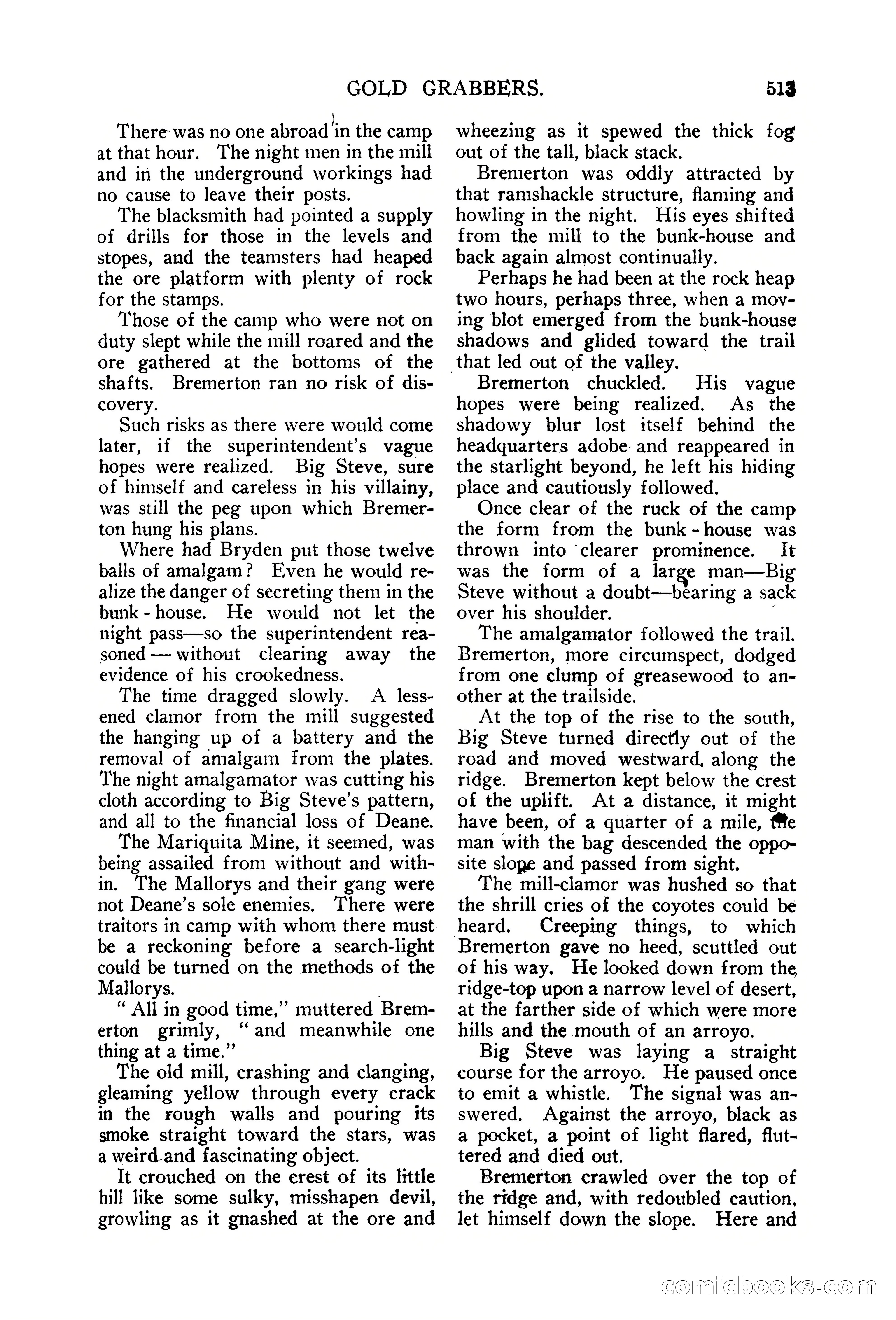
A restored page from Pulp Fiction, 1914. Page through the whole issue in the reader above.
📄 Transcribed text from this page (OCR, searchable)
Machine-transcribed from the original scan — historical spelling and the odd misread are preserved.
GOLD GRABBERS. There was no one abroad in the camp at that hour. The night men in the mill and in the underground workings had no cause to leave their posts. The blacksmith had pointed a supply of drills for those in the levels and stopes, and the teamsters had heaped the ore platform with plenty of rock for the stamps. Those of the camp who were not on duty slept while the mill roared and the ore gathered at the bottoms of the shafts. Bremerton ran no risk of dis- covery. Such risks as there were would come later, if the superintendent’s vague hopes were realized. Big Steve, sure of himself and careless in his villainy, was still the peg upon which Bremer- ton hung his plans. Where had Bryden put those twelve balls of amalgam? Even he would re- alize the danger of secreting them in the bunk - house. He would not let the night pass—so the superintendent rea- soned — without clearing away the evidence of his crookedness. The time dragged slowly. A less- ened clamor from the mill suggested the hanging up of a battery and the removal of amalgam from the plates. The night amalgamator was cutting his cloth according to Big Steve’s pattern, and all to the financial loss of Deane. The Mariquita Mine, it seemed, was being assailed from without and with- in. The Mallorys and their gang were not Deane’s sole enemies. There were traitors in camp with whom there must be a reckoning before a search-light could be turned on the methods of the Mallorys. | “ All in good time,” muttered Brem- erton grimly, ‘‘and meanwhile one thing at a time.” The old mill, crashing and clanging, gleaming yellow through every crack in the rough walls and pouring its smoke straight toward the stars, was a weird and fascinating object. It crouched on the erest of its little hill like some sulky, misshapen devil, growling as it gnashed at the ore and heard. 51g wheezing as it spewed the thick fog out of the tall, black stack. Bremerton was oddly attracted by that ramshackle structure, flaming and howling in the night. His eyes shifted from the mill to the bunk-house and back again almost continually. Perhaps he had been at the rock heap two hours, perhaps three, when a mov- ing blot emerged from the bunk-house shadows and glided toward the trail that led out of the valley. Bremerton chuckled. His vague hopes were being realized. As _ the shadowy blur lost itself behind the headquarters adobe- and reappeared in the starlight beyond, he left his hiding place and cautiously followed. Once clear of the ruck of the camp the form from the bunk -house was thrown into ‘clearer prominence. It was the form of a large man—Big Steve without a doubt—bearing a sack over his shoulder. The amalgamator followed the trail. Bremerton, more circumspect, dodged from one clump of greasewood to an- other at the trailside. At the top of the rise to the south, Big Steve turned directly out of the road and moved westward, along the ridge. Bremerton kept below the crest of the uplift. At a distance, it might have been, of a quarter of a mile, Me man with the bag descended the oppo- site slope and passed from sight. The mill-clamor was hushed so that the shrill cries of the coyotes could be Creeping things, to which Bremerton gave no heed, scuttled out of his way. He looked down from the ridge-top upon a narrow level of desert, at the farther side of which were more hills and the mouth of an arroyo. Big Steve was laying a straight course for the arroyo. He paused once to emit a whistle. The signal was an- swered. Against the arroyo, black as a pocket, a point of light flared, flut- tered and died out. Bremerton crawled over the top of the rrdge and, with redoubled caution, let himself down the slope. Here and COMicdoo S CO@