
Pulp Fiction, 1914 · page 235 of 266
The Argosy, Vol. 76, No. 3 — page 235: what you’re looking at
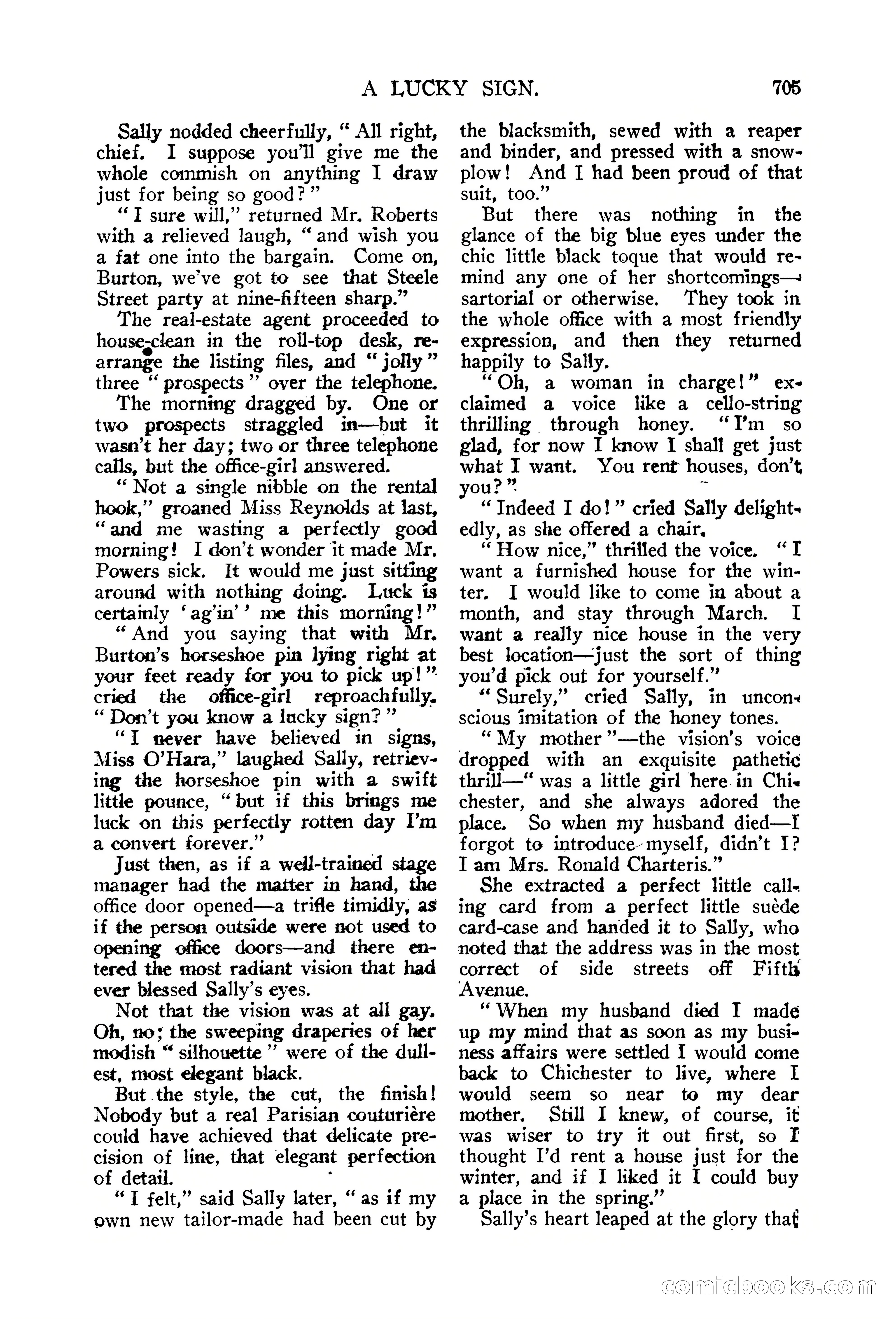
A restored page from Pulp Fiction, 1914. Page through the whole issue in the reader above.
📄 Transcribed text from this page (OCR, searchable)
Machine-transcribed from the original scan — historical spelling and the odd misread are preserved.
A LUCKY SIGN. Sally nodded cheerfully, “ All right, chief. I suppose you'll give me the whole commish on anything I draw just for being so good?” “T sure will,” returned Mr. Roberts with a relieved laugh, “and wish you a fat one into the bargain. Come on, Burton, we’ve got to see that Steele Street party at nine-fifteen sharp.” The real-estate agent proceeded to housesclean in the roll-top desk, re- arrange the listing files, and “jolly” three “ prospects” over the telephone. The morning dragged by. One or two prospects straggled in—but it wasn’t her day; two or three telephone cails, but the office-girl answered. “ Not a single nibble on the rental hook,” groaned Miss Reynolds at last, “and me wasting a perfectly good morning! I don’t wonder it made Mr. Powers sick. It would me just sitting around with nothing doing. Luck 1s certainly ‘ag’in’’ me this morning!” “And you saying that with Mr. Burton’s horseshoe pin lying right at your feet ready for you to pick up!” cried the office-girl reproachtully, “Don’t you know a lucky sign?” “IT never have believed in signs, Miss O’Hara,” laughed Sally, retriev- ing the horseshoe pin with a swift little pounce, “but if this brings me luck on this perfectly rotten day I’m a convert forever.” | Just then, as ii a well-trained stage manager had the matter in hand, the office door opened—a trifle timidly, as if the person outside were not used to opening office doors—and there en- tered the most radiant vision that had ever blessed Sally’s eyes. Not that the vision was at all gay. Oh, no; the sweeping draperies of her modish “ silhouette ’’ were of the dull- est, most elegant black. But the style, the cut, the finish! Nobody but a real Parisian couturiére could have achieved that delicate pre- cision of line, that elegant perfection of detail. “*T felt,” said Sally later, “as if my own new tailor-made had been cut by 705 the blacksmith, sewed with a reaper and binder, and pressed with a snow- plow! And I had been proud of that suit, too.” But there was nothing in the glance of the big blue eyes under the chic little black toque that would re- mind any one of her shortcomings— sartorial or otherwise. They took in the whole office with a most friendly expression, and then they returned happily to Sally. “Oh, a woman in charge!” ex- claimed a voice like a_ cello-string thrilling through honey. “I’m _ so glad, for now I know [I shall get just what I want. You rent houses, don’t, ou?” . “Indeed I do!” cried Sally delight. edly, as she offered a chair, ‘How nice,” thrilled the voice. “I want a furnished house for the win- ter. I would like to come in about a month, and stay through March. I want a really nice house in the very best location—just the sort of thing you'd pick out for yourself.” ** Surely,” cried Sally, in uncon scious imitation of the honey tones. “My mother ’’—the vision’s voice dropped with an exquisite pathetic thrill—* was a little girl here in Chi- chester, and she always adored the place. So when my husband died—I forgot to introduce myself, didn’t I? Iam Mrs. Ronald Charteris.” She extracted a perfect little call- ing card from a perfect little suéde card-case and handed it to Sally, who noted that the address was in the most correct of side streets off Fifth Avenue, “When my husband died I made up my mind that as soon as my busi- ness affairs were settled 1 would come back to Chichester to live, where I would seem so near to my dear mother. Still I knew, of course, it was wiser to try it out first, so I thought I’d rent a house just for the winter, and if I liked it I could buy a place in the spring.” Sally’s heart leaped at the glory that COMicdoo S CO@