
Pulp Fiction, 1914 · page 232 of 266
The Argosy, Vol. 76, No. 3 — page 232: what you’re looking at
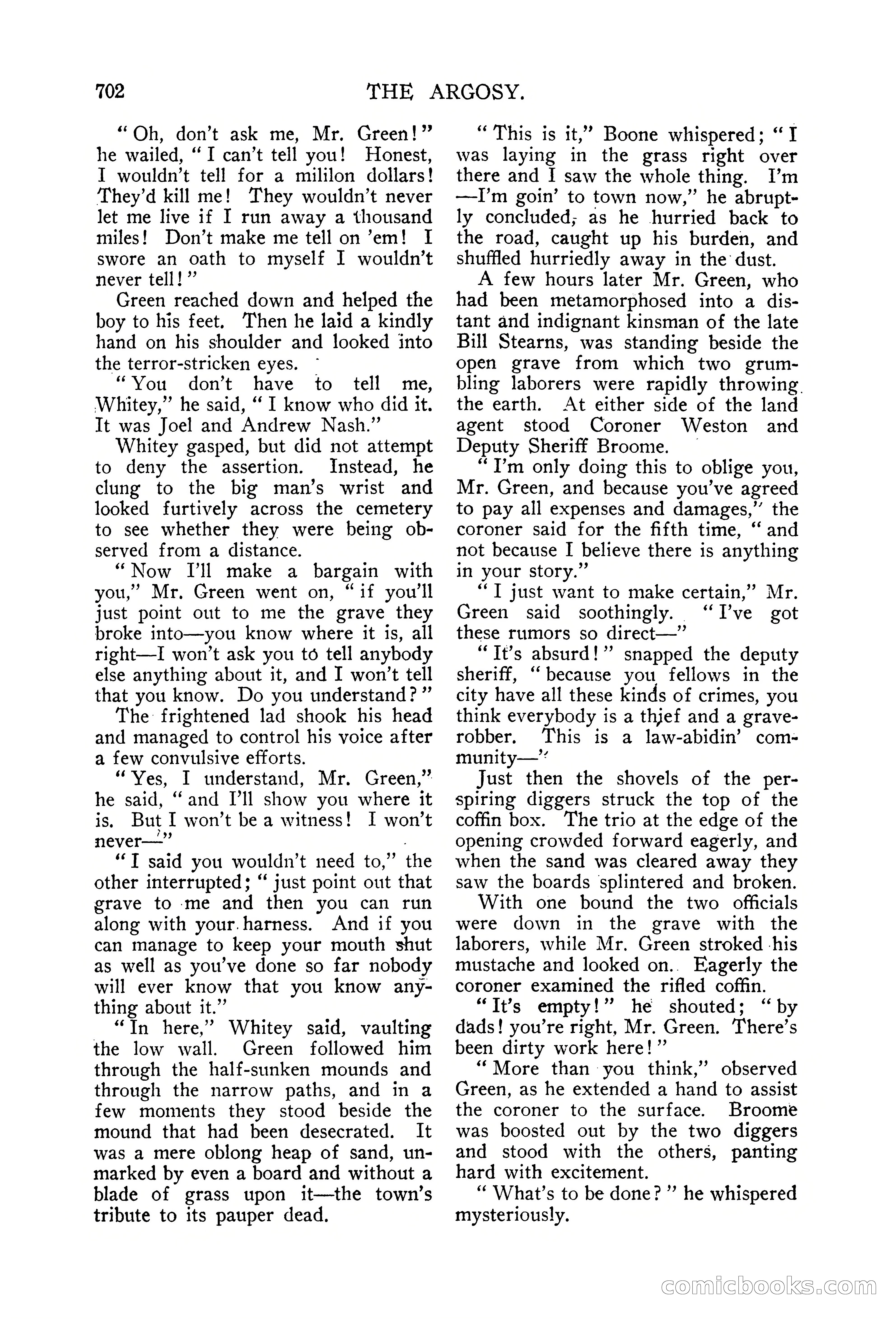
A restored page from Pulp Fiction, 1914. Page through the whole issue in the reader above.
📄 Transcribed text from this page (OCR, searchable)
Machine-transcribed from the original scan — historical spelling and the odd misread are preserved.
102 ““Oh, don’t ask me, Mr. Green!” he wailed, “I can’t tell you! Honest, I wouldn’t tell for a mililon dollars! They’d kill me! They wouldn’t never let me live if I run away a thousand miles! Don’t make me tell on ’em! I swore an oath to myself I wouldn’t never tell!” Green reached down and helped the boy to his feet. Then he laid a kindly hand on his shoulder and looked into the terror-stricken eyes. “Vou don’t have to tell me, Whitey,” he said, ‘ I know who did it. It was Joel and Andrew Nash.” Whitey gasped, but did not attempt to deny the assertion. Instead, he clung to the big man’s wrist and looked furtively across the cemetery to see whether they were being ob- served from a distance. “Now [ll make a bargain with you,’ Mr. Green went on, “if you'll just point out to me the grave they broke into—you know where it is, all right—I won’t ask you to tell anybody else anything about it, and I won't tell that you know. Do you understand?” The frightened lad shook his head and managed to control his voice after a few convulsive efforts. “Ves, I understand, Mr. Green,” he said, “and [ll show you where it is. But I won’t bea witness! I won’t never—” : ““T said you wouldn’t need to,” the other interrupted; “ just point out that grave to me and then you can run along with your. harness. And if you can manage to keep your mouth shut as well as you’ve done so far nobody will ever know that you know any- thing about it.” “In here,” Whitey said, vaulting the low wall. Green followed him through the half-sunken mounds and through the narrow paths, and in a few moments they stood beside the mound that had been desecrated. It was a mere oblong heap of sand, un- marked by even a board and without a blade of grass upon it—the town’s tribute to its pauper dead. THE ARGOSY. “This is it,” Boone whispered; “I was laying in the grass right over there and I saw the whole thing. I’m —I’m goin’ to town now,” he abrupt- ly concluded; as he hurried back to the road, caught up his burden, and shuffled hurriedly away in the dust. A few hours later Mr. Green, who had been metamorphosed into a dis- tant and indignant kinsman of the late Bill Stearns, was standing beside the open grave from which two grum- bling laborers were rapidly throwing. the earth. At either side of the land agent stood Coroner Weston and Deputy Sheriff Broome. _ “I’m only doing this to oblige you, Mr. Green, and because you’ve agreed to pay all expenses and damages,” the coroner said for the fifth time, “ and not because I believe there is anything in your story.” “IT just want to make certain,” Mr. Green said soothingly. ‘“Tve got these rumors so direct—” “It’s absurd!” snapped the deputy sheriff, “because you fellows in the city have all these kinds of crimes, you think everybody is a thjef and a grave- robber. This is a law-abidin’ com- munity—” Just then the shovels of the per- spiring diggers struck the top of the coffin box. The trio at the edge of the opening crowded forward eagerly, and when the sand was cleared away they saw the boards splintered and broken. With one bound the two officials were down in the grave with the laborers, while Mr. Green stroked -his mustache and looked on.. Eagerly the coroner examined the rifled coffin. “It’s empty!” he shouted; “by dads! you’re right, Mr. Green. There’s been dirty work here!” “More than you think,” observed Green, as he extended a hand to assist the coroner to the surface. Broome was boosted out by the two diggers and stood with the others, panting hard with excitement. “‘What’s to be done? ”’ he whispered mysteriously. COMicdoo S CO@