
Pulp Fiction, 1914 · page 206 of 266
The Argosy, Vol. 76, No. 3 — page 206: what you’re looking at
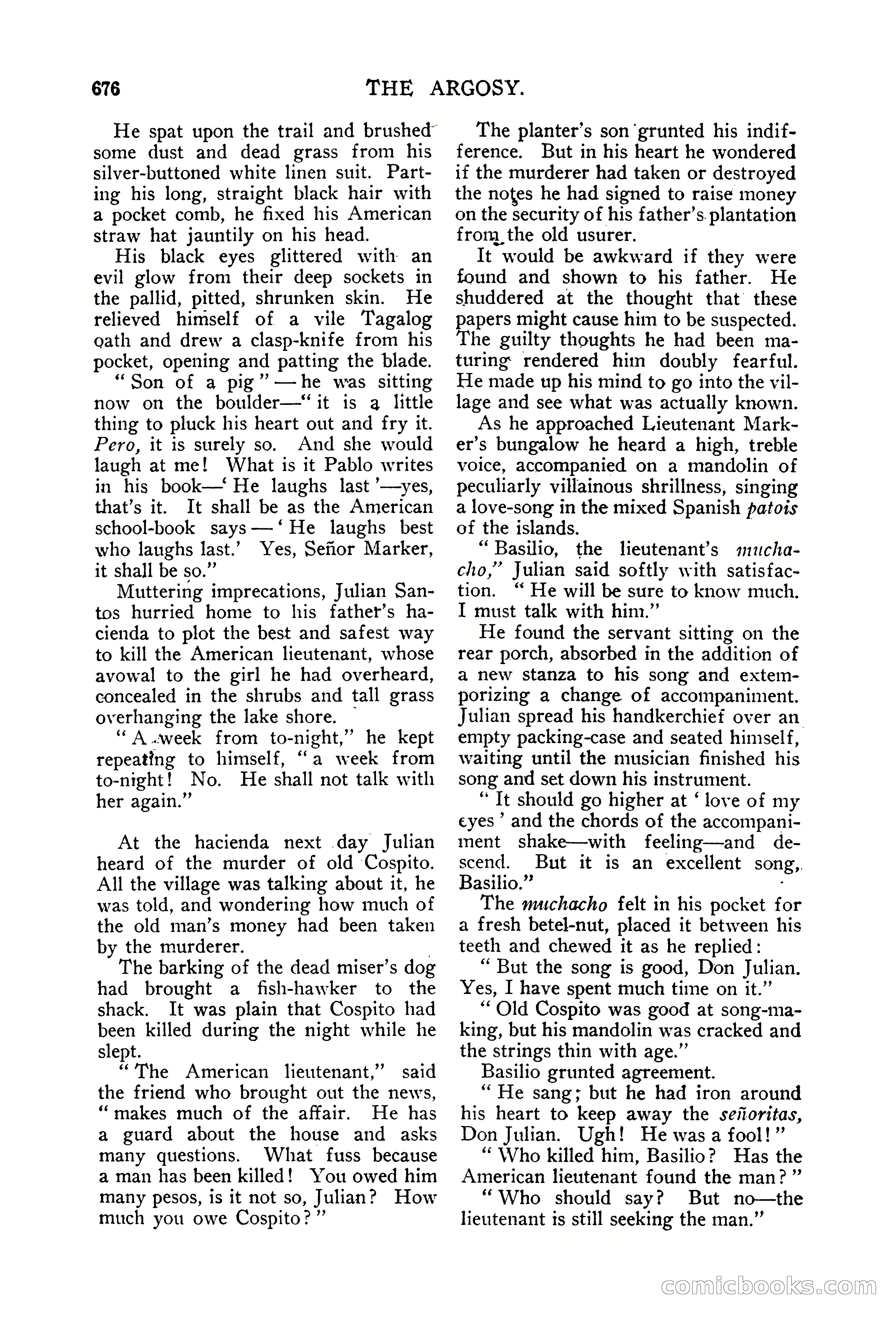
A restored page from Pulp Fiction, 1914. Page through the whole issue in the reader above.
📄 Transcribed text from this page (OCR, searchable)
Machine-transcribed from the original scan — historical spelling and the odd misread are preserved.
676 He spat upon the trail and brushed” some dust and dead grass from his silver-buttoned white linen suit. Part- ing his long, straight black hair with a pocket comb, he fixed his American straw hat jauntily on his head. His black eyes glittered with an evil glow from their deep sockets in the pallid, pitted, shrunken skin. He relieved himself of a vile Tagalog oath and drew a clasp-knife from his pocket, opening and patting the blade. “Son of a pig” —he was sitting now on the boulder—“ it is a little thing to pluck his heart out and fry it. Pero, it is surely so. And she would laugh at me! What is it Pablo writes in his book— He laughs last ’—yes, that’s it. It shall be as the American school-book says— ‘He laughs best who laughs last.’ Yes, Senor Marker, it sha]l be so.” Muttering imprecations, Julian San- tos hurried home to his father’s ha- cienda to plot the best and safest way to kill the American lieutenant, whose avowal to the girl he had overheard, concealed in the shrubs and tall grass overhanging the lake shore. © ‘“A .week from to-night,” he kept repeating to himself, ‘a week from to-night! No. He shall not talk with her again.” At the hacienda next day Julian heard of the murder of old Cospito. All the village was talking about it, he was told, and wondering how much of the old man’s money had been taken by the murderer. | The barking of the dead miser’s dog had brought a fish-hawker to the shack. It was plain that Cospito had been killed during the night while he slept. “The American lieutenant,” said the friend who brought out the news, “makes much of the affair. He has a guard about the house and asks many questions. What fuss because a man has been killed! You owed him many pesos, is it not so, Julian? How much you owe Cospito?”’ THE ARGOSY. The planter’s son grunted his indif- ference. But in his heart he wondered if the murderer had taken or destroyed the notes he had signed to raise money on the security of his father’s. plantation from,the old usurer. It would be awkward if they were found and shown to his father. He shuddered at the thought that’ these papers might cause him to be suspected. The guilty thoughts he had been ma- turing: rendered him doubly fearful. He made up his mind to go into the vil- lage and see what was actually known. As he approached Lieutenant Mark- er’s bungalow he heard a high, treble voice, accompanied on a mandolin of peculiarly villainous shrillness, singing a love-song in the mixed Spanish patois of the islands. “ Basilio, the lieutenant’s a1ucha- cho,” Julian said softly with satisfac- tion. “ He will be sure to know much. I must talk with him.” He found the servant sitting on the rear porch, absorbed in the addition of a new stanza to his song and extem- porizing a change of accompaniment. Julian spread his handkerchief over an empty packing-case and seated himself, waiting until the musician finished his song and set down his instrument. “ It should go higher at ‘ love of my eyes ’ and the chords of the accompani- ment shake—with feeling—and de- scend. | Basilio.” The muchacho felt in his pocket for a fresh betel-nut, placed it between his teeth and chewed it as he replied: “ But the song is good, Don Julian. Yes, I have spent much time on it.” ““ Old Cospito was good at song-ma- king, but his mandolin was cracked and the strings thin with age.” Basilio grunted agreement. “He sang; but he had iron around his heart to keep away the seiioritas, Don Julian. Ugh! He was a fool!” “Who killed him, Basilio? Has the American lieutenant found the man? ” “Who should say? But no—the lieutenant ts still seeking the man.” But it is an excellent song, COMicdoo S CO@