
Pulp Fiction, 1914 · page 172 of 266
The Argosy, Vol. 76, No. 3 — page 172: what you’re looking at
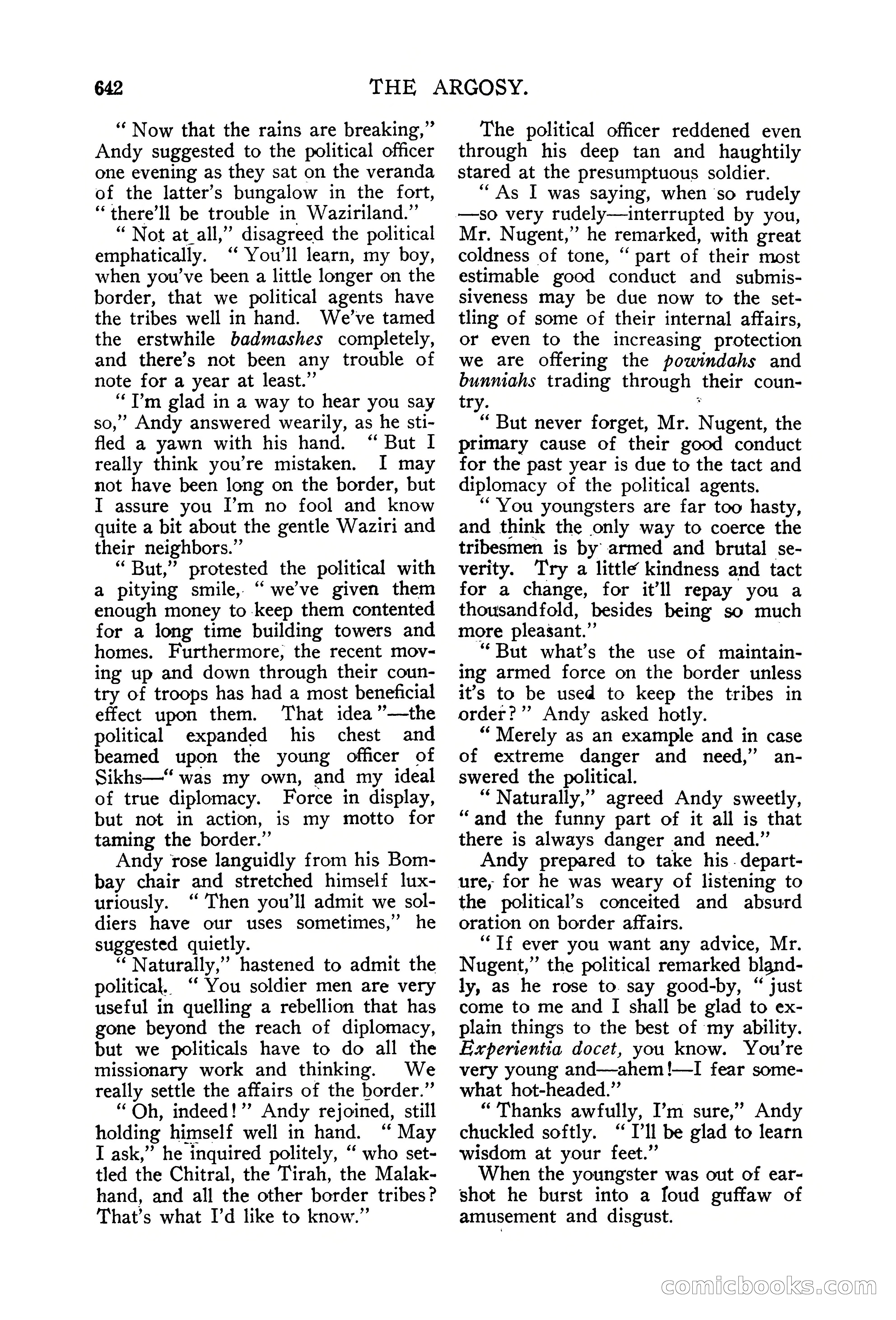
A restored page from Pulp Fiction, 1914. Page through the whole issue in the reader above.
📄 Transcribed text from this page (OCR, searchable)
Machine-transcribed from the original scan — historical spelling and the odd misread are preserved.
642 ‘“‘ Now that the rains are breaking,” Andy suggested to the political officer one evening as they sat on the veranda of the latter’s bungalow in the fort, ‘there'll be trouble in Waziriland.” “ Not at all,” disagreed the political emphatically. “You'll learn, my boy, when you've been a little longer on the border, that we political agents have the tribes well in hand. We’ve tamed the erstwhile badmashes completely, and there’s not been any trouble of note for a year at least.” “T’m glad in a way to hear you say so,’ Andy answered wearily, as he sti- fled a yawn with his hand. “But I really think you’re mistaken. I may not have been long on the border, but I assure you I’m no fool and know quite a bit about the gentle Waziri and their neighbors.” “ But,” protested the political with a pitying smile, “we've given them enough money to keep them contented for a long time building towers and homes. Furthermore, the recent mov- ing up and down through their coun- try of troops has had a most beneficial effect upon them. That idea ”—the political expanded his chest and beamed upon the young officer of Sikhs—“ was my own, and my ideal of true diplomacy. Force in display, but not in action, is my motto for taming the border.” Andy rose languidly from his Bom- bay chair and stretched himself lux- uriously. “ Then you'll admit we sol- diers have our uses sometimes,” he suggested quietly. “Naturally,” hastened to admit the political. ‘‘ You soldier men are very useful in quelling a rebellion that has gone beyond the reach of diplomacy, but we politicals have to do all the missionary work and thinking. We really settle the affairs of the border.” “ Oh, indeed!” Andy rejoined, still holding himself well in hand. ‘* May I ask,” he inquired politely, “ who set- tled the Chitral, the Tirah, the Malak- hand, and all the other border tribes? That’s what I’d like to know.” THE ARGOSY. The political officer reddened even through his deep tan and haughtily stared at the presumptuous soldier. “As I was saying, when ‘so rudely —so very rudely—interrupted by you, Mr. Nugent,” he remarked, with great coldness of tone, “ part of their most estimable good conduct and submis- siveness may be due now to the set- tling of some of their internal affairs, or even to the increasing protection we are offering the powindahs and bunniahs trading through their coun- try. “ But never forget, Mr. Nugent, the primary cause of their good conduct for the past year is due to the tact and diplomacy of the political agents. “You youngsters are far too hasty, and think the only way to coerce the tribesmen is by armed and brutal se- verity. Try a little kindness and tact for a change, for it'll repay you a thousand fold, besides being so much more pleasant.”’ “But what’s the use of maintain- ing armed force on the border unless it’s to be used to keep the tribes in order?’ Andy asked hotly. “ Merely as an example and in case of extreme danger and need,” an- swered the political. ** Naturally,” agreed Andy sweetly, “and the funny part of it all is that there is always danger and need.” Andy prepared to take his. depart- ure, for he was weary of listening to the political’s conceited and absurd oration on border affairs. “Tf ever you want any advice, Mr. Nugent,” the political remarked bland- ly, as he rose to. say good-by, “ just come to me and I shall be glad to ex- plain things to the best of ‘my ability. Experientia docet, you know. You're very young and—ahem!—I fear some- what hot-headed.” “Thanks awfully, I’m sure,” Andy chuckled softly. ‘“‘ Pll be glad to learn wisdom at your feet.” When the youngster was out of ear- shot he burst into a [oud guffaw of amusement and disgust. COMicdoo S CO@