
Pulp Fiction, 1914 · page 155 of 266
The Argosy, Vol. 76, No. 3 — page 155: what you’re looking at
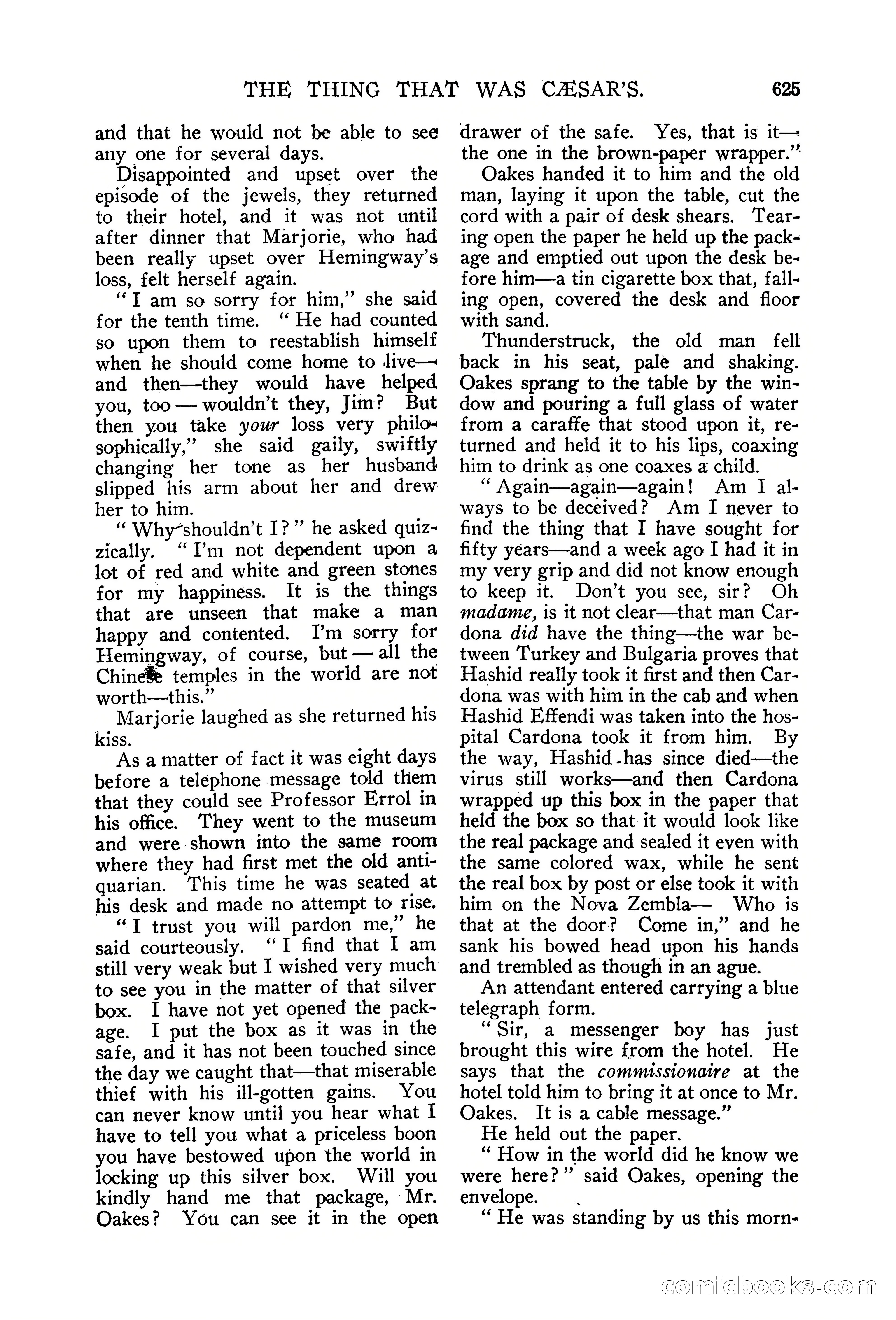
A restored page from Pulp Fiction, 1914. Page through the whole issue in the reader above.
📄 Transcribed text from this page (OCR, searchable)
Machine-transcribed from the original scan — historical spelling and the odd misread are preserved.
THE THING THAT WAS C/AESAR’S. and that he would not be able to see any one for several days. Disappointed and upset over the episode of the jewels, they returned to their hotel, and it was not until after dinner that Marjorie, who had been really upset over Hemingway’s loss, felt herself again. “IT am so sorry for him,” she said for the tenth time. ‘“‘ He had counted so upon them to reestablish himself when he should come home to live— and then—they would have helped you, too— wouldn’t they, Jim? But then you take your loss very philo- sophically,’ she said gaily, swiftly changing her tone as her husband slipped his arm about her and drew her to him. “ Why~shouldn’t 1?” he asked quiz- zically. “I’m not dependent upon a lot of red and white and green stones for my happiness. It is the things that are unseen that make a man happy and contented. I’m sorry for Hemingway, of course, but — all the Chinefe temples in the world are not worth—this.” Marjorie laughed as she returned his kiss. As a matter of fact it was eight days before a telephone message told them that they could see Professor Errol in his office. They went to the museum and were shown into the same room where they had first met the old anti- quarian. ‘This time he was seated at his desk and made no attempt to rise. “T trust you will pardon me,” he said courteously. “I find that I am still very weak but I wished very much to see you in the matter of that silver box. I have not yet opened the pack- age. I put the box as it was in the safe, and it has not been touched since the day we caught that—that miserable thief with his ill-gotten gains. You can never know until you hear what 1 have to tell you what a priceless boon you have bestowed upon the world in locking up this silver box. Will you kindly hand me that package, Mr. Oakes? You can see it in the open 625 drawer of the safe. Yes, that is it— the one in the brown-paper wrapper.” Oakes handed it to him and the old man, laying it upon the table, cut the cord with a pair of desk shears. Tear- ing open the paper he held up the pack- age and emptied out upon the desk be- fore him—a tin cigarette box that, fall- ing open, covered the desk and floor with sand. Thunderstruck, the old man fell back in his seat, pale and shaking. Oakes sprang to the table by the win- dow and pouring a full glass of water from a caraffe that stood upon it, re- turned and held it to his lips, coaxing him to drink as one coaxes a child. “ Again—again—again! Am I al- ways to be deceived? Am I never to find the thing that I have sought for fifty years—and a week ago I had it in my very grip and did not know enough to keep it. Don’t you see, sir? Oh madame, is it not clear—that man Car- dona did have the thing—the war be- tween Turkey and Bulgaria proves that Hashid really took it first and then Car- dona was with him in the cab and when Hashid Effendi was taken into the hos- pital Cardona took it from him. By the way, Hashid-has since died—the virus still works—and then Cardona wrapped up this box in the paper that held the box so that it would look like the real package and sealed it even with the same colored wax, while he sent the real box by post or else took it with him on the Nova Zembla— Who is that at the door? Come in,” and he sank his bowed head upon his hands and trembled as though in an ague. An attendant entered carrying a blue telegraph form. “Sir, a messenger boy has just brought this wire from the hotel. He says that the commissionaire at the hotel told him to bring it at once to Mr. Oakes. It is a cable message.” He held out the paper. “* How in the world did he know we were here?” said Oakes, opening the envelope. “He was standing by us this morn- COMicdoo S CO@