
Pulp Fiction, 1914 · page 149 of 266
The Argosy, Vol. 76, No. 3 — page 149: what you’re looking at
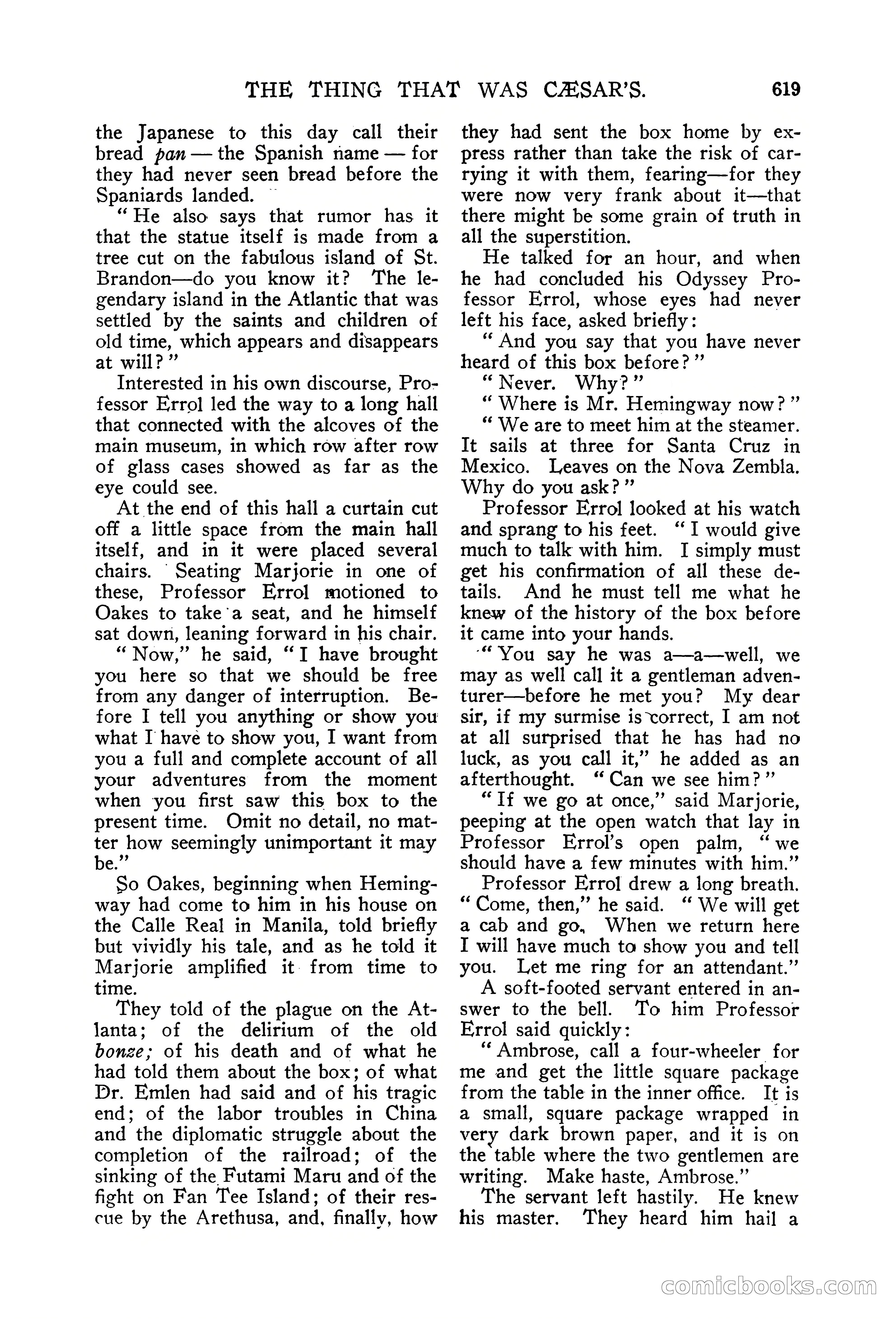
A restored page from Pulp Fiction, 1914. Page through the whole issue in the reader above.
📄 Transcribed text from this page (OCR, searchable)
Machine-transcribed from the original scan — historical spelling and the odd misread are preserved.
THE THING THAT WAS CAKSAR’S. the Japanese to this day call their bread pan — the Spanish name — for they had never seen bread before the Spaniards landed. ~ “He also says that rumor has it that the statue itself is made from a tree cut on the fabulous island of St. Brandon—do you know it? ‘The le- gendary island in the Atlantic that was settled by the saints and children of old time, which appears and disappears at will?” Interested in his own discourse, Pro- fessor Errol led the way to a long hall that connected with the alcoves of the main museum, in which row after row of glass cases showed as far as the eye could see. At the end of this hall a curtain cut off a little space from the main hall itself, and in it were placed several chairs. Seating Marjorie in one of these, Professor Errol motioned to Oakes to take’a seat, and he himself sat down, leaning forward in his chair. “Now,” he said, “I have brought you here so that we should be free from any danger of interruption. Be- fore I tell you anything or show you what I have to show you, I want from you a full and complete account of all your adventures from the moment when you first saw this box to the present time. Omit no detail, no mat- ter how seemingly unimportant it may be.” So Oakes, beginning when Heming- way had come to him in his house on the Calle Real in Manila, told briefly but vividly his tale, and as he told it Marjorie amplified it. from time to time. They told of the plague on the At- lanta; of the delirium of the old bonze; of his death and of what he had told them about the box; of what Dr. Emlen had said and of his tragic end; of the labor troubles in China and the diplomatic struggle about the completion of the railroad; of the sinking of the Futami Maru and of the fight on Fan Tee Island; of their res- cue by the Arethusa, and, finallv, how 619 they had sent the box home by ex- press rather than take the risk of car- rying it with them, fearing—for they were now very frank about it—that there might be some grain of truth in all the superstition. He talked for an hour, and when he had concluded his Odyssey Pro- fessor Errol, whose eyes had never left his face, asked briefly: “And you say that you have never heard of this box before? ”’ “Never. Why?” “Where is Mr. Hemingway now?” “We are to meet him at the steamer. It sails at three for Santa Cruz in Mexico. Leaves on the Nova Zembla. Why do you ask?” Professor Errol looked at his watch and sprang to his feet. “I would give much to talk with him. I simply must get his confirmation of all these de- tails. And he must tell me what he knew of the history of the box before it came into your hands. “You say he was a—a—well, we may as well call it a gentleman adven- turer—before he met you? My dear sir, if my surmise is ‘correct, I am not at all surprised that he has had no luck, as you call it,” he added as an afterthought. ‘Can we see him?” “If we go at once,” said Marjorie, peeping at the open watch that lay in Professor Errol’s open palm, “we should have a few minutes with him.” Professor Errol drew a long breath. “Come, then,” he said. ‘ We will get a cab and go, When we return here I will have much to show you and tell you. Let me ring for an attendant.” A soft-footed servant entered in an- swer to the bell. To him Professor Errol said quickly: ‘Ambrose, call a four-wheeler for me and get the little square package from the table in the inner office. It is a small, square package wrapped in very dark brown paper, and it is on the table where the two gentlemen are writing. Make haste, Ambrose.” The servant left hastily. He knew his master. They heard him hail a COMicdoo S CO@