
Pulp Fiction, 1914 · page 140 of 266
The Argosy, Vol. 76, No. 3 — page 140: what you’re looking at
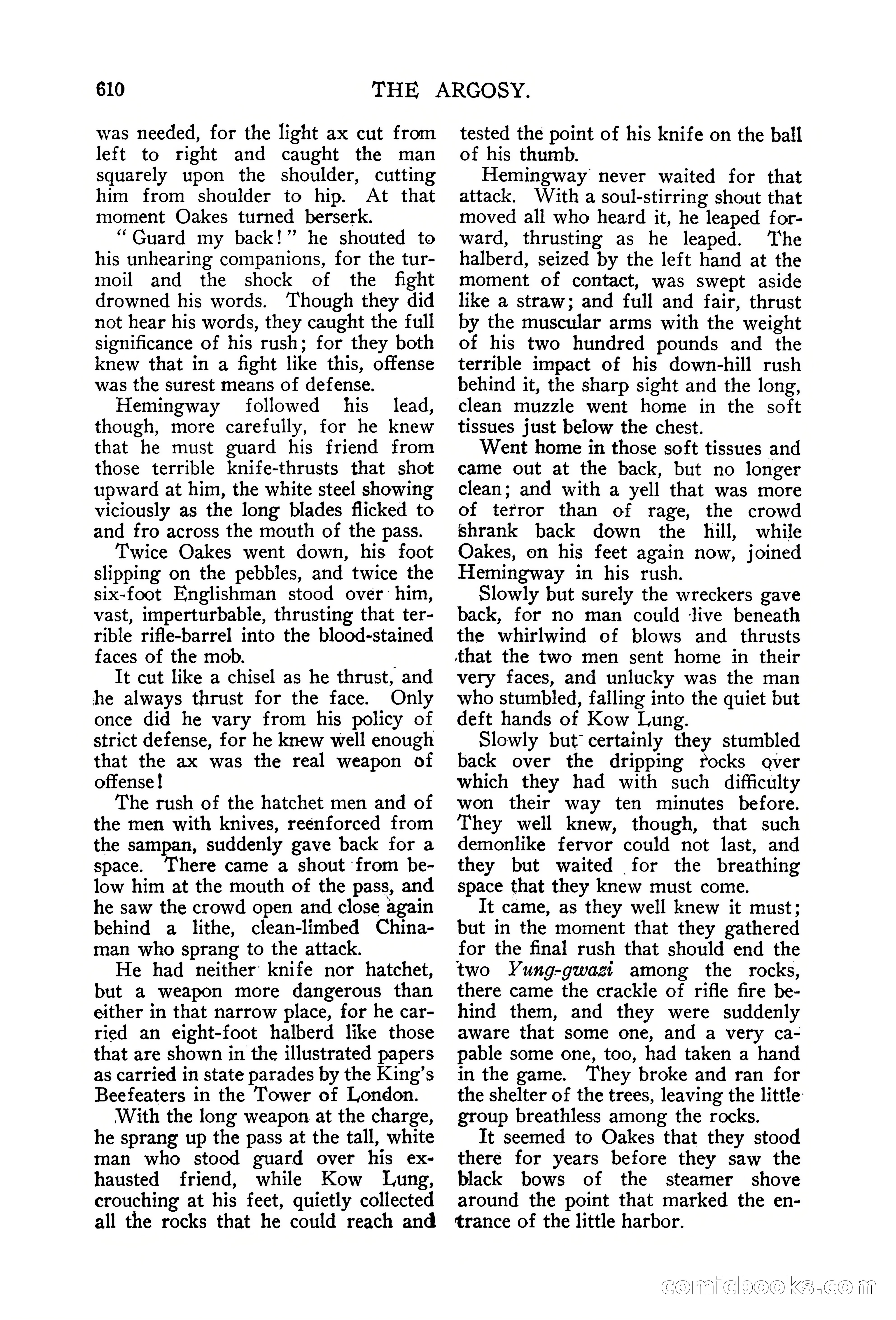
A restored page from Pulp Fiction, 1914. Page through the whole issue in the reader above.
📄 Transcribed text from this page (OCR, searchable)
Machine-transcribed from the original scan — historical spelling and the odd misread are preserved.
610 was needed, for the light ax cut from left to right and caught the man squarely upon the shoulder, cutting him from shoulder to hip. At that moment Oakes turned berserk. “Guard my back!” he shouted to his unhearing companions, for the tur- moil and the shock of the fight drowned his words. Though they did not hear his words, they caught the full significance of his rush; for they both knew that in a fight like this, offense was the surest means of defense. Hemingway followed his lead, though, more carefully, for he knew that he must guard his friend from those terrible knife-thrusts that shot upward at him, the white steel showing viciously as the long blades flicked to and fro across the mouth of the pass. Twice Oakes went down, his foot slipping on the pebbles, and twice the six-foot Englishman stood over him, vast, imperturbable, thrusting that ter- rible rifle-barrel into the blood-stained faces of the mob. It cut like a chisel as he thrust, and he always thrust for the face. Only once did he vary from his policy of strict defense, for he knew well enough that the ax was the real weapon of offense! The rush of the hatchet men and of the men with knives, reenforced from the sampan, suddenly gave back for a space. There came a shout from be- low him at the mouth of the pass, and he saw the crowd open and close again behind a lithe, clean-limbed China- man who sprang to the attack. He had neither knife nor hatchet, but a weapon more dangerous than either in that narrow place, for he car- ried an eight-foot halberd like those that are shown in the illustrated papers as carried in state parades by the King’s Beefeaters in the Tower of London. With the long weapon at the charge, he sprang up the pass at the tall, white man who stood guard over his ex- hausted friend, while Kow Lung, crouching at his feet, quietly collected all the rocks that he could reach and THE ARGOSY. tested the point of his knife on the ball of his thumb. Hemingway never waited for that attack. With a soul-stirring shout that moved all who heard it, he leaped for- ward, thrusting as he leaped. The halberd, seized by the left hand at the moment of contact, was swept aside like a straw; and full and fair, thrust by the muscular arms with the weight of his two hundred pounds and the terrible impact of his down-hill rush behind it, the sharp sight and the long, clean muzzle went home in the soft tissues just below the chest. Went home in those soft tissues and came out at the back, but no longer clean; and with a yell that was more of terror than of rage, the crowd Shrank back down the hill, while Oakes, on his feet again now, joined Hemingway in his rush. Slowly but surely the wreckers gave back, for no man could ‘live beneath the whirlwind of blows and thrusts that the two men sent home in their very faces, and unlucky was the man who stumbled, falling into the quiet but deft hands of Kow Lung. slowly but certainly they stumbled back over the dripping rocks over which they had with such difficulty won their way ten minutes before. They well knew, though, that such demonlike fervor could not last, and they but waited for the breathing space that they knew must come. It came, as they well knew it must; but in the moment that they gathered for the final rush that should end the two Yung-gwazt among the rocks, there came the crackle of rifle fire be- hind them, and they were suddenly aware that some one, and a very ca- pable some one, too, had taken a hand in the game. They broke and ran for the shelter of the trees, leaving the little group breathless among the rocks. It seemed to Oakes that they stood there for years before they saw the black bows of the steamer shove around the point that marked the en- trance of the little harbor. COMicdoo S CO@