
Pulp Fiction, 1914 · page 122 of 266
The Argosy, Vol. 76, No. 3 — page 122: what you’re looking at
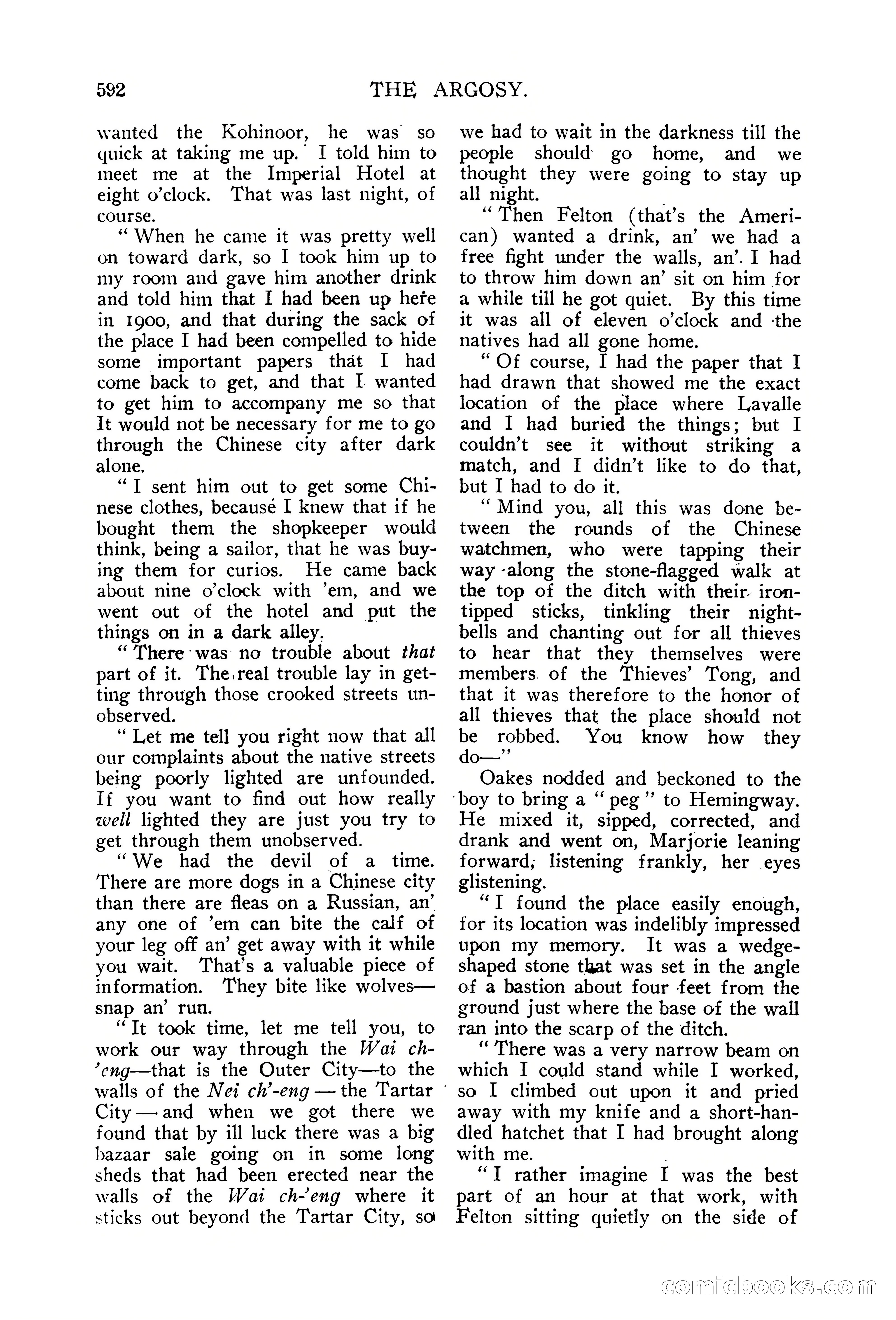
A restored page from Pulp Fiction, 1914. Page through the whole issue in the reader above.
📄 Transcribed text from this page (OCR, searchable)
Machine-transcribed from the original scan — historical spelling and the odd misread are preserved.
O92 wanted the Kohinoor, he was so quick at taking me up. I told him to meet me at the Imperial Hotel at eight o’clock. That was last night, of course. ‘““When he came it was pretty well on toward dark, so I took him up to my room and gave him another drink and told him that I had been up here in 1900, and that during the sack of the place I had been compelled to hide some important papers that I had come back to get, and that I wanted to get him to accompany me so that It would not be necessary for me to go through the Chinese city after dark alone. “T sent him out to get some Chi- nese clothes, because I knew that if he bought them the shopkeeper would think, being a sailor, that he was buy- ing them for curios. He came back about nine o’clock with ’em, and we went out of the hotel and put the things on in a dark alley, “There was no trouble about that part of it. The.real trouble lay in get- ting through those crooked streets un- observed. ‘Let me tell you right now that all our complaints about the native streets being poorly lighted are unfounded. If you want to find out how really well lighted they are just you try to get through them unobserved. “We had the devil of a time. There are more dogs in a Chinese city than there are fleas on a Russian, an’ any one of ’em can bite the calf of your leg off an’ get away with it while you wait. That’s a valuable piece of information. They bite like wolves— snap an’ run. “Tt took time, let me tell you, to work our way through the Wai ch- ’eng—that is the Outer City—to the walls of the Nei ch’-eng —the Tartar ~ City — and when we got there we found that by ill luck there was a big bazaar sale going on in some long sheds that had been erected near the walls of the Wai cheng where it sticks out beyond the Tartar City, so ‘boy to bring a THE ARGOSY. we had to wait in the darkness till the people should go home, and we thought they were going to stay up all night. “Then Felton (that’s the Ameri- can) wanted a drink, an’ we had a free fight under the walls, an’. I had to throw him down an’ sit on him for a while till he got quiet. By this time it was all of eleven o’clock and ‘the natives had all gone home. “ Of course, I had the paper that I had drawn that showed me the exact location of the place where Lavalle and I had buried the things; but I couldn’t see it without striking a match, and I didn’t like to do that, but I had to do it. “Mind you, all this was done be- tween the rounds of the Chinese watchmen, who were tapping their way -along the stone-flagged walk at the top of the ditch with their- iron- tipped sticks, tinkling their night- bells and chanting out for all thieves to hear that they themselves were members. of the Thieves’ Tong, and that it was therefore to the honor of all thieves that the place should not be robbed. You know how they do—”’ Oakes nodded and beckoned to the ‘peg’ to Hemingway. He mixed it, sipped, corrected, and drank and went on, Marjorie leaning forward, listening frankly, her eyes glistening. “T found the place easily enough, for its location was indelibly impressed upon my memory. It was a wedge- shaped stone that was set in the angle of a bastion about four feet from the ground just where the base of the wall ran into the scarp of the ditch. “There was a very narrow beam on which I could stand while I worked, so I climbed out upon it and pried away with my knife and a short-han- died hatchet that I had brought along with me. “T rather imagine I was the best part of an hour at that work, with Felton sitting quietly on the side of COMicdoo S CO@