
Pulp Fiction, 1914 · page 109 of 266
The Argosy, Vol. 76, No. 3 — page 109: what you’re looking at
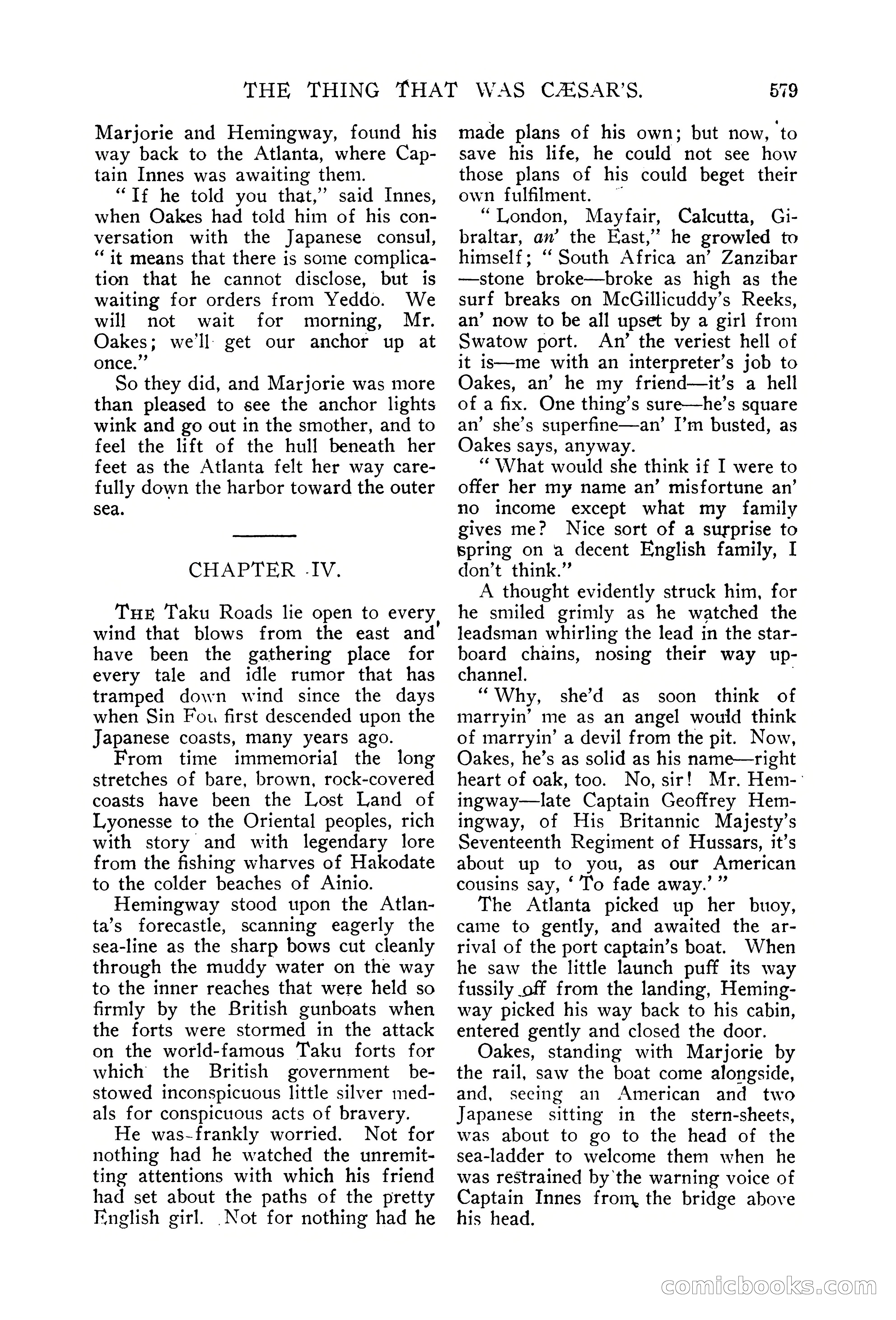
A restored page from Pulp Fiction, 1914. Page through the whole issue in the reader above.
📄 Transcribed text from this page (OCR, searchable)
Machine-transcribed from the original scan — historical spelling and the odd misread are preserved.
THE THING THAT WAS CESAR’S. 579 Marjorie and Hemingway, found his way back to the Atlanta, where Cap- tain Innes was awaiting them. “Tf he told you that,’ said Innes, when Oakes had told him of his con- versation with the Japanese consul, “it means that there is some complica- tion that he cannot disclose, but is waiting for orders from Yeddo. We will not wait for morning, Mr. Oakes; we'll get our anchor up at once.” So they did, and Marjorie was more than pleased to see the anchor lights wink and go out in the smother, and to feel the lift of the hull beneath her feet as the Atlanta felt her way care- fully down the harbor toward the outer sea. CHAPTER -IV. THe Taku Roads lie open to every wind that blows from the east and have been the gathering place for every tale and idle rumor that has tramped down wind since the days when Sin Fou first descended upon the Japanese coasts, many years ago. From time immemorial the long stretches of bare, brown, rock-covered coasts have been the Lost Land of Lyonesse to the Oriental peoples, rich with story and with legendary lore from the fishing wharves of Hakodate to the colder beaches of Ainio. Hemingway stood upon the Atlan- ta’s forecastle, scanning eagerly the sea-line as the sharp bows cut cleanly through the muddy water on the way to the inner reaches that were held so firmly by the British gunboats when the forts were stormed in the attack on the world-famous Taku forts for which the British government be- stowed inconspicuous little silver med- als for conspicuous acts of bravery. He was-frankly worried. Not for nothing had he watched the unremit- ting attentions with which his friend had set about the paths of the pretty Finglish girl. Not for nothing had he made plans of his own; but now, to save his life, he could not see how those plans of his could beget their own fulfilment. ~ “London, Mayfair, Calcutta, Gi- braltar, an’ the East,” he growled to himself; “South Africa an’ Zanzibar —stone broke—broke as high as the surf breaks on McGillicuddy’s Reeks, an’ now to be all upset by a girl from Swatow port. An’ the veriest hell of it is—me with an interpreter’s job to Oakes, an’ he my friend—it’s a hell of a fix. One thing’s sure—he’s square an’ she’s superfine—an’ I’m busted, as Oakes says, anyway. “What would she think if I were to offer her my name an’ misfortune an’ no income except what my family gives me? Nice sort of a surprise to spring on a decent English family, I don’t think.” A thought evidently struck him, for he smiled grimly as he watched the leadsman whirling the lead in the star- board chains, nosing their way up- channel. | “Why, she’d as soon think of marryin’ me as an angel would think of marryin’ a devil from the pit. Now, Oakes, he’s as solid as his name—right heart of oak, too. No, sir! ingway—late Captain Geoffrey Hem- ingway, of His Britannic Majesty’s Seventeenth Regiment of Hussars, it’s about up to you, as our American cousins say, ‘To fade away.’ ” The Atlanta picked up her buoy, came to gently, and awaited the ar- rival of the port captain’s boat. When he saw the little launch puff its way fussily off from the landing, Heming- way picked his way back to his cabin, entered gently and closed the door. Oakes, standing with Marjorie by the rail, saw the boat come alongside, and, seeing an American and two Japanese sitting in the stern-sheets, was about to go to the head of the sea-ladder to welcome them when he was restrained by the warning voice of Captain Innes from, the bridge above his head. Mr. Hem-° COMicdoo S CO@