
Pulp Fiction, 1912 · page 83 of 276
The Argosy, Christmas 1912 — page 83: what you’re looking at
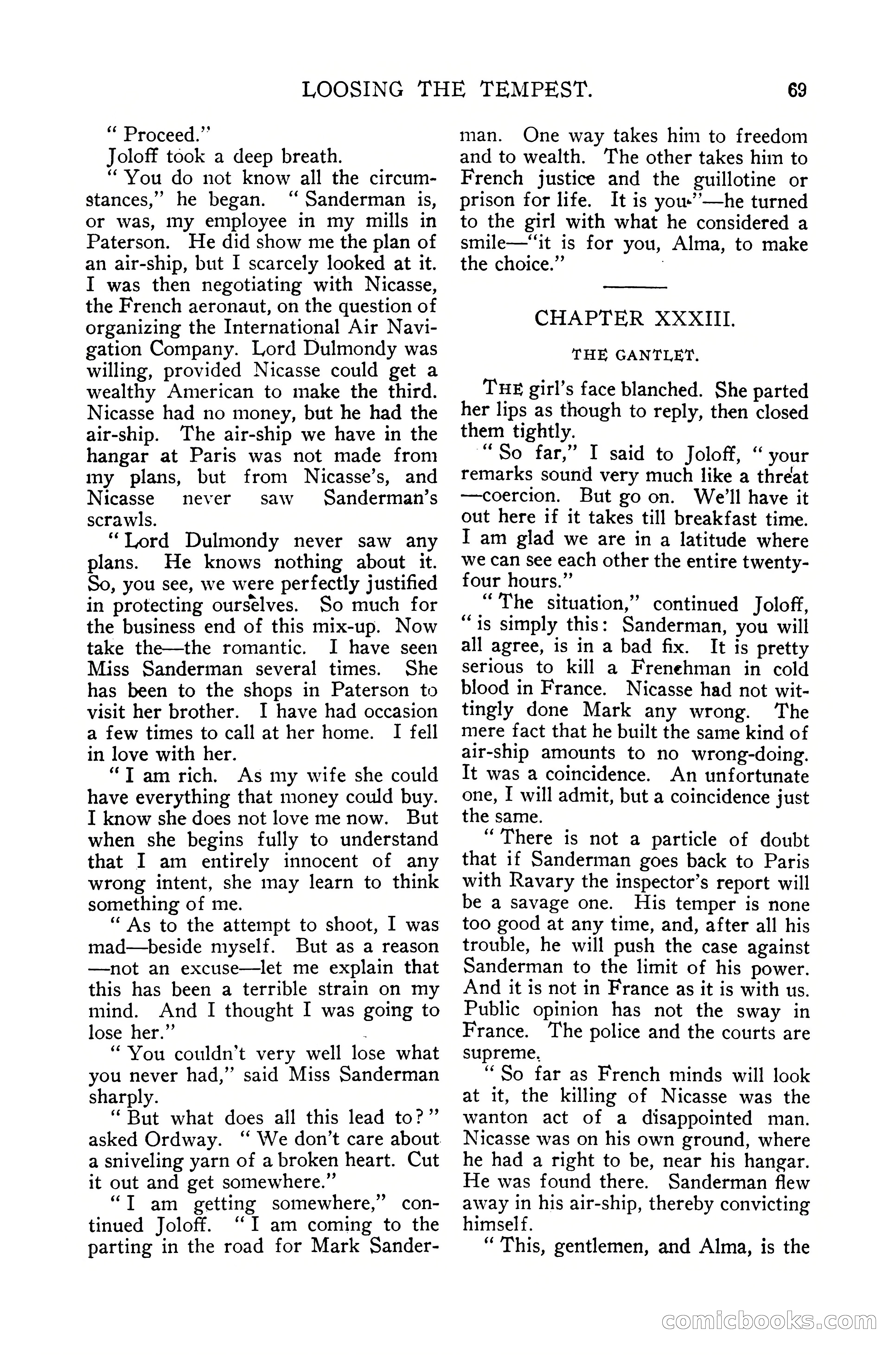
A restored page from Pulp Fiction, 1912. Page through the whole issue in the reader above.
📄 Transcribed text from this page (OCR, searchable)
Machine-transcribed from the original scan — historical spelling and the odd misread are preserved.
LOOSING THE TEMPEST. “ Proceed.” Joloff took a deep breath. “You do not know all the circum- stances,” he began. ‘“‘ Sanderman is, or was, my employee in my mills in Paterson. He did show me the plan of an air-ship, but I scarcely looked at it. I was then negotiating with Nicasse, the French aeronaut, on the question of organizing the International Air Navi- gation Company. Lord Dulmondy was willing, provided Nicasse could get a wealthy American to make the third. Nicasse had no money, but he had the air-ship. The air-ship we have in the hangar at Paris was not made from my plans, but from Nicasse’s, and Nicasse never saw Sanderman’s scrawls. “Lord Dulmondy never saw any plans. He knows nothing about it. So, you see, we were perfectly justified in protecting ourselves. So much for the business end of this mix-up. Now take the—the romantic. I have seen Miss Sanderman several times. She has been to the shops in Paterson to visit her brother. I have had occasion a few times to call at her home. I fell in love with her. “JT am rich. As my wife she could have everything that money could buy. I know she does not love me now. But when she begins fully to understand that I am entirely innocent of any wrong intent, she may learn to think something of me. “As to the attempt to shoot, I was mad—beside myself. But as a reason —not an excuse—let me explain that this has been a terrible strain on my mind. And I thought I was going to lose her.”’ : “You couldn’t very well lose what you never had,” said Miss Sanderman sharply. ‘But what does all this lead to?” asked Ordway. a sniveling yarn of a broken heart. Cut it out and get somewhere.” “TI am getting somewhere,” con- tinued Joloff. “I am coming to the parting in the road for Mark Sander- ‘We don’t care about. 69 man. One way takes him to freedom and to wealth. The other takes him to French justice and the guillotine or prison for life. It is you’’—he turned to the girl with what he considered a smile—‘it is for you, Alma, to make the choice.” : CHAPTER XXXIII. THE GANTLET. THE girl’s face blanched. She parted her lips as though to reply, then closed them tightly. “So far,” I said to Joloff, “ your remarks sound very much like a threat —coercion. But goon. We'll have it out here if it takes till breakfast time. I am glad we are in a latitude where we can see each other the entire twenty- four hours.” “The situation,” continued Joloff, “is simply this: Sanderman, you will all agree, is in a bad fix. It is pretty serious to kill a Frenehman in cold blood in France. Nicasse had not wit- tingly done Mark any wrong. The mere fact that he built the same kind of air-ship amounts to no wrong-doing. It was a coincidence. An unfortunate one, I will admit, but a coincidence just the same. “There is not a particle of doubt that 1f Sanderman goes back to Paris with Ravary the inspector’s report will be a savage one. His temper is none too good at any time, and, after all his trouble, he will push the case against Sanderman to the limit of his power. And it is not in France as it is with us. Public opinion has not the sway in France. The police and the courts are supreme, “So far as French minds will look at it, the killing of Nicasse was the wanton act of a disappointed man. Nicasse was on his own ground, where he had a right to be, near his hangar. He was found there. Sanderman flew away in his air-ship, thereby convicting himself. “This, gentlemen, and Alma, is the CoOMmicbook CO