
Pulp Fiction, 1912 · page 68 of 276
The Argosy, Christmas 1912 — page 68: what you’re looking at
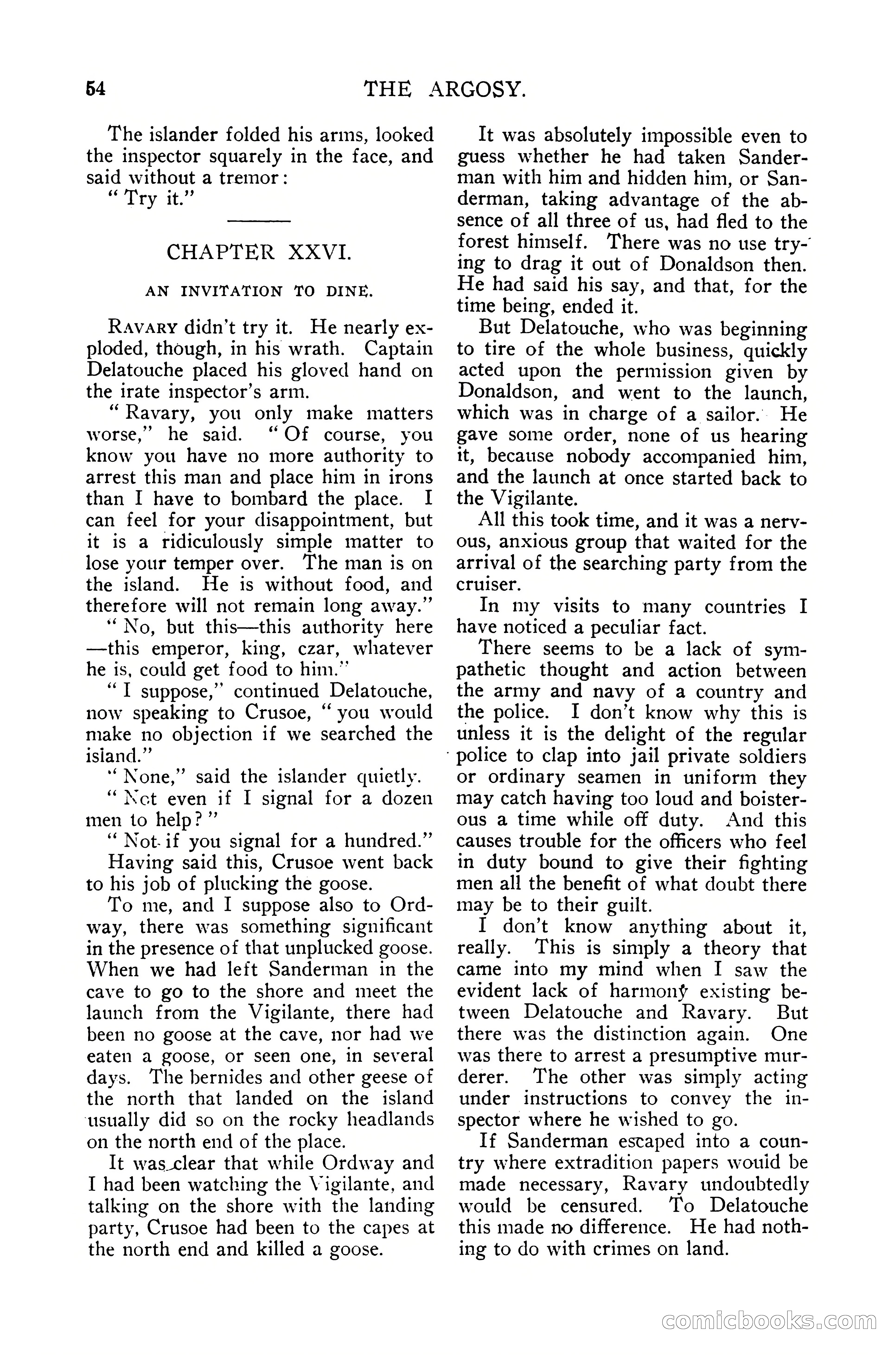
A restored page from Pulp Fiction, 1912. Page through the whole issue in the reader above.
📄 Transcribed text from this page (OCR, searchable)
Machine-transcribed from the original scan — historical spelling and the odd misread are preserved.
54 The islander folded his arms, looked the inspector squarely in the face, and said without a tremor: CHAPTER XXVI. AN INVITATION TO DINE. Ravary didn’t try it. He nearly ex- ploded, though, in his wrath. Captain Delatouche placed his gloved hand on the irate inspector’s arm. “Ravary, you only make matters worse,’ he said. “ Of course, you know you have no more authority to arrest this man and place him in irons than I have to bombard the place. I can feel for your disappointment, but it is a ridiculously simple matter to lose your temper over. The man is on the island. He is without food, and therefore will not remain long away.” “No, but this—this authority here —this emperor, king, czar, whatever he is, could get food to him.” “I suppose,’ continued Delatouche, now speaking to Crusoe, “ you would make no objection if we searched the isiand.” “None,” said the islander quietly. “Net even if I signal for a dozen men to help?” ‘“ Not-if you signal for a hundred.” Having said this, Crusoe went back to his job of plucking the goose. To me, and I suppose also to Ord- way, there was something significant in the presence of that unplucked goose. When we had left Sanderman in the cave to go to the shore and meet the launch from the Vigilante, there had been no goose at the cave, nor had we eaten a goose, or seen one, in several days. The bernides and other geese of the north that landed on the island ‘usually did so on the rocky headlands on the north end of the place. It was_clear that while Ordway and I had been watching the Vigilante, and talking on the shore with the landing party, Crusoe had been to the capes at the north end and killed a goose. b THE ARGOSY. It was absolutely impossible even to guess whether he had taken Sander- man with him and hidden him, or San- derman, taking advantage of the ab- sence of all three of us, had fled to the forest himself. There was no use try- ing to drag it out of Donaldson then. He had said his say, and that, for the time being, ended it. But Delatouche, who was beginning to tire of the whole business, quickly acted upon the permission given by Donaldson, and went to the launch, which was in charge of a sailor. He gave some order, none of us hearing it, because nobody accompanied him, and the launch at once started back to the Vigilante. All this took time, and it was a nerv- ous, anxious group that waited for the arrival of the searching party from the cruiser. In my visits to many countries I have noticed a peculiar fact. There seems to be a lack of sym- pathetic thought and action between the army and navy of a country and the police. I don’t know why this is unless it is the delight of the regular ‘police to clap into jail private soldiers or ordinary seamen in uniform they may catch having too loud and boister- ous a time while off duty. And this causes trouble for the officers who feel in duty bound to give their fighting men all the benefit of what doubt there may be to their guilt. I don’t know anything about it, really. This is simply a theory that came into my mind when I saw the evident lack of harmony existing be- tween Delatouche and Ravary. But there was the distinction again. One was there to arrest a presumptive mur- derer. The other was simply acting under instructions to convey the in- spector where he wished to go. If Sanderman escaped into a coun- try where extradition papers would be made necessary, Ravary undoubtedly would be censured. To Delatouche this made no difference. He had noth- ing to do with crimes on land. CoOMmicbook CO