
Pulp Fiction, 1912 · page 65 of 276
The Argosy, Christmas 1912 — page 65: what you’re looking at
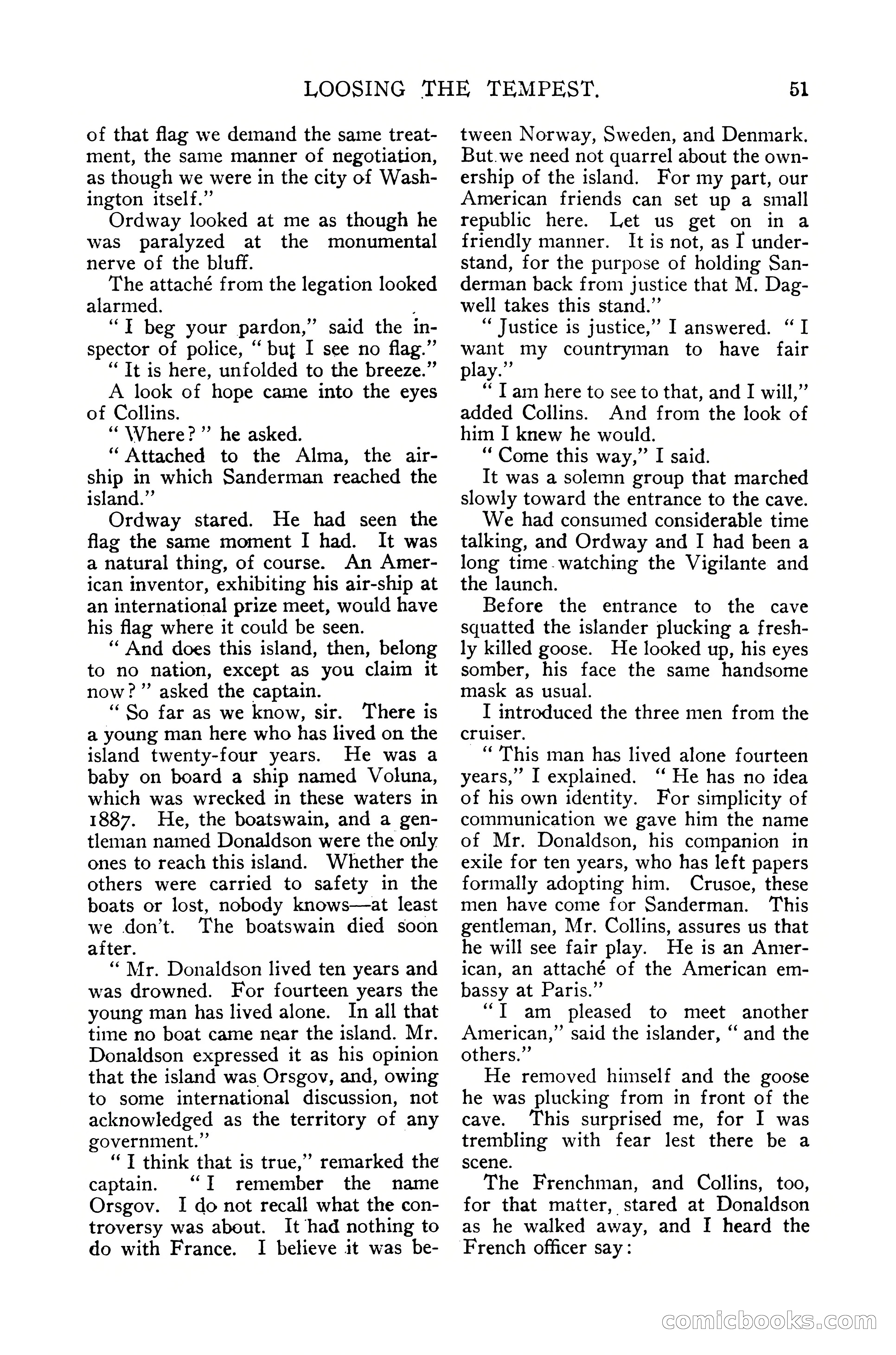
A restored page from Pulp Fiction, 1912. Page through the whole issue in the reader above.
📄 Transcribed text from this page (OCR, searchable)
Machine-transcribed from the original scan — historical spelling and the odd misread are preserved.
LOOSING THE TEMPEST. of that flag we demand the same treat- ment, the same manner of negotiation, as though we were in the city of Wash- ington itself.” Ordway looked at me as though he was paralyzed at the monumental nerve of the bluff. The attaché from the legation looked alarmed. ‘“T beg your pardon,” said the in- spector of police, “ but I see no flag.” “It is here, unfolded to the breeze.” A look of hope came into the eyes of Collins. “Where?” he asked. “ Attached to the Alma, the air- ship in which Sanderman reached the island.”’ Ordway stared. He had seen the flag the same moment I had. It was a natural thing, of course. An Amer- ican inventor, exhibiting his air-ship at an international prize meet, would have his flag where it could be seen. ‘““ And does this island, then, belong to no nation, except as you claim it now?” asked the captain. ‘“‘So far as we know, sir. There is a young man here who has lived on the island twenty-four years. He was a baby on board a ship named Voluna, which was wrecked in these waters in 1887. He, the boatswain, and a gen- tleman named Donaldson were the only ones to reach this island. Whether the others were carried to safety in the boats or lost, nobody knows—at least we don’t. The boatswain died soon after. “ Mr. Donaldson lived ten years and was drowned. For fourteen years the young man has lived alone. In all that time no boat came near the island. Mr. Donaldson expressed it as his opinion that the island was Orsgov, and, owing to some international discussion, not acknowledged as the territory of any government.” “TI think that is true,” remarked the captain. “I remember the name Orsgov. I do not recall what the con- troversy was about. It had nothing to do with France. I believe it was be- 51 tween Norway, Sweden, and Denmark. But.we need not quarrel about the own- ership of the island. For my part, our American friends can set up a small republic here. Let us get on in a friendly manner. It is not, as I under- stand, for the purpose of holding San- derman back from justice that M. Dag- well takes this stand.” “Justice is justice,’ I answered. “I want my countryman to have fair play.” “Tam here to see to that, and I will,” added Collins. And from the look of him I knew he would. “Come this way,” I said. It was a solemn group that marched slowly toward the entrance to the cave. We had consumed considerable time talking, and Ordway and I had been a long time-.watching the Vigilante and the launch. Before the entrance to the cave squatted the islander plucking a fresh- ly killed goose. He looked up, his eyes somber, his face the same handsome mask as usual. I introduced the three men from the cruiser. “This man has lived alone fourteen years,” I explained. “ He has no idea of his own identity. For simplicity of communication we gave him the name of Mr. Donaldson, his companion in exile for ten years, who has left papers formally adopting him. Crusoe, these men have come for Sanderman. This gentleman, Mr. Collins, assures us that he will see fair play. He is an Amer- ican, an attaché of the American em- bassy at Paris.” “T am pleased to meet another American,” said the islander, “‘ and the others.”’ He removed himself and the goose he was plucking from in front of the cave. This surprised me, for I was trembling with fear lest there be a scene. The Frenchman, and Collins, too, for that matter, stared at Donaldson as he walked away, and I heard the French officer say: CoOMmicbook CO