
Pulp Fiction, 1912 · page 56 of 276
The Argosy, Christmas 1912 — page 56: what you’re looking at
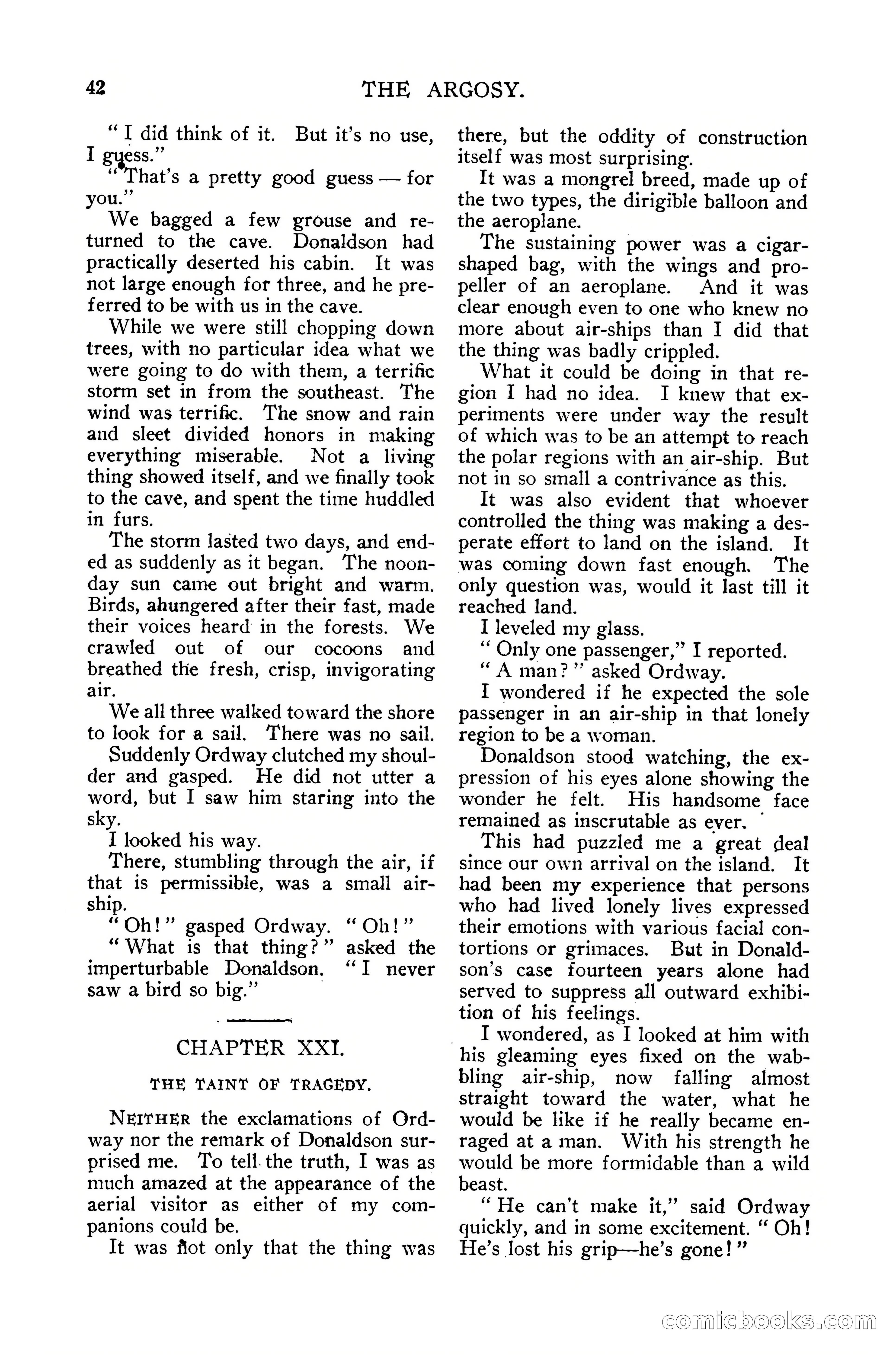
A restored page from Pulp Fiction, 1912. Page through the whole issue in the reader above.
📄 Transcribed text from this page (OCR, searchable)
Machine-transcribed from the original scan — historical spelling and the odd misread are preserved.
42 “TI did think of it. But it’s no use, I guess.” ‘““That’s a pretty good guess — for you.” We bagged a few grouse and re- turned to the cave. Donaldson had practically deserted his cabin. It was not large enough for three, and he pre- ferred to be with us in the cave. While we were still chopping down trees, with no particular idea what we were going to do with them, a terrific storm set in from the southeast. The wind was terrific. The snow and rain and sleet divided honors in making everything miserable. Not a living thing showed itself, and we finally took to the cave, and spent the time huddled in furs. The storm lasted two days, and end- ed as suddenly as it began. The noon- day sun came out bright and warm. Birds, ahungered after their fast, made their voices heard in the forests. We crawled out of our cocoons and breathed the fresh, crisp, invigorating air. We all three walked toward the shore to look for a sail. There was no sail. suddenly Ordway clutched my shoul- der and gasped. He did not utter a word, but I saw him staring into the sky. I looked his way. There, stumbling through the air, if that 1s permissible, was a small air- ship. “Oh!” gasped Ordway. ‘“ Oh!” “What is that thing?” asked the imperturbable Donaldson. “I never saw a bird so big.” CHAPTER XXII. THE TAINT OF TRAGEDY. NEITHER the exclamations of Ord- way nor the remark of Donaldson sur- prised me. To tell. the truth, I was as much amazed at the appearance of the aerial visitor as either of my com- panions could be. It was fiot only that the thing was THE ARGOSY. there, but the oddity of construction itself was most surprising. It was a mongrel breed, made up of the two types, the dirigible balloon and the aeroplane. The sustaining power was a cigar- shaped bag, with the wings and pro- peller of an aeroplane. And it was clear enough even to one who knew no more about air-ships than I did that the thing was badly crippled. What it could be doing in that re- gion I had no idea. I knew that ex- periments were under way the result of which was to be an attempt to reach the polar regions with an air-ship. But not in so small a contrivance as this. It was also evident that whoever controlled the thing was making a des- perate effort to land on the island. It was coming down fast enough. The only question was, would it last till it reached land. I leveled my glass. ‘“ Only one passenger,” I reported. “A man?” asked Ordway. I wondered if he expected the sole passenger in an air-ship in that lonely region to be a woman. Donaldson stood watching, the ex- pression of his eyes alone showing the wonder he felt. His handsome face remained as inscrutable as ever. © This had puzzled me a great deal since our own arrival on the island. It had been my experience that persons who had lived lonely lives expressed their emotions with various facial con- tortions or grimaces. But in Donald- son’s case fourteen years alone had served to suppress all outward exhibi- tion of his feelings. I wondered, as I looked at him with his gleaming eyes fixed on the wab- bling air-ship, now falling almost straight toward the water, what he would be like if he really became en- raged at a man. With his strength he would be more formidable than a wild beast. “He can’t make it,” said Ordway quickly, and in some excitement. “ Oh! He’s lost his grip—he’s gone! ” CoOMmicbook CO