
Pulp Fiction, 1912 · page 51 of 276
The Argosy, Christmas 1912 — page 51: what you’re looking at
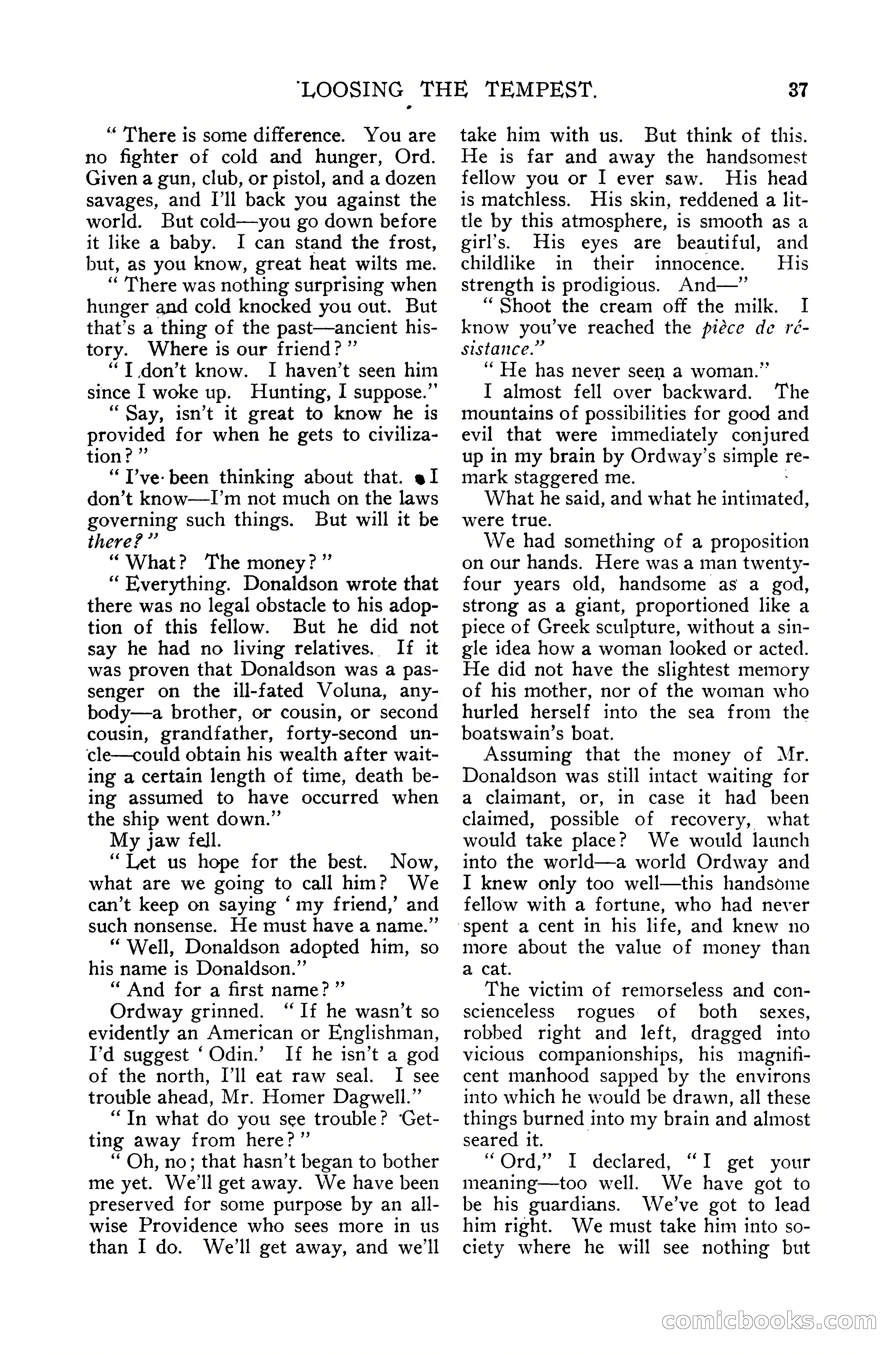
A restored page from Pulp Fiction, 1912. Page through the whole issue in the reader above.
📄 Transcribed text from this page (OCR, searchable)
Machine-transcribed from the original scan — historical spelling and the odd misread are preserved.
‘(LOOSING THE TEMPEST. ‘““ There is some difference. You are no fighter of cold and hunger, Ord. Given a gun, club, or pistol, and a dozen savages, and I’ll back you against the world. But cold—you go down before it like a baby. I can stand the frost, but, as you know, great heat wilts me. “ There was nothing surprising when hunger and cold knocked you out. But that’s a thing of the past—ancient his- tory. Where is our friend? ” “T don’t know. I haven’t seen him since I woke up. Hunting, I suppose.”’ “Say, isn’t it great to know he is provided for when he gets to civiliza- tion? ” “T’ve- been thinking about that. eI don’t know—I’m not much on the laws governing such things. But will it be there?” “What? The money?” “ Everything. Donaldson wrote that there was no legal obstacle to his adop- tion of this fellow. But he did not say he had no living relatives. If it was proven that Donaldson was a pas- senger on the ill-fated Voluna, any- body—a brother, or cousin, or second cousin, grandfather, forty-second un- cle—could obtain his wealth after wait- ing a certain length of time, death be- ing assumed to have occurred when the ship went down.” My jaw fell. “Let us hope for the best. what are we going to call him? We can’t keep on saying “my friend,’ and such nonsense. He must have a name.” “ Well, Donaldson adopted him, so his name is Donaldson.”’ “And for a first name? ” Ordway grinned. “If he wasn’t so evidently an American or Englishman, I’d suggest ‘Odin.’ If he isn’t a god of the north, I’ll eat raw seal. I see trouble ahead, Mr. Homer Dagwell.” “In what do you see trouble? ‘Get- ting away from here?” “Oh, no; that hasn’t began to bother me yet. We'll get away. We have been preserved for some purpose by an all- wise Providence who sees more in us than I do. We'll get away, and we'll Now, 37 take him with us. But think of this. He is far and away the handsomest fellow you or I ever saw. His head is matchless. His skin, reddened a lit- tle by this atmosphere, is smooth as a girl’s. His eyes are beautiful, and childlike in their innocence. His strength is prodigious. And—” “Shoot the cream off the milk. I know you’ve reached the préce de ré- sistance.” “He has never seen a woman.” I almost fell over backward. The mountains of possibilities for good and evil that were immediately conjured up in my brain by Ordway’s simple re- mark staggered me. What he said, and what he satiated were true. We had something of a proposition on our hands. Here was a man twenty- four years old, handsome as a god, strong as a giant, proportioned like a piece of Greek sculpture, without a sin- gle idea how a woman looked or acted. He did not have the slightest memory of his mother, nor of the woman who hurled herself into the sea from the boatswain’s boat. Assuming that the money of Mr. Donaldson was still intact waiting for a claimant, or, in case it had been claimed, possible of recovery, what would take place? We would launch into the world—a world Ordway and I knew only too well—this handsome fellow with a fortune, who had never ‘spent a cent in his life, and knew no more about the value of money than a Cat. The victim of remorseless and con- scienceless rogues. of both sexes, robbed right and left, dragged into vicious companionships, his magnifi- cent manhood sapped by the environs into which he would be drawn, all these things burned into my brain and almost seared it. “Ord,” I declared, meaning—too well. be his guardians. We've got to lead him right. We must take him into so- ciety where he will see nothing but “TI get your We have got to CoOMmicbook CO