
Pulp Fiction, 1912 · page 49 of 276
The Argosy, Christmas 1912 — page 49: what you’re looking at
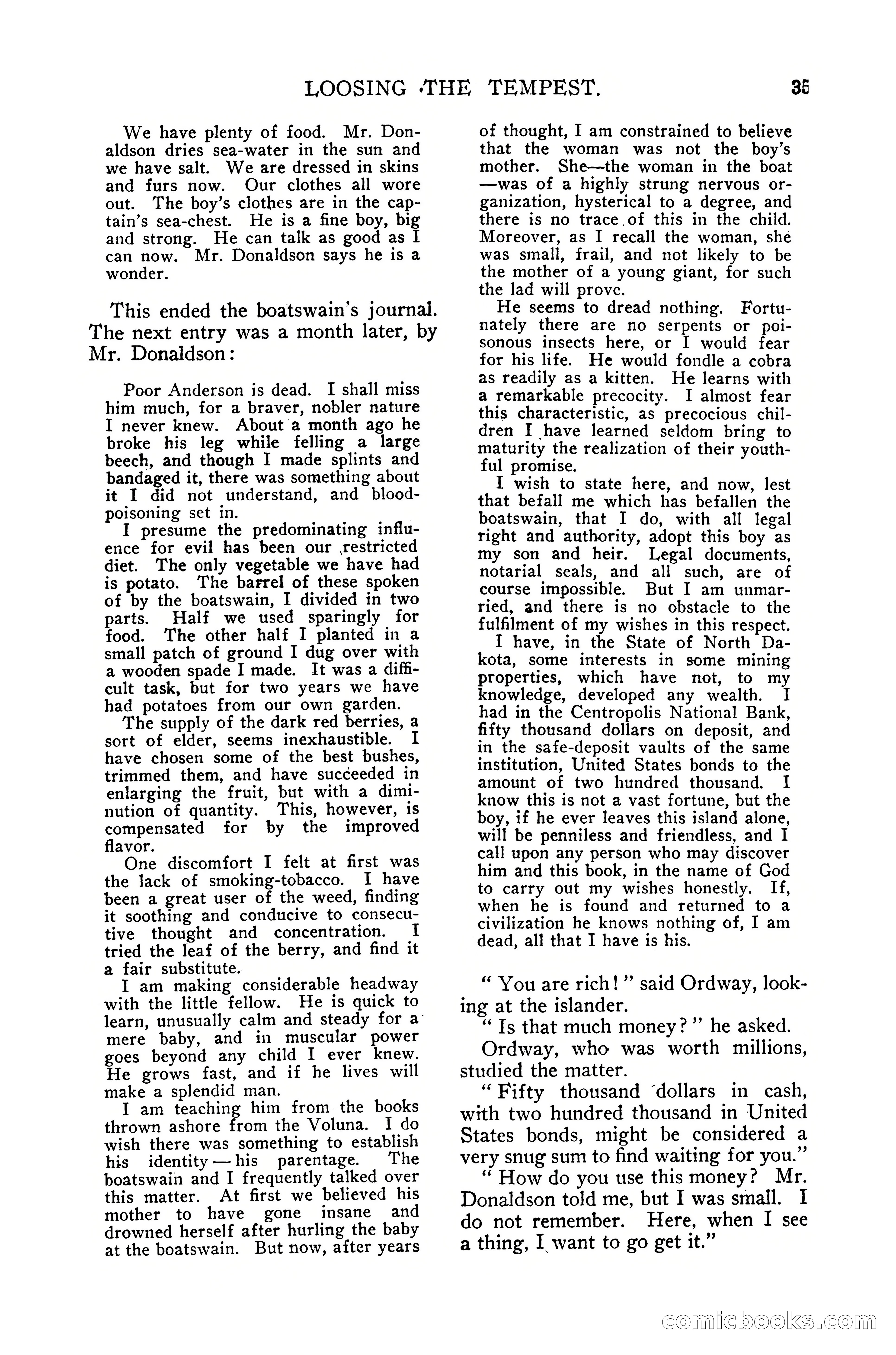
A restored page from Pulp Fiction, 1912. Page through the whole issue in the reader above.
📄 Transcribed text from this page (OCR, searchable)
Machine-transcribed from the original scan — historical spelling and the odd misread are preserved.
LOOSING ‘THE TEMPEST. 36 We have plenty of food. Mr. Don- aldson dries sea-water in the sun and we have salt. We are dressed in skins and furs now. Our clothes all wore out. The boy’s clothes are in the cap- tain’s sea-chest. He is a fine boy, big and strong. He can talk as good as I can now. Mr. Donaldson says he is a wonder. This ended the boatswain’s journal. The next entry was a month later, by Mr. Donaldson: Poor Anderson is dead. I shall miss him much, for a braver, nobler nature I never knew. About a month ago he broke his leg while felling a large beech, and though I made splints and bandaged it, there was something about it I did not understand, and blood- poisoning set in. | I presume the predominating influ- ence for evil has been our restricted diet. The only vegetable we have had is potato. The barrel of these spoken of by the boatswain, I divided in two parts. Half we used sparingly for food. The other half I planted in a small patch of ground I dug over with a wooden spade I made. It was a difh- cult task, but for two years we have had potatoes from our own garden. The supply of the dark red berries, a sort of elder, seems inexhaustible. I have chosen some of the best bushes, trimmed them, and have succeeded in enlarging the fruit, but with a dimi- nution of quantity. This, however, is compensated for by the improved flavor. One discomfort I felt at first was the lack of smoking-tobacco. I have been a great user of the weed, finding it soothing and conducive to consecu- tive thought and concentration. I tried the leaf of the berry, and find it a fair substitute. I am making considerable headway with the little fellow. He is quick to learn, unusually calm and steady for a mere baby, and in muscular power goes beyond any child I ever knew. He grows fast, and if he lives will make a splendid man. I am teaching him from the books thrown ashore from the Voluna. I do wish there was something to establish his identity—his parentage. The boatswain and I frequently talked over this matter. At first we believed his mother to have gone insane and drowned herself after hurling the baby at the boatswain. But now, after years of thought, I am constrained to believe that the woman was not the boy’s mother. She—the woman in the boat —was of a highly strung nervous or- ganization, hysterical to a degree, and there is no trace of this in the child. Moreover, as I recall the woman, she was small, frail, and not likely to be the mother of a young giant, for such the lad will prove. He seems to dread nothing. Fortu- nately there are no serpents or poi- sonous insects here, or I would fear for his life. He would fondle a cobra as readily as a kitten. He learns with a remarkable precocity. I almost fear this characteristic, as precocious chil- dren I have learned seldom bring to maturity the realization of their youth- ful promise. I wish to state here, and now, lest that befall me which has befallen the boatswain, that I do, with all legal right and authority, adopt this boy as my son and heir. Legal documents, notarial seals, and all such, are of course impossible. But I am unmar- ried, and there is no obstacle to the fulfilment of my wishes in this respect. I have, in the State of North Da- kota, some interests in some mining properties, which have not, to my knowledge, developed any wealth. I had in the Centropolis National Bank, fifty thousand dollars on deposit, and in the safe-deposit vaults of the same institution, United States bonds to the amount of two hundred thousand. I know this is not a vast fortune, but the boy, if he ever leaves this island alone, will be penniless and friendless, and I call upon any person who may discover him and this book, in the name of God to carry out my wishes honestly. If, when he is found and returned to a civilization he knows nothing of, I am dead, all that I have is his. “ You are rich!” said Ordway, look- ing at the islander. “Ts that much money? ”’ he asked. Ordway, who was worth millions, studied the matter. “Fifty thousand ‘dollars in cash, with two hundred thousand in United States bonds, might be considered a very snug sum to find waiting for you.” “How do you use this money? Mr. Donaldson told me, but I was small. I do not remember. Here, when I see a thing, I want to go get it.” cComicbooks CO