
Pulp Fiction, 1912 · page 44 of 276
The Argosy, Christmas 1912 — page 44: what you’re looking at
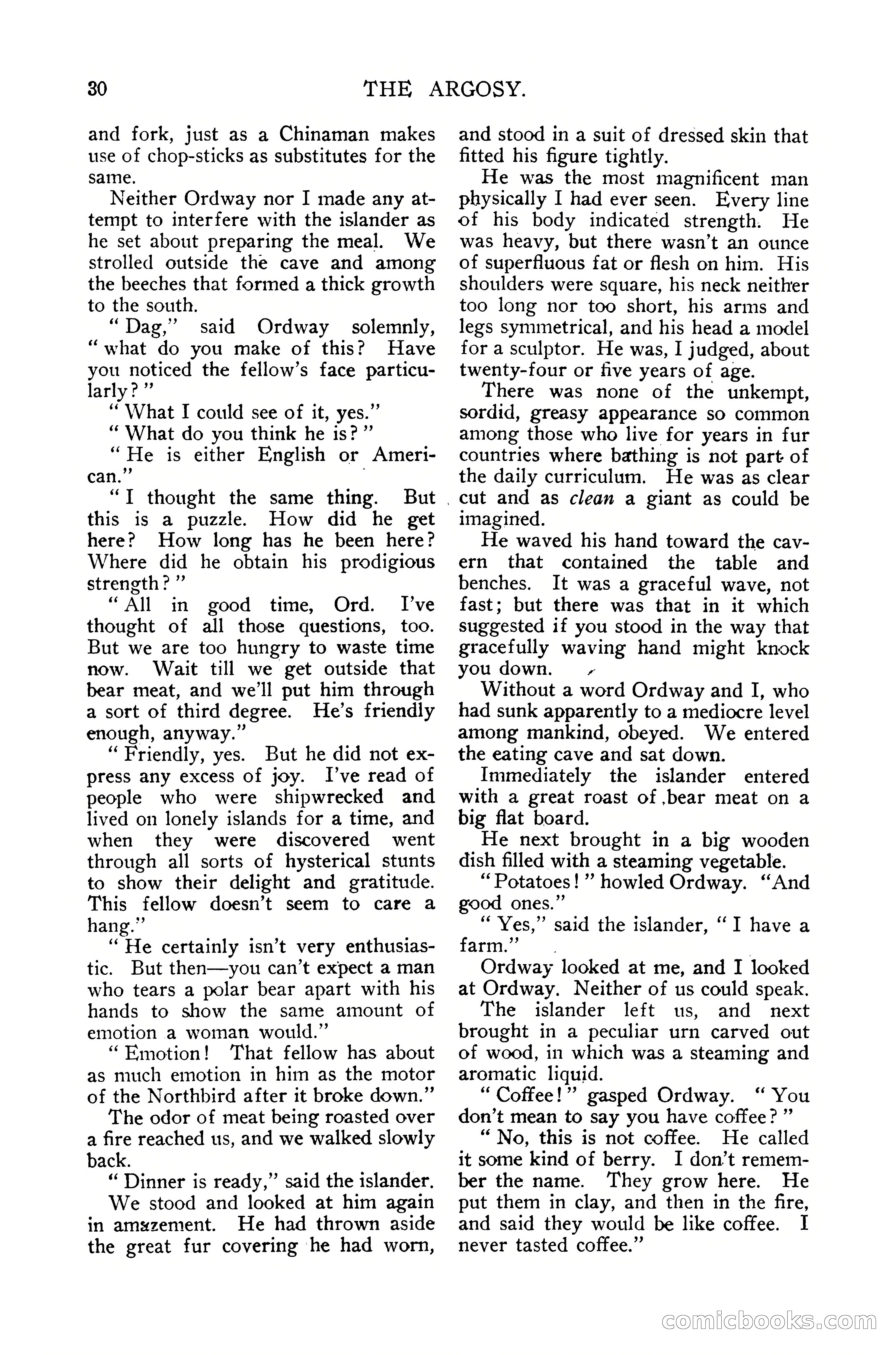
A restored page from Pulp Fiction, 1912. Page through the whole issue in the reader above.
📄 Transcribed text from this page (OCR, searchable)
Machine-transcribed from the original scan — historical spelling and the odd misread are preserved.
30 and fork, just as a Chinaman makes use of chop-sticks as substitutes for the same. Neither Ordway nor I made any at- tempt to interfere with the islander as he set about preparing the meal. We strolled outside the cave and among the beeches that formed a thick growth to the south. “ Dag,’ said Ordway solemnly, “what do you make of this? Have you noticed the fellow’s face particu- larly?” “What I could see of it, yes.” “What do you think he is? ”’ “He is either English or Amerti- can.” “TI thought the same thing. But this is a puzzle. How did he get here? How long has he been here? Where did he obtain his prodigious strength? ” “All in good time, Ord. I’ve thought of all those questions, too. But we are too hungry to waste time now. Wait till we get outside that bear meat, and we’ll put him through a sort of third degree. He’s friendly enough, anyway.” “Friendly, yes. But he did not ex- press any excess of joy. I’ve read of people who were shipwrecked and lived on lonely islands for a time, and when they were discovered went through all sorts of hysterical stunts to show their delight and gratitude. This fellow doesn’t seem to care a hang.” “He certainly isn’t very enthusias- tic. But then—you can’t expect a man who tears a polar bear apart with his hands to show the same amount of emotion a woman would.” “Emotion! That fellow has about as much emotion in him as the motor of the Northbird after it broke down.”’ The odor of meat being roasted over a fire reached us, and we walked slowly back. “ Dinner is ready,” said the islander. We stood and looked at him again in amgzement. He had thrown aside the great fur covering he had worn, THE ARGOSY. and stood in a suit of dressed skin that fitted his figure tightly. He was the most magnificent man physically I had ever seen. Every line of his body indicated strength. He was heavy, but there wasn’t an ounce of superfluous fat or flesh on him. His shoulders were square, his neck neither too long nor too short, his arms and legs symmetrical, and his head a model for a sculptor. He was, I judged, about twenty-four or five years of age. There was none of the unkempt, sordid, greasy appearance so common among those who live for years in fur countries where bathing is not part of the daily curriculum. He was as clear _cut and as clean a giant as could be imagined. He waved his hand toward the cav- ern that contained the table and benches. It was a graceful wave, not fast; but there was that in it which suggested if you stood in the way that gracefully waving hand might knock you down. - Without a word Ordway and I, who had sunk apparently to a mediocre level among mankind, obeyed. We entered the eating cave and sat down. Immediately the islander entered with a great roast of ,\bear meat on a big flat board. He next brought in a big wooden dish filled with a steaming vegetable. “Potatoes!” howled Ordway. “And good ones.” “Yes,” said the islander, “I have a farm.” | Ordway looked at me, and I looked at Ordway. Neither of us could speak. The islander left us, and next brought in a peculiar urn carved out of wood, in which was a steaming and aromatic liquid. “ Coffee!” gasped Ordway. “ You don’t mean to say you have coffee? ” “No, this is not coffee. He called it some kind of berry. I don’t remem- ber the name. They grow here. He put them in clay, and then in the fire, and said they would be like coffee. I never tasted coffee.” CoOMmicbook CO