
Pulp Fiction, 1912 · page 224 of 276
The Argosy, Christmas 1912 — page 224: what you’re looking at
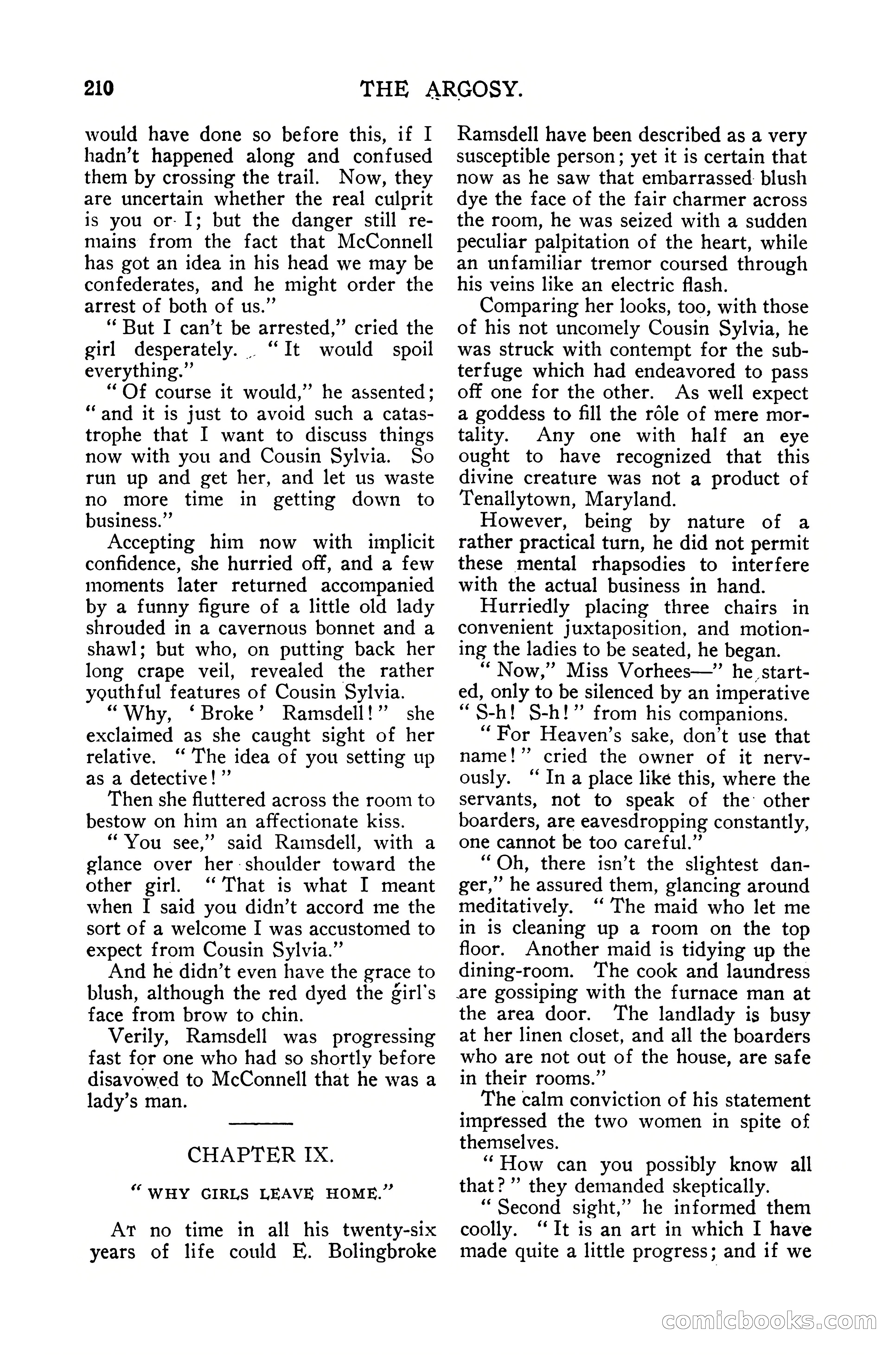
A restored page from Pulp Fiction, 1912. Page through the whole issue in the reader above.
📄 Transcribed text from this page (OCR, searchable)
Machine-transcribed from the original scan — historical spelling and the odd misread are preserved.
210 would have done so before this, if I hadn’t happened along and confused them by crossing the trail. Now, they are uncertain whether the real culprit is you or-I; but the danger still re- mains from the fact that McConnell has got an idea in his head we may be confederates, and he might order the arrest of both of us.” “But I can’t be arrested,” cried the girl desperately. . “It would spoil everything.” “Of course it would,” he assented; “and it is just to avoid such a catas- trophe that I want to discuss things now with you and Cousin Sylvia. So run up and get her, and let us waste no more time in getting down to business.” Accepting him now with implicit confidence, she hurried off, and a few moments later returned accompanied by a funny figure of a little old lady shrouded in a cavernous bonnet and a shawl; but who, on putting back her long crape veil, revealed the rather youthful features of Cousin Sylvia. “Why, ‘Broke’ Ramsdell!” she exclaimed as she caught sight of her relative. “ The idea of you setting up as a detective!” Then she fluttered across the room to bestow on him an affectionate kiss. “You see,’ said Ramsdell, with a glance over her shoulder toward the other girl. ‘‘ That is what I meant when I said you didn’t accord me the sort of a welcome I was accustomed to expect from Cousin Sylvia.” And he didn’t even have the grace to blush, although the red dyed the girl's face from brow to chin. Verily, Ramsdell was progressing fast for one who had so shortly before disavowed to McConnell that he was a lady’s man. CHAPTER IX. “ WHY GIRLS LEAVE HOME.” AT no time in all his twenty-six years of life could E. Bolingbroke THE ARGOSY. Ramsdell have been described as a very susceptible person; yet it is certain that now as he saw that embarrassed. blush dye the face of the fair charmer across the room, he was seized with a sudden peculiar palpitation of the heart, while an unfamiliar tremor coursed through his veins like an electric flash. Comparing her looks, too, with those of his not uncomely Cousin Sylvia, he was struck with contempt for the sub- terfuge which had endeavored to pass off one for the other. As well expect a goddess to fill the role of mere mor- tality. Any one with half an eye ought to have recognized that this divine creature was not a product of Tenallytown, Maryland. However, being by nature of a rather practical turn, he did not permit these mental rhapsodies to interfere with the actual business in hand. Hurriedly placing three chairs in convenient juxtaposition, and motion- ing the ladies to be seated, he began. “Now,” Miss Vorhees—” he start- ed, only to be silenced by an imperative “S-h! S-h!” from his companions. “For Heaven’s sake, don’t use that name!” cried the owner of it nerv- ously. ‘ Ina place like this, where the servants, not to speak of the other boarders, are eavesdropping constantly, one cannot be too careful.” “Oh, there isn’t the slightest dan- ger,” he assured them, glancing around meditatively. ‘‘ The maid who let me in is cleaning up a room on the top floor. Another maid is tidying up the dining-room. ‘The cook and laundress are gossiping with the furnace man at the area door. The landlady is busy at her linen closet, and all the boarders who are not out of the house, are safe in their rooms.” The calm conviction of his statement impressed the two women in spite of themselves. “How can you possibly know all that?” they demanded skeptically. “ Second sight,” he informed them coolly. “It is an art in which I have made quite a little progress; and if we oO COMmMiclhoo S CO