
Pulp Fiction, 1912 · page 215 of 276
The Argosy, Christmas 1912 — page 215: what you’re looking at
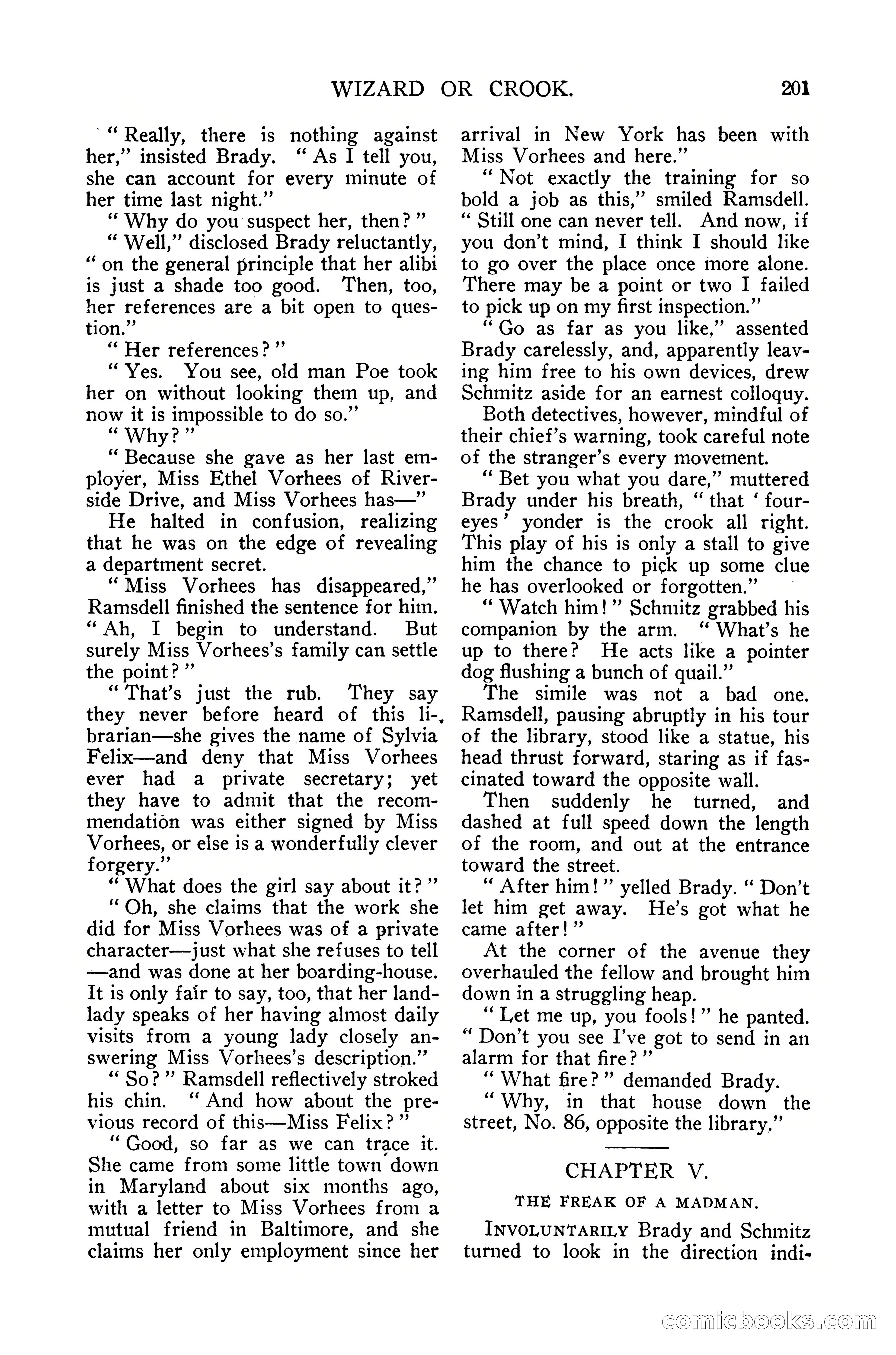
A restored page from Pulp Fiction, 1912. Page through the whole issue in the reader above.
📄 Transcribed text from this page (OCR, searchable)
Machine-transcribed from the original scan — historical spelling and the odd misread are preserved.
WIZARD OR CROOK. '“ Really, there is nothing against her,” insisted Brady. “ As I tell you, she can account for every minute of her time last night.” “Why do you suspect her, then? ” “ Well,” disclosed Brady reluctantly, “on the general principle that her alibi is just a shade too good. Then, too, her references are a bit open to ques- tion.” “Her references? ” “Yes. You see, old man Poe took her on without looking them up, and now it is impossible to do so.”’ 66 Why? 99 “Because she gave as her last em- ployer, Miss Ethel Vorhees of River- side Drive, and Miss Vorhees has—” He halted in confusion, realizing that he was on the edge of revealing a department secret. “Miss Vorhees has disappeared,” Ramsdell finished the sentence for him. “Ah, I begin to understand. But surely Miss Vorhees’s family can settle the point?” “That’s just the rub. They say they never before heard of this li-, brarian—she gives the name of Sylvia Felix—and deny that Miss Vorhees ever had a private secretary; yet they have to admit that the recom- mendation was either signed by Miss Vorhees, or else is a wonderfully clever forgery.” * What does the girl say about it?” “Oh, she claims that the work she did for Miss Vorhees was of a private character—yjust what she refuses to tell —and was done at her boarding-house. It is only fair to say, too, that her land- lady speaks of her having almost daily visits from a young lady closely an- swering Miss Vorhees’s description.” “So? ” Ramsdell reflectively stroked his chin. ‘‘ And how about the pre- vious record of this—Miss Felix? ” “Good, so far as we can trace it. She came from some little town down in Maryland about six months ago, with a letter to Miss Vorhees from a mutual friend in Baltimore, and she claims her only employment since her 201 arrival in New York has been with Miss Vorhees and here.” “Not exactly the training for so bold a job as this,” smiled Ramsdell. “ Still one can never tell. And now, if you don’t mind, I think I should like to go over the place once more alone. There may be a point or two I failed to pick up on my first inspection.”’ “Go as far as you like,” assented Brady carelessly, and, apparently leav- ing him free to his own devices, drew Schmitz aside for an earnest colloquy. Both detectives, however, mindful of their chief’s warning, took careful note of the stranger’s every movement. “Bet you what you dare,” muttered Brady under his breath, “ that ‘ four- eyes’ yonder is the crook all right. This play of his is only a stall to give him the chance to pick up some clue he has overlooked or forgotten.” “Watch him!” Schmitz grabbed his companion by the arm. ‘‘ What’s he up to there? He acts like a pointer dog flushing a bunch of quail.” The simile was not a bad one. Ramsdell, pausing abruptly in his tour of the library, stood like a statue, his head thrust forward, staring as if fas- cinated toward the opposite wall. Then suddenly he turned, and dashed at full speed down the length of the room, and out at the entrance toward the street. “ After him!” yelled Brady. ‘‘ Don’t let him get away. He’s got what he came after!” At the corner of the avenue they overhauled the fellow and brought him down in a struggling heap. “Let me up, you fools!” he panted. “ Don’t you see I’ve got to send in an alarm for that fire?” ‘What fire?’ demanded Brady. “Why, in that house down the street, No. 86, opposite the library,” CHAPTER V. THE FREAK OF A MADMAN. INVOLUNTARILY Brady and Schmitz turned to look in the direction indi- CoOMmicbook CO