
Pulp Fiction, 1912 · page 210 of 276
The Argosy, Christmas 1912 — page 210: what you’re looking at
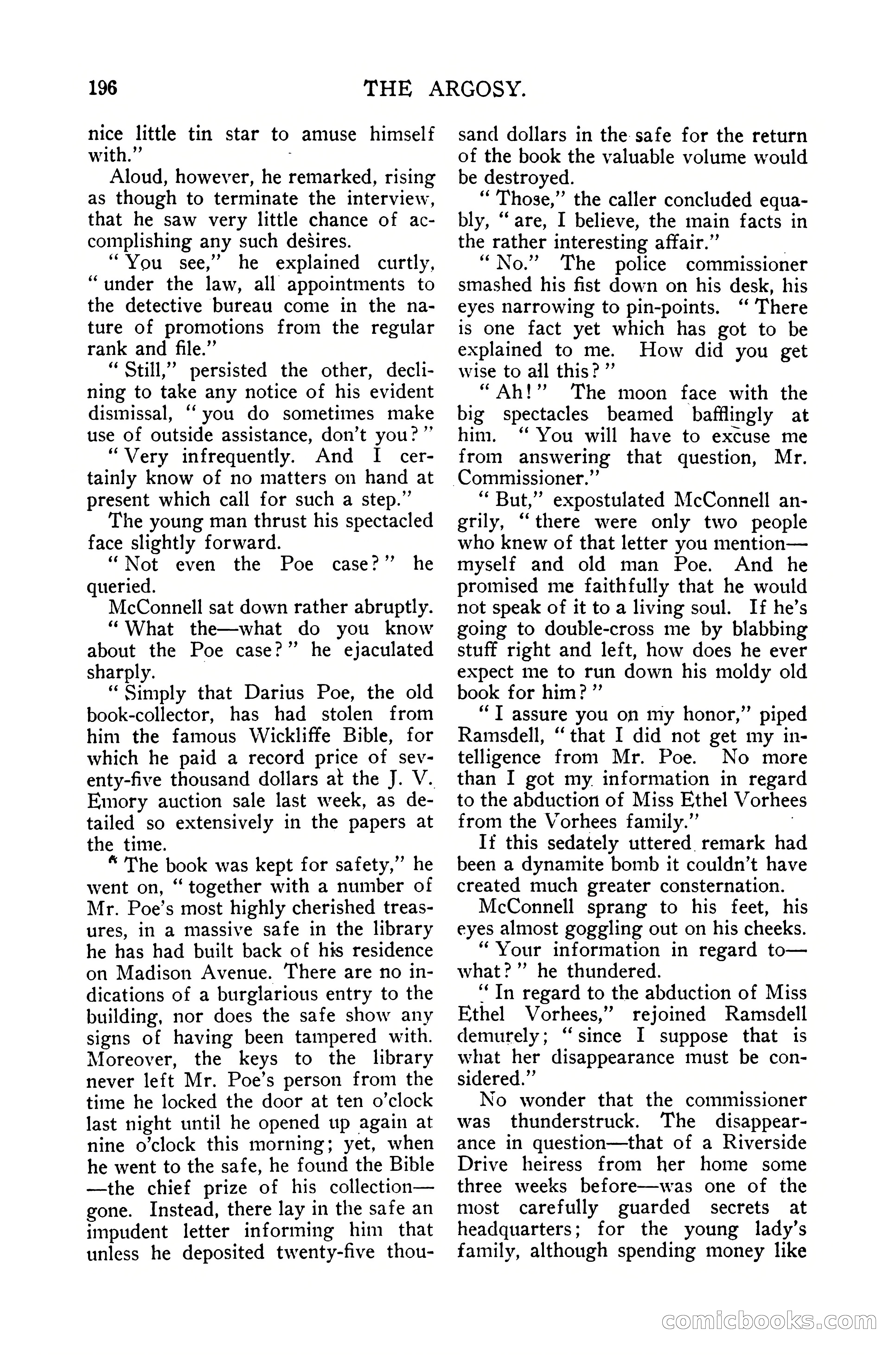
A restored page from Pulp Fiction, 1912. Page through the whole issue in the reader above.
📄 Transcribed text from this page (OCR, searchable)
Machine-transcribed from the original scan — historical spelling and the odd misread are preserved.
196 nice little tin star to amuse himself with.” Aloud, however, he remarked, rising as though to terminate the interview, that he saw very little chance of ac- complishing any such desires. “You see,’ he explained curtly, “under the law, all appointments to the detective bureau come in the na- ture of promotions from the regular rank and file.” “ Still,” persisted the other, decli- ning to take any notice of his evident distnissal, ‘ you do sometimes make use of outside assistance, don’t you?” “Very infrequently. And I cer- tainly know of no matters on hand at present which call for such a step.” The young man thrust his spectacled face slightly forward. “Not even the queried. McConnell sat down rather abruptly. “ What the—what do you know about the Poe case?” he ejaculated sharply. ‘Simply that Darius Poe, the old book-collector, has had stolen from him the famous Wickliffe Bible, for which he paid a record price of sev- enty-five thousand dollars at the J. V. Emory auction sale last week, as de- tailed so extensively in the papers at the time. “ The book was kept for safety,” he went on, ‘“ together with a number of Mr. Poe’s most highly cherished treas- ures, in a massive safe in the library he has had built back of his residence on Madison Avenue. There are no in- dications of a burglarious entry to the building, nor does the safe show any signs of having been tampered with. Moreover, the keys to the library never left Mr. Poe’s person from the time he locked the door at ten o’clock last night until he opened up again at nine o'clock this morning; yet, when he went to the safe, he found the Bible —the chief prize of his collection— gone. Instead, there lay in the safe an impudent letter informing him that unless he deposited twenty-five thou- Poe case?” he THE ARGOSY. sand dollars in the safe for the return of the book the valuable volume would be destroyed. “ Those,” the caller concluded equa- bly, “are, I believe, the main facts in the rather interesting affair.”’ | “No.” The police commissioner smashed his fist down on his desk, his eyes narrowing to pin-points. “ There is one fact yet which has got to be explained to me. How did you get wise to all this? ”’ “Ah!” The moon face with the big spectacles beamed bafflingly at him. ‘ You will have to excuse me from answering that question, Mr. ‘Commissioner.”’ “ But,” expostulated McConnell an- grily, “there were only two people who knew of that letter you mention— myself and old man Poe. And he promised me faithfully that he would not speak of it to a living soul. If he’s going to double-cross me by blabbing stuff right and left, how does he ever expect me to run down his moldy old book for him?” “T assure you on my honor,” piped Ramsdell, “that I did not get my in- telligence from Mr. Poe. No more than I got my information in regard to the abduction of Miss Ethel Vorhees from the Vorhees family.” : It this sedately uttered remark had been a dynamite bomb it couldn’t have created much greater consternation. McConnell sprang to his feet, his eyes almost goggling out on his cheeks. “Your information in regard to— what?” he thundered. ‘In regard to the abduction of Miss Ethel Vorhees,” rejoined Ramsdell demurely; “since I suppose that 1s what her disappearance must be con- sidered.” No wonder that the commissioner was thunderstruck. The disappear- ance in question—that of a Riverside Drive heiress from her home some three weeks before—was one of the most carefully guarded secrets at headquarters; for the young lady’s family, although spending money like oO COMmMiclhoo S CO