
Pulp Fiction, 1912 · page 200 of 276
The Argosy, Christmas 1912 — page 200: what you’re looking at
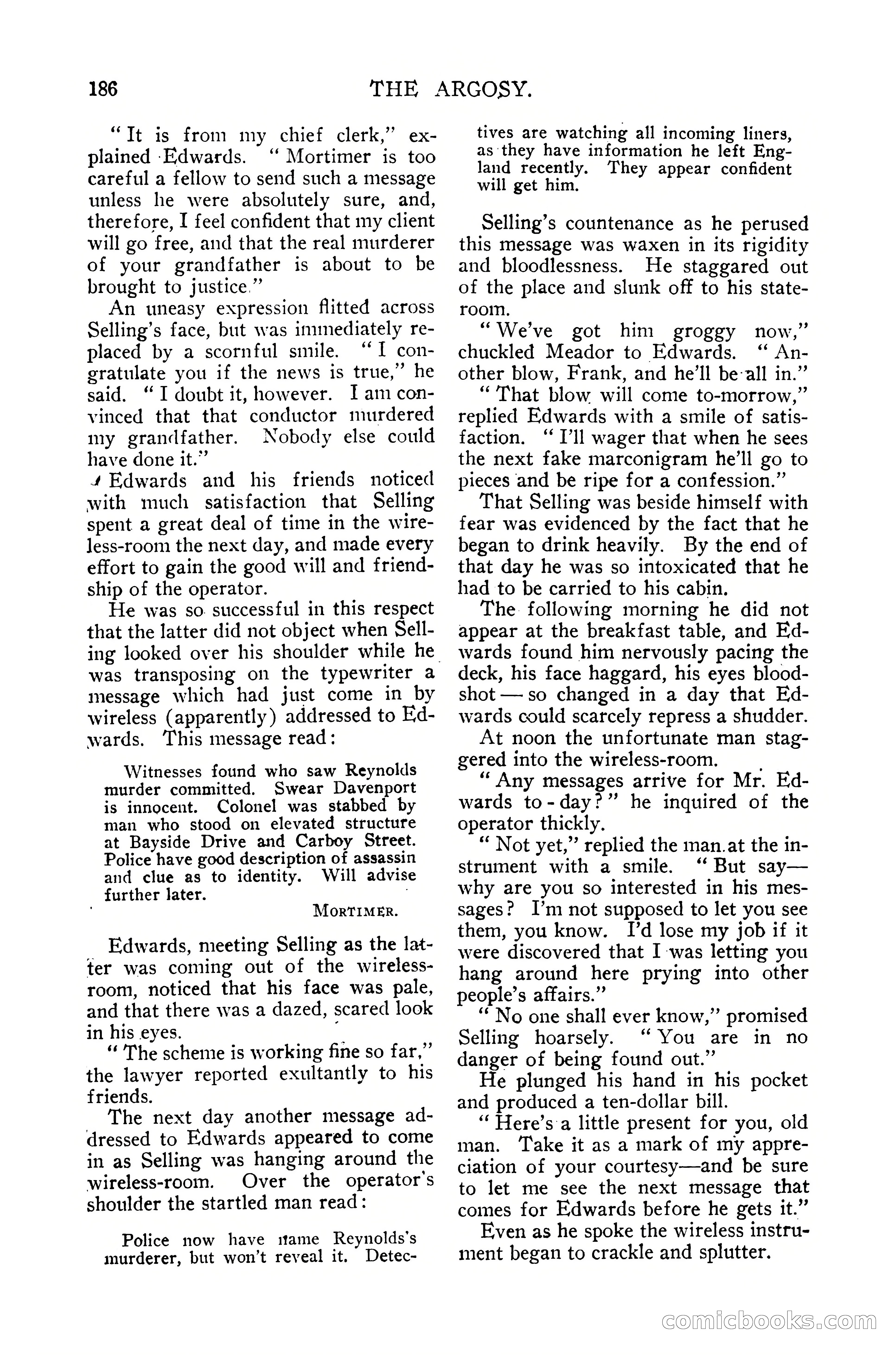
A restored page from Pulp Fiction, 1912. Page through the whole issue in the reader above.
📄 Transcribed text from this page (OCR, searchable)
Machine-transcribed from the original scan — historical spelling and the odd misread are preserved.
186 “Tt is from my chief clerk,” ex- plained ‘Edwards. ‘“ Mortimer is too careful a fellow to send such a message unless he were absolutely sure, and, therefore, I feel confident that my client will go free, and that the real murderer of your grandfather is about to be brought to justice.” An uneasy expression flitted across Selling’s face, but was immediately re- placed by a scornful smile. “I con- sratulate you if the news is true,” he said. “I doubt it, however. I am con- vinced that that conductor murdered my grandfather. Nobody else could have done it.” 4 Edwards and his friends noticed with much satisfaction that Selling spent a great deal of time in the wire- less-room the next day, and made every effort to gain the good will and friend- ship of the operator. He was so. successful in this respect that the latter did not object when Sell- ing looked over his shoulder while he. was transposing on the typewriter a message which had just come in by wireless (apparently) addressed to Ed- wards. This message read: Witnesses found who saw Reynolds murder committed. Swear Davenport is innocent. Colonel was stabbed by man who stood on elevated structure at Bayside Drive and Carboy Street. Police have good description of assassin and clue as to identity. Will advise further later. MortTIMER. Edwards, meeting Selling as the lat- ter was coming out of the wireless- room, noticed that his face was pale, and that there was a dazed, scared look in his eyes. “ The scheme is working fine so far,” the lawyer reported exultantly to his friends. The next day another message ad- dressed to Edwards appeared to come in as Selling was hanging around the wireless-room. Over the operator's shoulder the startled man read: Police now have itame Reynolds's murderer, but won’t reveal it. Detec- THE ARGOSY. tives are watching all incoming liners, as they have information he left Eng- land recently. They appear confident will get him. Selling’s countenance as he perused this message was waxen in its rigidity and bloodlessness. He staggared out of the place and slunk off to his state- room. “We've got him groggy now,” chuckled Meador to Edwards. ‘“ An- other blow, Frank, and he’ll be-all in.” “ That blow will come to-morrow,” replied Edwards with a smile of satis- faction. “ Ill wager that when he sees the next fake marconigram he’ll go to pieces and be ripe for a confession.” That Selling was beside himself with fear was evidenced by the fact that he began to drink heavily. By the end of that day he was so intoxicated that he had to be carried to his cabin. The following morning he did not appear at the breakfast table, and Ed- wards found him nervously pacing the deck, his face haggard, his eyes blood- shot — so changed in a day that Ed- wards could scarcely repress a shudder. At noon the unfortunate man stag- gered into the wireless-room. . “Any messages arrive for Mr. Ed- wards to-day?” he inquired of the operator thickly. “Not yet,” replied the man.at the in- strument with a smile. “‘ But say— why are you so interested in his mes- sages? I’m not supposed to let you see them, you know. I'd lose my job if it were discovered that I was letting you hang around here prying into other people’s affairs.” “* No one shall ever know,” promised Selling hoarsely. “ You are in no danger of being found out.” He plunged his hand in his pocket and produced a ten-dollar bill. “ Here’s a little present for you, old man. Take it as a mark of my appre- ciation of your courtesy—and be sure to let me see the next message that comes for Edwards before he gets it.” Even as he spoke the wireless instru- ment began to crackle and splutter. oO CoOMmicbook CO