
Pulp Fiction, 1912 · page 195 of 276
The Argosy, Christmas 1912 — page 195: what you’re looking at
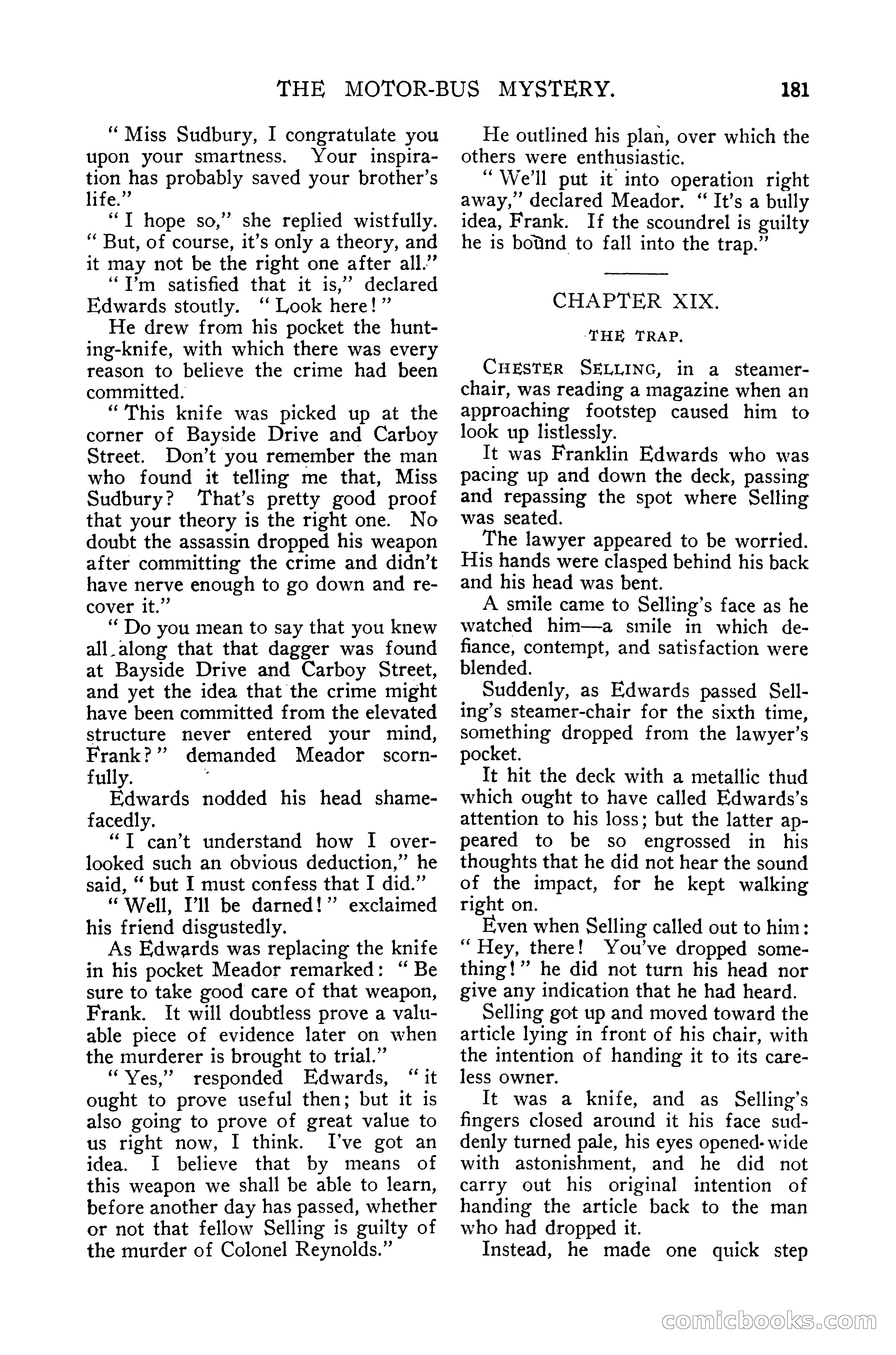
A restored page from Pulp Fiction, 1912. Page through the whole issue in the reader above.
📄 Transcribed text from this page (OCR, searchable)
Machine-transcribed from the original scan — historical spelling and the odd misread are preserved.
THE MOTOR-BUS MYSTERY. “Miss Sudbury, I congratulate you upon your smartness. Your inspira- tion has probably saved your brother’s life.” ““T hope so,” she replied wistfully. “ But, of course, it’s only a theory, and it may not be the right one after all.” ‘I’m satisfied that it is,’ declared Edwards stoutly. ‘“ Look here!” He drew from his pocket the hunt- ing-knife, with which there was every reason to believe the crime had been committed. “This knife was picked up at the corner of Bayside Drive and Carboy Street. Don’t you remember the man who found it telling me that, Miss Sudbury? That’s pretty good proof that your theory is the right one. No doubt the assassin dropped his weapon after committing the crime and didn’t have nerve enough to go down and re- cover it.” “Do you mean to say that you knew all.along that that dagger was found at Bayside Drive and Carboy Street, and yet the idea that the crime might have been committed from the elevated structure never entered your mind, Frank?” demanded Meador scorn- fully. . Edwards nodded his head shame- facedly. “T can’t understand how I over- looked such an obvious deduction,” he said, “ but I must confess that I did.” “Well, Vll be darned!” exclaimed his friend disgustedly. As Edwards was replacing the knife in his pocket Meador remarked: “ Be sure to take good care of that weapon, Frank. It will doubtless prove a valu- able piece of evidence later on when the murderer is brought to trial.” “Yes,” responded Edwards, “it ought to prove useful then; but it is also going to prove of great value to us right now, I think. I’ve got an idea. I believe that by means of this weapon we shall be able to learn, before another day has passed, whether or not that fellow Selling is guilty of the murder of Colonel Reynolds.” 181 He outlined his plan, over which the others were enthusiastic. “We'll put it into operation right away,’ declared Meador. “ It’s a bully idea, Frank. If the scoundrel is guilty he 1s botind to fall into the trap.” CHAPTER XIX. THE TRAP. CHESTER SELLING, in a steamer- chair, was reading a magazine when an approaching footstep caused him to look up listlessly. It was Franklin Edwards who was pacing up and down the deck, passing and repassing the spot where Selling was seated. The lawyer appeared to be worried. His hands were clasped behind his back and his head was bent. A smile came to Selling’s face as he watched him—a smile in which de- fiance, contempt, and satisfaction were blended. Suddenly, as Edwards passed Sell- ing’s steamer-chair for the sixth time, something dropped from the lawyer’s pocket. It hit the deck with a metallic thud which ought to have called Edwards’s attention to his loss; but the latter ap- peared to be so engrossed in his thoughts that he did not hear the sound of the impact, for he kept walking right on. Even when Selling called out to him: “ Hey, there! You’ve dropped some- thing!” he did not turn his head nor give any indication that he had heard. Selling got up and moved toward the article lying in front of his chair, with the intention of handing it to its care- less owner. It was a knife, and as Selling’s fingers closed around it his face sud- denly turned pale, his eyes opened- wide with astonishment, and he did not carry out his original intention of handing the article back to the man who had dropped it. Instead, he made one quick step cComicbooks CO