
Pulp Fiction, 1912 · page 186 of 276
The Argosy, Christmas 1912 — page 186: what you’re looking at
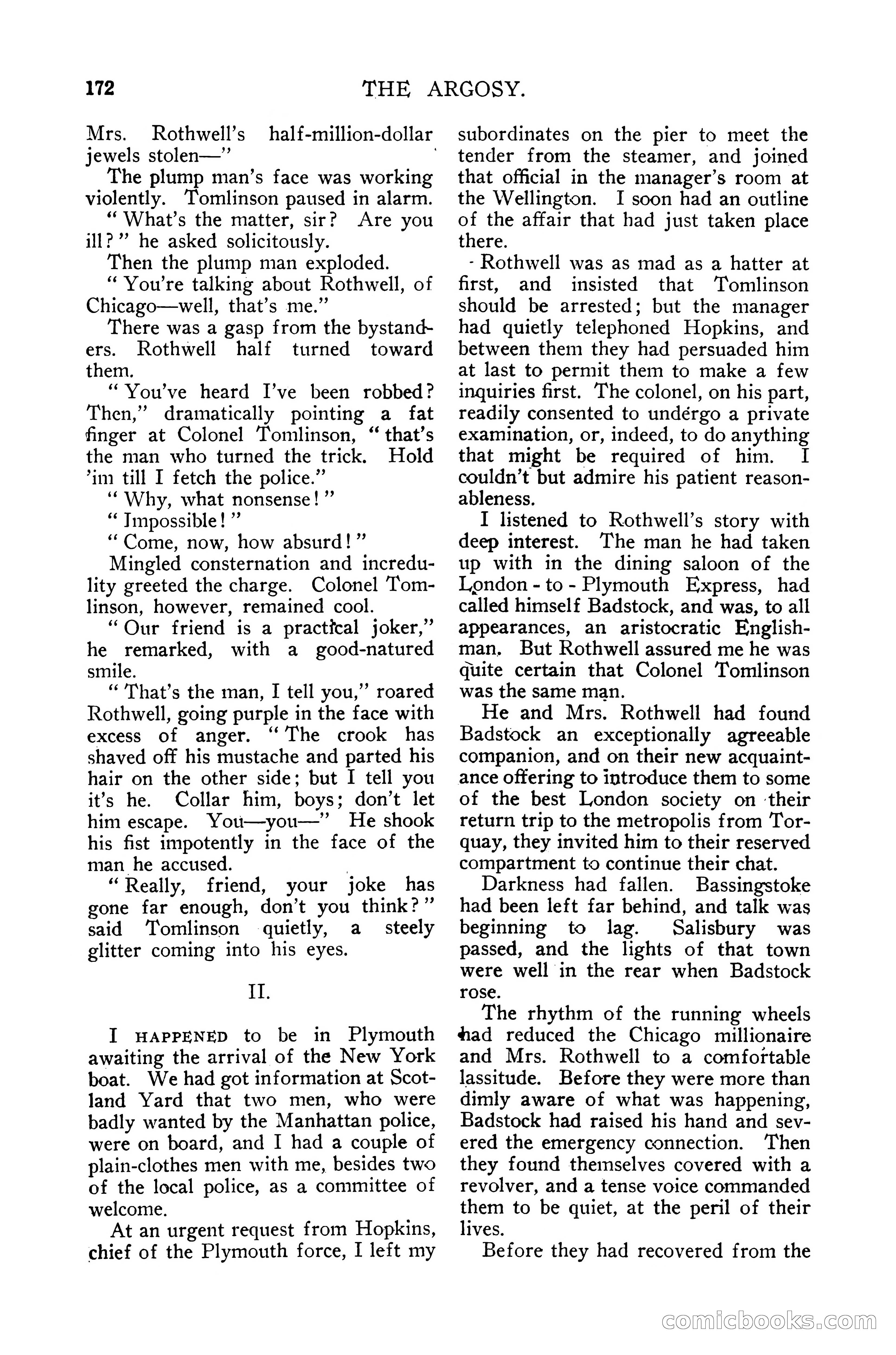
A restored page from Pulp Fiction, 1912. Page through the whole issue in the reader above.
📄 Transcribed text from this page (OCR, searchable)
Machine-transcribed from the original scan — historical spelling and the odd misread are preserved.
172 Mrs. Rothwell’s half-million-dollar jewels stolen—”’ The plump man’s face was working violently. ‘Tomlinson paused in alarm. ““What’s the matter, sir? Are you ill?” he asked solicitously. Then the plump man exploded. “You're talking about Rothwell, of Chicago—well, that’s me.” There was a gasp from the bystand- ers. Rothwell half turned toward them. “You've heard I’ve been robbed? Then,” dramatically pointing a fat finger at Colonel Tomlinson, “ that’s the man who turned the trick. Hold "im till I fetch the police.” ‘“Why, what nonsense! ” “‘Tmpossible! ” ““Come, now, how absurd! ”’ Mingled consternation and incredu- lity greeted the charge. Colonel Tom- linson, however, remained cool. “Our friend is a practical joker,” he remarked, with a good-natured smile. “ That’s the man, I tell you,” roared Rothwell, going purple in the face with excess of anger. “The crook has shaved off his mustache and parted his hair on the other side; but I tell you it’s he. Collar him, boys; don’t let him escape. You—you—’ He shook his fist impotently in the face of the man he accused. | “Really, friend, your joke has gone far enough, don’t you think?” said ‘Tomlinson quietly, a _ steely glitter coming into his eyes. II. I HAPPENED to be in Plymouth awaiting the arrival of the New York boat. We had got information at Scot- land Yard that two men, who were badly wanted by the Manhattan police, were on board, and I had a couple of plain-clothes men with me, besides two of the local police, as a committee of welcome. At an urgent request from Hopkins, chief of the Plymouth force, I left my THE ARGOSY. subordinates on the pier to meet the tender from the steamer, and joined that official in the manager’s room at the Wellington. I soon had an outline of the affair that had just taken place there. - Rothwell was as mad as a hatter at first, and insisted that ‘Tomlinson should be arrested; but the manager had quietly telephoned Hopkins, and between them they had persuaded him at last to permit them to make a few inquiries first. The colonel, on his part, readily consented to undérgo a private examination, or, indeed, to do anything that might be required of him. I couldn’t but admire his patient reason- ableness. I listened to Rothwell’s story with deep interest. The man he had taken up with in the dining saloon of the London - to - Plymouth Express, had called himself Badstock, and was, to all appearances, an aristocratic English- man. But Rothwell assured me he was quite certain that Colonel Tomlinson was the same man. He and Mrs. Rothwell had found Badstock an exceptionally agreeable companion, and on their new acquaint- ance offering to introduce them to some of the best London society on their return trip to the metropolis from Tor- quay, they invited him to their reserved compartment to continue their chat. Darkness had fallen. Bassingstoke had been left far behind, and talk was beginning to lag. Salisbury was passed, and the lights of that town were well in the rear when Badstock rose. The rhythm of the running wheels had reduced the Chicago millionaire and Mrs. Rothwell to a comfortable lassitude. Before they were more than dimly aware of what was happening, Badstock had raised his hand and sev- ered the emergency connection. Then they found themselves covered with a revolver, and a tense voice commanded them to be quiet, at the peril of their lives. Before they had recovered from the oO COMmMiclhoo S CO