
Pulp Fiction, 1912 · page 18 of 276
The Argosy, Christmas 1912 — page 18: what you’re looking at
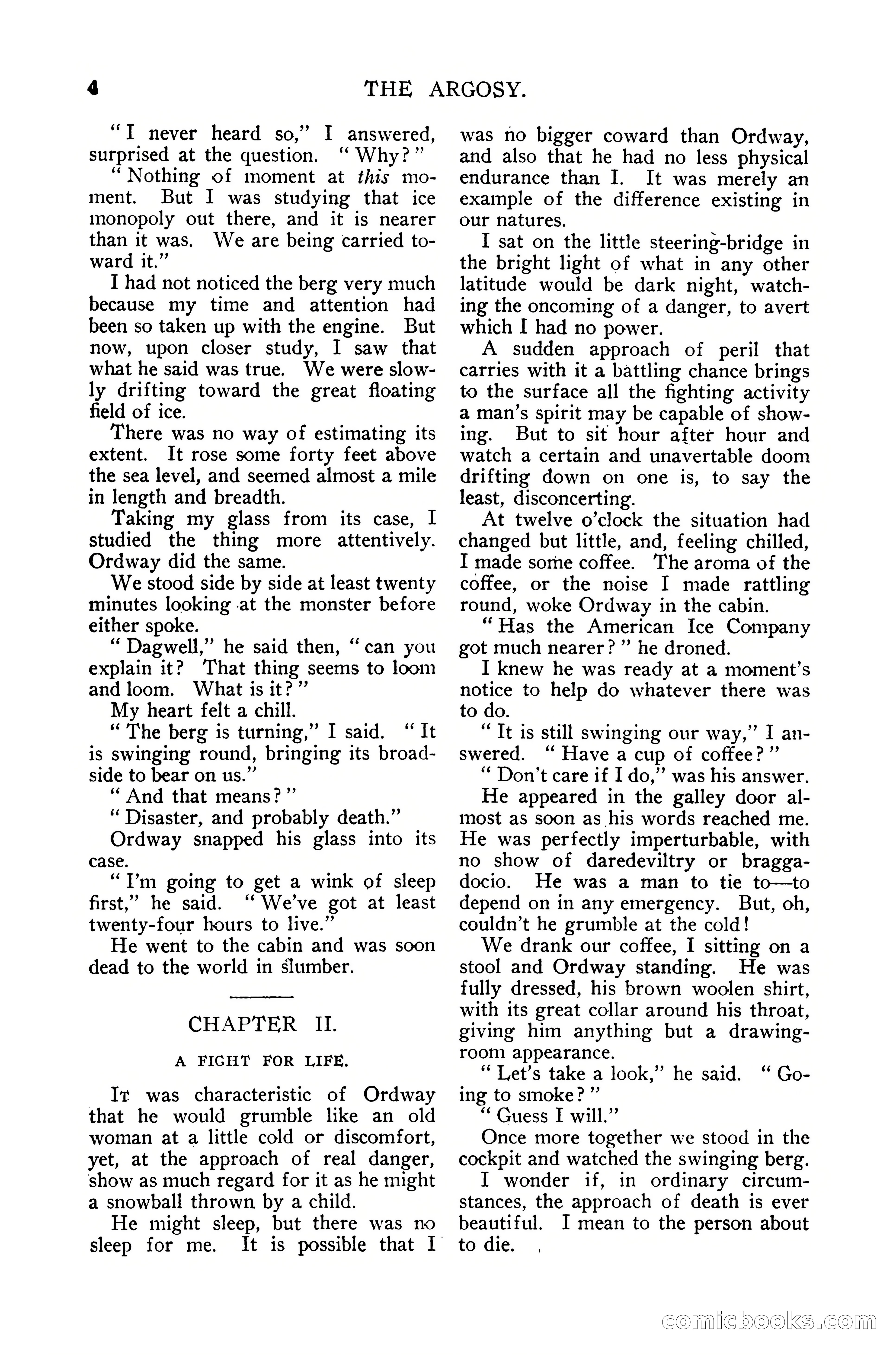
A restored page from Pulp Fiction, 1912. Page through the whole issue in the reader above.
📄 Transcribed text from this page (OCR, searchable)
Machine-transcribed from the original scan — historical spelling and the odd misread are preserved.
“T never heard so,” I answered, surprised at the question. “ Why?” ‘Nothing of moment at this mo- ment. But I was studying that ice monopoly out there, and it is nearer than it was. We are being carried to- ward it.” I had not noticed the berg very much because my time and attention had been so taken up with the engine. But now, upon closer study, I saw that what he said was true. We were slow- ly drifting toward the great floating field of ice. There was no way of estimating its extent. It rose some forty feet above the sea level, and seemed almost a mile in length and breadth. Taking my glass from its case, I studied the thing more attentively. Ordway did the same. We stood side by side at least twenty minutes looking at the monster before either spoke. “ Dagwell,” he said then, “can you explain it? That thing seems to loom and loom. What is it?” My heart felt a chill. “The berg is turning,” I said. “It is swinging round, bringing its broad- side to bear on us.” “And that means?” ‘Disaster, and probably death.” Ordway snapped his glass into its case. “Tm going to get a wink of sleep first,” he said. “ We've got at least twenty-four hours to live.” He went to the cabin and was soon dead to the world in slumber. CHAPTER ILI. A FIGHT FOR LIFE. It was characteristic of Ordway that he would grumble like an old woman at a little cold or discomfort, yet, at the approach of real danger, show as much regard for it as he might a snowball thrown by a child. He might sleep, but there was no sleep for me. It is possible that I THE ARGOSY. was no bigger coward than Ordway, and also that he had no less physical endurance than I. It was merely an example of the difference existing in our natures. I sat on the little steering-bridge in the bright light of what in any other latitude would be dark night, watch- ing the oncoming of a danger, to avert which I had no power. A sudden approach of peril that carries with it a battling chance brings to the surface all the fighting activity a man’s spirit may be capable of show- ing. But to sit hour after hour and watch a certain and unavertable doom drifting down on one is, to say the least, disconcerting. At twelve o’clock the situation had changed but little, and, feeling chilled, I made some coffee. The aroma of the coffee, or the noise I made rattling round, woke Ordway in the cabin. “Has the American Ice Company got much nearer?” he droned. I knew he was ready at a moment's notice to help do whatever there was to do. “It is still swinging our way,” I an- swered. “ Have a cup of coffee? ”’ “Don’t care if I do,” was his answer. He appeared in the galley door al- most as soon as his words reached me. He was perfectly imperturbable, with no show of daredeviltry or bragga- docio. He was a man to tie to—to depend on in any emergency. But, oh, couldn’t he grumble at the cold! We drank our coffee, I sitting on a stool and Ordway standing. He was fully dressed, his brown woolen shirt, with its great collar around his throat, giving him anything but a drawing- room appearance. “‘ Let’s take a look,” he said. ing to smoke? ” “Guess I will.” Once more together we stood in the cockpit and watched the swinging berg. I wonder if, in ordinary circum- stances, the approach of death is ever beautiful. I mean to the person about to die. “ Go- CoOMmicbook CO