
Pulp Fiction, 1912 · page 16 of 276
The Argosy, Christmas 1912 — page 16: what you’re looking at
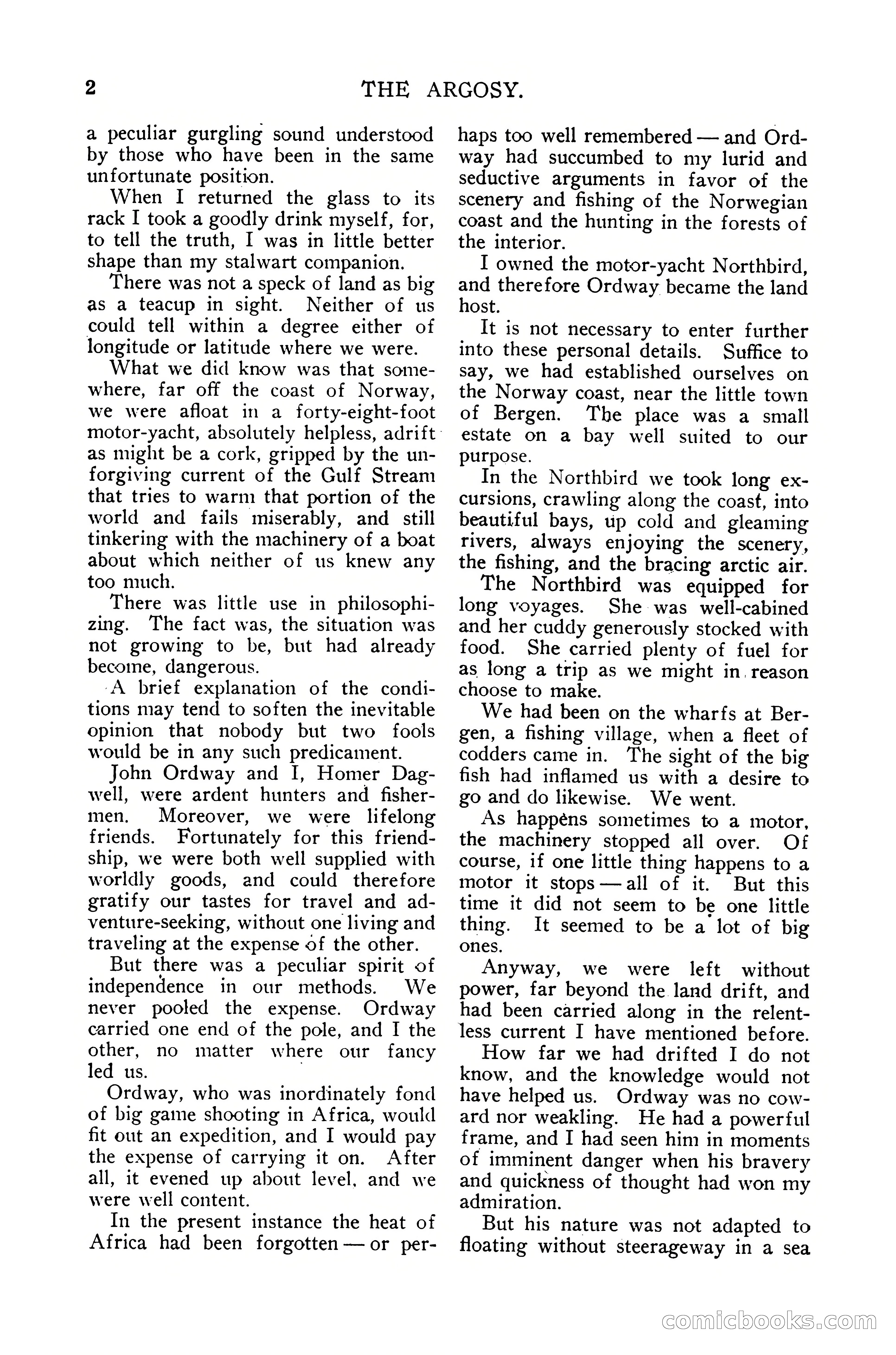
A restored page from Pulp Fiction, 1912. Page through the whole issue in the reader above.
📄 Transcribed text from this page (OCR, searchable)
Machine-transcribed from the original scan — historical spelling and the odd misread are preserved.
2 THE ARGOSY. a peculiar gurgling sound understood by those who have been in the same unfortunate position. When I returned the glass to its rack I took a goodly drink myself, for, to tell the truth, I was in little better shape than my stalwart companion. There was not a speck of land as big as a teacup in sight. Neither of us could tell within a degree either of longitude or latitude where we were. What we did know was that some- where, far off the coast of Norway, we were afloat in a forty-eight-foot motor-yacht, absolutely helpless, adrift: as might be a cork, gripped by the un- forgiving current of the Gulf Stream that tries to warm that portion of the world and fails miserably, and _ still tinkering with the machinery of a boat about which neither of us knew any too much. There was little use in philosophi- zing. The fact was, the situation was not growing to be, but had already become, dangerous. ‘A brief explanation of the condi- tions may tend to soften the inevitable opinion that nobody but two fools would be in any such predicament. John Ordway and I, Homer Dag- well, were ardent hunters and fisher- men. Moreover, we were lifelong friends. Fortunately for this friend- ship, we were both well supplied with worldly goods, and could therefore gratify our tastes for travel and ad- venture-seeking, without one living and traveling at the expense of the other. But there was a peculiar spirit of independence in our methods. We never pooled the expense. Ordway carried one end of the pole, and I the other, no matter where our fancy led us. | Ordway, who was inordinately fond of big game shooting in Africa, would fit out an expedition, and I would pay the expense of carrying it on. After all, it evened up about level, and we were well content. In the present instance the heat of Africa had been forgotten — or per- haps too well remembered — and Ord- way had succumbed to my lurid and seductive arguments in favor of the scenery and fishing of the Norwegian coast and the hunting in the forests of the interior. I owned the motor-yacht Northbird, and therefore Ordway became the land host. It is not necessary to enter further into these personal details. Suffice to say, we had established ourselves on the Norway coast, near the little town of Bergen. The place was a small estate on a bay well suited to our purpose. In the Northbird we took long ex- cursions, crawling along the coast, into beautiful bays, up cold and gleaming rivers, always enjoying the scenery, the fishing, and the bracing arctic air. The Northbird was equipped for long voyages. She was well-cabined and her cuddy generously stocked with food. She carried plenty of fuel for as long a trip as we might in, reason choose to make. We had been on the wharfs at Ber- gen, a fishing village, when a fleet of codders came in. The sight of the big fish had inflamed us with a desire to go and do likewise. We went. As happéns sometimes to a motor, the machinery stopped all over. Of course, if one little thing happens to a motor it stops—all of it. But this time it did not seem to be one little thing. It seemed to be a lot of big ones. Anyway, we were left without power, far beyond the land drift, and had been carried along in the relent- less current I have mentioned before. How far we had drifted I do not know, and the knowledge would not have helped us. Ordway was no cow- ard nor weakling. He had a powerful frame, and I had seen him in moments of imminent danger when his bravery and quickness of thought had won my admiration. But his nature was not adapted to floating without steerageway in a sea CoOMmicbook CO