
Pulp Fiction, 1912 · page 133 of 276
The Argosy, Christmas 1912 — page 133: what you’re looking at
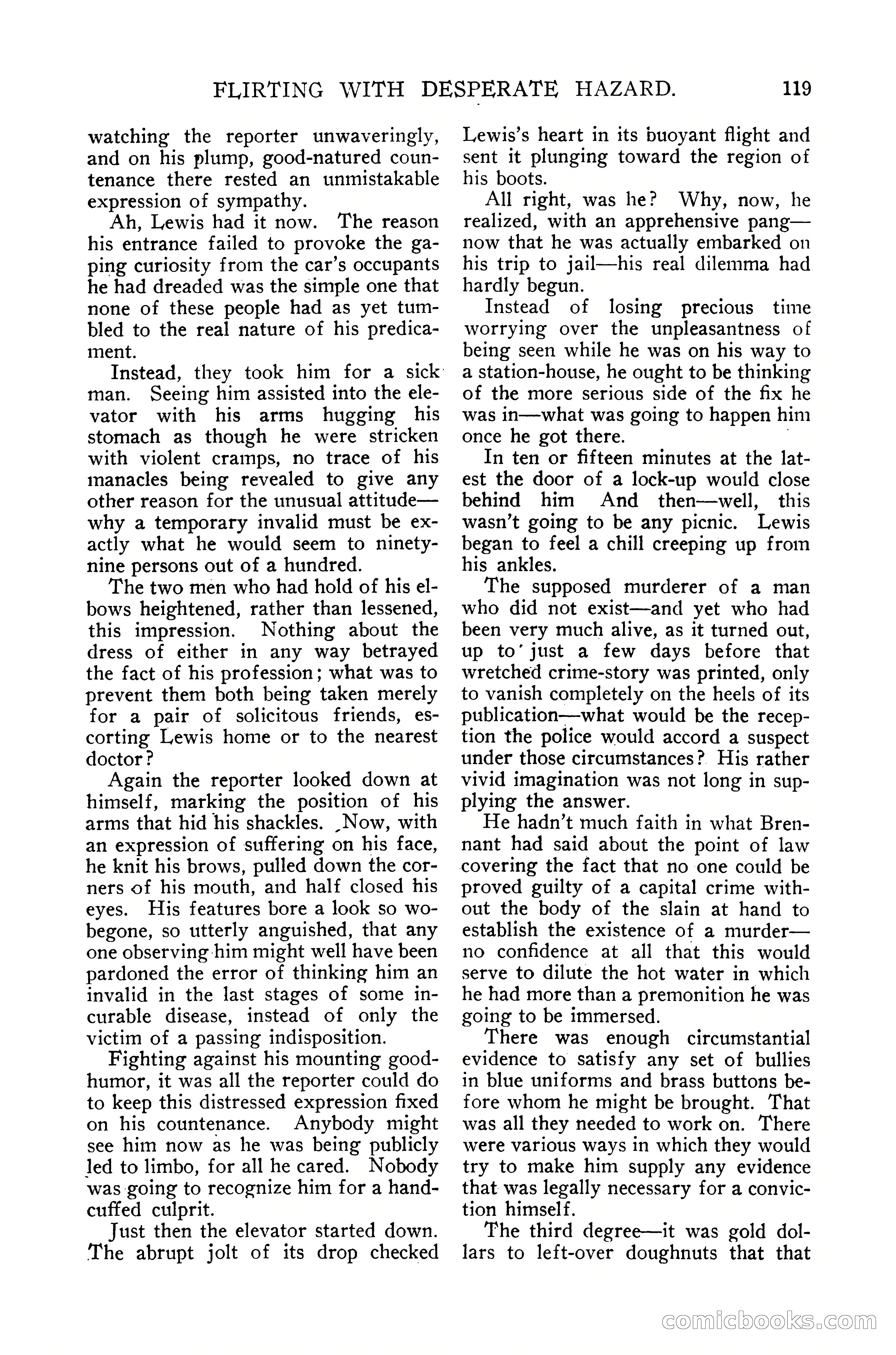
A restored page from Pulp Fiction, 1912. Page through the whole issue in the reader above.
📄 Transcribed text from this page (OCR, searchable)
Machine-transcribed from the original scan — historical spelling and the odd misread are preserved.
FLIRTING WITH DESPERATE HAZARD. watching the reporter unwaveringly, and on his plump, good-natured coun- tenance there rested an unmistakable expression of sympathy. Ah, Lewis had it now. The reason his entrance failed to provoke the ga- ping curiosity from the car’s occupants he had dreaded was the simple one that none of these people had as yet tum- bled to the real nature of his predica- ment. Instead, they took him for a sick man. Seeing him assisted into the ele- vator with his arms hugging his stomach as though he were stricken with violent cramps, no trace of his manacles being revealed to give any other reason for the unusual attitude— why a temporary invalid must be ex- actly what he would seem to ninety- nine persons out of a hundred. The two men who had hold of his el- bows heightened, rather than lessened, this impression. Nothing about the dress of either in any way betrayed the fact of his profession; what was to prevent them both being taken merely for a pair of solicitous friends, es- corting Lewis home or to the nearest doctor? Again the reporter looked down at himself, marking the position of his arms that hid his shackles. Now, with an expression of suffering on his face, he knit his brows, pulled down the cor- ners of his mouth, and half closed his eyes. His features bore a look so wo- begone, so utterly anguished, that any one observing him might well have been pardoned the error of thinking him an invalid in the last stages of some in- curable disease, instead of only the victim of a passing indisposition. Fighting against his mounting good- humor, it was all the reporter could do to keep this distressed expression fixed on his countenance. Anybody might see him now as he was being publicly led to limbo, for all he cared. Nobody was going to recognize him for a hand- cuffed culprit. Just then the elevator started down. The abrupt jolt of its drop checked 119 Lewis’s heart in its buoyant flight and sent it plunging toward the region of his boots. All right, was he? Why, now, he realized, with an apprehensive pang— now that he was actually embarked on his trip to jail—his real dilemma had hardly begun. Instead of losing precious time worrying over the unpleasantness of being seen while he was on his way to a station-house, he ought to be thinking of the more serious side of the fix he was in—what was going to happen him once he got there. | In ten or fifteen minutes at the lat- est the door of a lock-up would close behind him And _ then—well, this wasn’t going to be any picnic. Lewis began to feel a chill creeping up from his ankles. The supposed murderer of a man who did not exist—and yet who had been very much alive, as it turned out, up to’ just a few days before that wretched crime-story was printed, only to vanish completely on the heels of its publication—what would be the recep- tion the police would accord a suspect under those circumstances? His rather vivid imagination was not long in sup- plying the answer. He hadn’t much faith in what Bren- nant had said about the point of law covering the fact that no one could be proved guilty of a capital crime with- out the body of the slain at hand to establish the existence of a murder— no confidence at all that this would serve to dilute the hot water in which he had more than a premonition he was going to be immersed. There was enough circumstantial evidence to satisfy any set of bullies in blue uniforms and brass buttons be- fore whom he might be brought. That was all they needed to work on. There were various ways in which they would try to make him supply any evidence that was legally necessary for a convic- tion himself. The third degree—it was gold dol- lars to left-over doughnuts that that oO cComicbooks CO