
Pulp Fiction, 1912 · page 111 of 276
The Argosy, Christmas 1912 — page 111: what you’re looking at
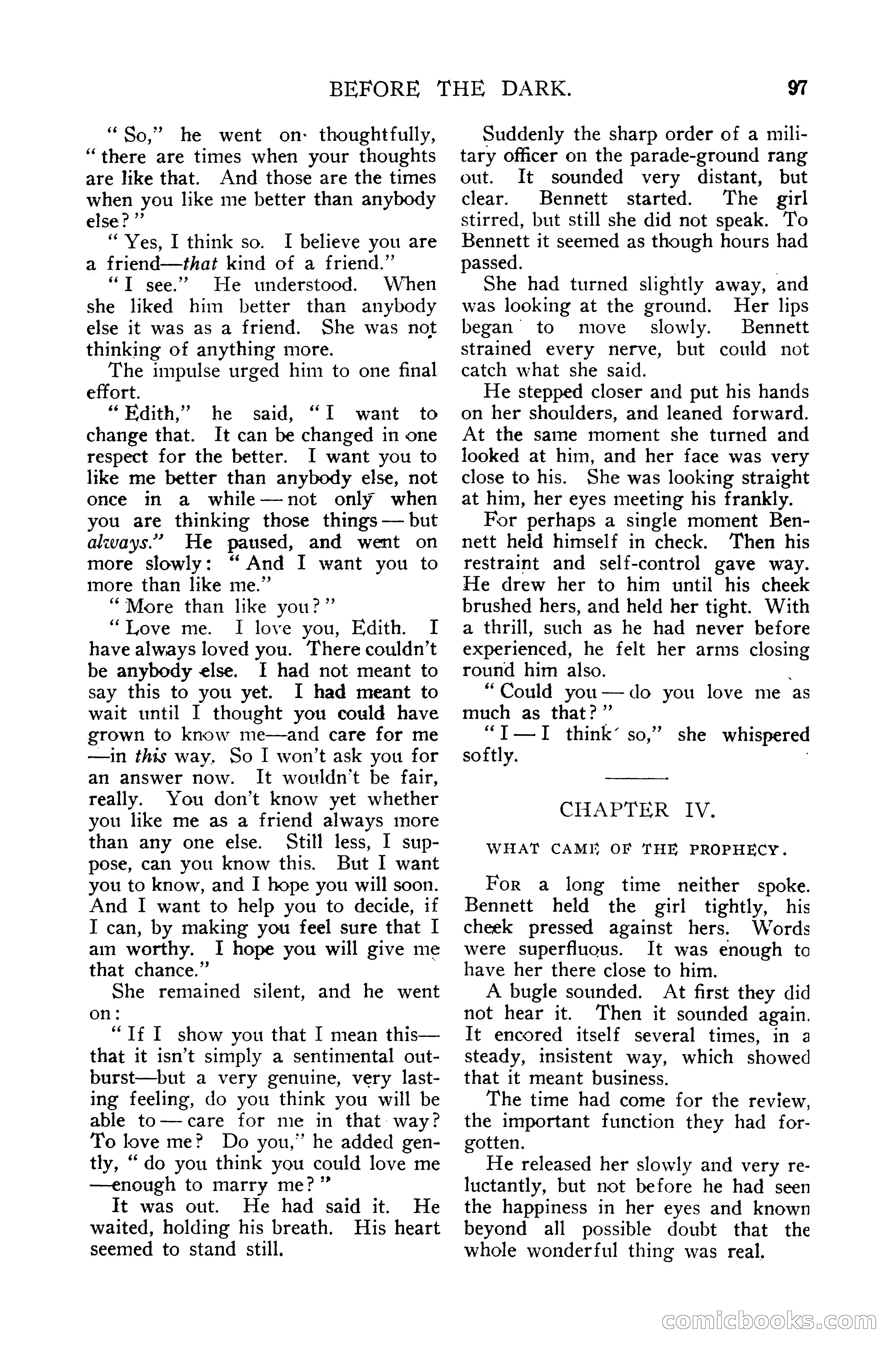
A restored page from Pulp Fiction, 1912. Page through the whole issue in the reader above.
📄 Transcribed text from this page (OCR, searchable)
Machine-transcribed from the original scan — historical spelling and the odd misread are preserved.
BEFORE THE DARK. “So,” he went on- thoughtfully, “there are times when your thoughts are like that. And those are the times when you like me better than anybody else?” “Yes, I think so. I believe you are a friend—that kind of a friend.” “T see.” He understood. When she liked him better than anybody else it was as a friend. She was not thinking of anything more. The impulse urged him to one final effort. “Edith,” he said, “I want to change that. It can be changed in one respect for the better. I want you to like me better than anybody else, not once in a while—not only when you are thinking those things — but always.’ He paused, and went on more slowly: “ And I want you to more than like me.” “More than like you?” “Love me. I love you, Edith. I have always loved you. There couldn’t be anybody else. I had not meant to say this to you yet. I had meant to wait until I thought you could have grown to know me—and care for me —in this way. So I won’t ask you for an answer now. It wouldn't be fair, really. You don’t know yet whether you like me as a friend always more than any one else. Still less, I sup- pose, can you know this. But I want you to know, and I hope you will soon. And I want to help you to decide, if I can, by making you feel sure that I am worthy. I hope you will give me that chance.” She remained silent, and he went on: “Tf I show you that I mean this— that it isn’t simply a sentimental out- burst—but a very genuine, very last- ing feeling, do you think you will be able to—care for me in that way? To love me? Do you,” he added gen- tly, “do you think you could love me —enough to marry me?” It was out. He had said it. He waited, holding his breath. His heart seemed to stand still. 97 Suddenly the sharp order of a mili- tary officer on the parade-ground rang out. It sounded very distant, but clear. Bennett started. The girl stirred, but still she did not speak. To Bennett it seemed as though hours had passed. | | She had turned slightly away, and was looking at the ground. Her lips began to move slowly. Bennett strained every nerve, but could not catch what she said. He stepped closer and put his hands on her shoulders, and leaned forward. At the same moment she turned and looked at him, and her face was very close to his. She was looking straight at him, her eyes meeting his frankly. For perhaps a single moment Ben- nett held himself in check. ‘Then his restraint and self-control gave way. He drew her to him until his cheek brushed hers, and held her tight. With a thrill, such as he had never before experienced, he felt her arms closing round him also. : “Could you—do you love me as much as that?” “T—I_ think’ so,” she whispered softly. : CHAPTER IV. WHAT CAME OF THE PROPHECY. For a long time neither spoke. Bennett held the girl tightly, his cheek pressed against hers. Words were superfluous. It was enough to have her there close to him. A bugle sounded. At first they did not hear it. Then it sounded again. It encored itself several times, in a steady, insistent way, which showed that 1t meant business. The time had come for the review, the important function they had for- gotten. He released her slowly and very re- luctantly, but not before he had seen the happiness in her eyes and known beyond all possible doubt that the whole wonderful thing was real. oO CoOMmicbook CO