
Pulp Fiction, 1912 · page 102 of 276
The Argosy, Christmas 1912 — page 102: what you’re looking at
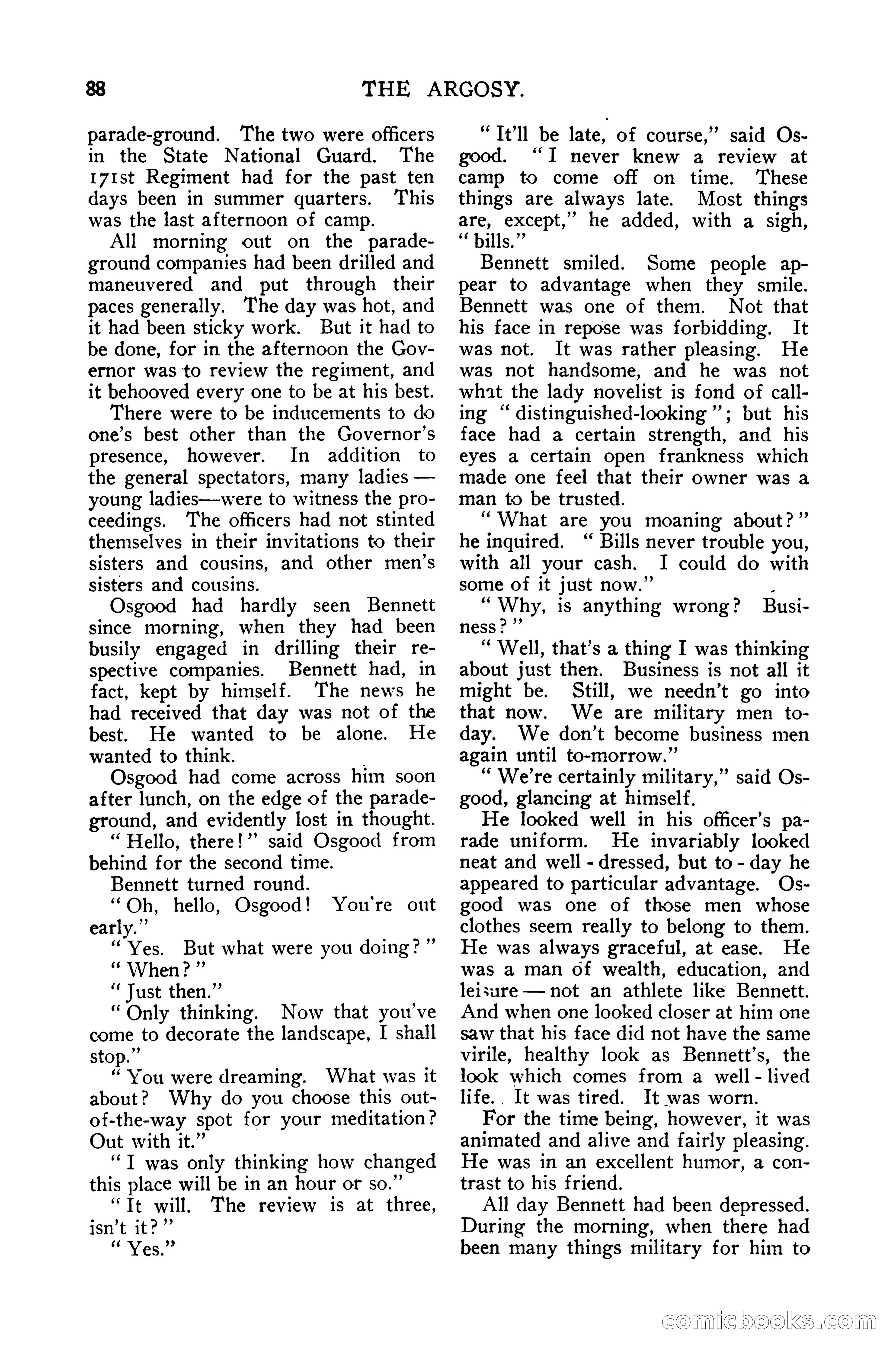
A restored page from Pulp Fiction, 1912. Page through the whole issue in the reader above.
📄 Transcribed text from this page (OCR, searchable)
Machine-transcribed from the original scan — historical spelling and the odd misread are preserved.
88 parade-ground. The two were officers in the State National Guard. The 171st Regiment had for the past ten days been in summer quarters. This was the last afternoon of camp. All morning out on the parade- ground companies had been drilled and maneuvered and put through their paces generally. The day was hot, and it had been sticky work. But it had to be done, for in the afternoon the Gov- ernor was to review the regiment, and it behooved every one to be at his best. There were to be inducements to do one’s best other than the Governor's presence, however. In addition to the general spectators, many ladies — young ladies—were to witness the pro- ceedings. The officers had not stinted themselves in their invitations to their sisters and cousins, and other men’s sisters and cousins. Osgood had hardly seen Bennett since morning, when they had been busily engaged in drilling their re- spective companies. Bennett had, in fact, kept by himself. The news he had received that day was not of the best. He wanted to be alone. He wanted to think. Osgood had come across him soon after lunch, on the edge of the parade- ground, and evidently lost in thought. “ Hello, there!’’ said Osgood from behind for the second time. Bennett turned round. ‘Oh, hello, Osgood! early.” “Yes. But what were you doing? ”’ “When?” “Just then.” “Only thinking. Now that you’ve come to decorate the landscape, I shall stop.” “You were dreaming. What was it about? Why do you choose this out- of-the-way spot for your meditation? Out with it.” ‘“T was only thinking how changed this place will be in an hour or so.” “Tt will. The review is at three, isn’t it?” 66 Yes.” You're out THE ARGOSY. “It'll be late, of course,” said Os- good. “I never knew a review at camp to come off on time. These things are always late. Most things are, except,’ he added, with a sigh, “bills.” Bennett smiled. Some people ap- pear to advantage when they smile. Bennett was one of them. Not that his face in repose was forbidding. It was not. It was rather pleasing. He was not handsome, and he was not what the lady novelist is fond of call- ing “ distinguished-looking ”; but his face had a certain strength, and his eyes a certain open frankness which made one feel that their owner was a man to be trusted. “What are you moaning about?” he inquired. “ Bills never trouble you, with all your cash. I could do with some of it just now.” “Why, is anything wrong? ness?” “Well, that’s a thing I was thinking about just then. Business is not all it might be. Still, we needn’t go into that now. We are military men to- day. We don’t become business men again until to-morrow.” “We're certainly military,” said Os- good, glancing at himself. He looked well in his officer’s pa- rade uniform. He invariably looked neat and well - dressed, but to - day he appeared to particular advantage. Os- good was one of those men whose clothes seem really to belong to them. He was always graceful, at ease. He was a man of wealth, education, and leisure — not an athlete like Bennett. And when one looked closer at him one saw that his face did not have the same virile, healthy look as Bennett’s, the look which comes from a well - lived life.. It was tired. It was worn. For the time being, however, it was animated and alive and fairly pleasing. He was in an excellent humor, a con- trast to his friend. All day Bennett had been depressed. During the morning, when there had been many things military for him to Busi- CoOMmicbook CO