
Pulp Fiction, 1909 · page 96 of 227
The Argosy for May — page 96: what you’re looking at
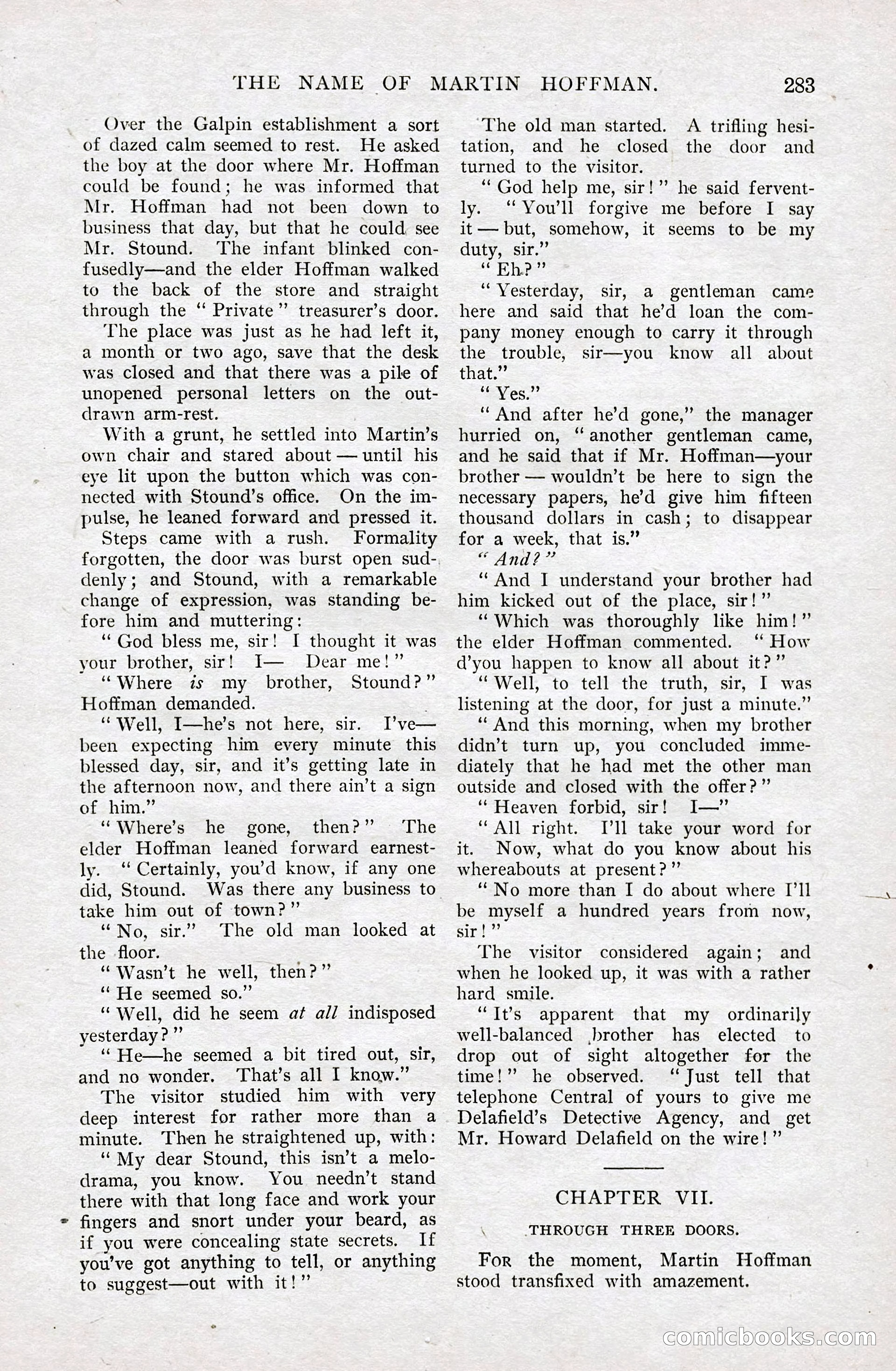
A restored page from Pulp Fiction, 1909. Page through the whole issue in the reader above.
📄 Transcribed text from this page (OCR, searchable)
Machine-transcribed from the original scan — historical spelling and the odd misread are preserved.
THE NAME OF Over the Galpin establishment a sort of dazed calm seemed to rest. He asked the boy at the door where Mr. Hoffman could be found; he was informed that Mr. Hoffman had not been down to business that day, but that he could see Mr. Stound. The infant blinked con- fusedly—and the elder Hoffman walked to the back of the store and _ straight through the “ Private” treasurer’s door. The place was just as he had left it, a month or two ago, save that the desk was closed and that there was a pile of unopened personal letters on the out- drawn arm-rest. With a grunt, he settled into Martin’s own chair and stared about — until his eye lit upon the button which was con- nected with Stound’s office. On the im- pulse, he leaned forward and pressed it. Steps came with a rush. Formality forgotten, the door was burst open sud- denly; and Stound, with a remarkable change of expression, was standing be- fore him and muttering: ‘““God bless me, sir! I thought it was your brother, sir! I— Dear me!” ‘Where is my brother, Stound?” Hoffman demanded. . ‘Well, I—he’s not here, sir. I’ve— been expecting him every minute this blessed day, sir, and it’s getting late in the afternoon now, and there ain’t a sign of him.” ‘““Where’s he gone, then?” The elder Hoffman leaned forward earnest- ly. ‘Certainly, you’d know, if any one did, Stound. Was there any business to take him out of town?” “No, sir.’ The old man looked at the floor. “Wasn't he well, then?” “He seemed so.” “ Well, did he seem aé all indisposed yesterday?” ‘““ He—he seemed a bit tired out, sir, and no wonder. ‘That’s all I know.” The visitor studied him with very deep interest for rather more than a minute. Then he straightened up, with: “My dear Stound, this isn’t a melo- drama, you know. You needn’t stand there with that long face and work your fingers and snort under your beard, as if you were concealing state secrets. If you’ve got anything to tell, or anything to suggest—out with it!” ray MARTIN HOFFMAN. 283 The old man started. A trifling hesi- tation, and he closed the door and turned to the visitor. ‘““God help me, sir!”’ he said fervent- ly. “You'll forgive me before I say it — but, somehow, it seems to be my duty, sir.” ¢¢ Eh? 2? “ Yesterday, sir, a gentleman came here and said that he’d loan the com- pany money enough to carry it through the trouble, sir—you know all about that.” (7 Yes.”’ “And after he’d gone,” the manager hurried on, “another gentleman came, and he said that if Mr. Hoffman—your brother — wouldn’t be here to sign the necessary papers, he’d give him fifteen thousand dollars in cash; to disappear for a week, that is.” And? ‘“And I understand your brother had him kicked out of the place, sir!” “Which was thoroughly like him!” the elder Hoffman commented. “ How d’you happen to know all about it?” “Well, to tell the truth, sir, I was listening at the door, for just a minute.” ‘And this morning, when my brother didn’t turn up, you concluded imme- diately that he had met the other man outside and closed with the offer?” ‘Heaven forbid, sir! I—” “All right. Pll take your word for it. Now, what do you know about his whereabouts at present?” ‘No more than I do about where I'll be myself a hundred years from now, sir!” The visitor considered again; and when he looked up, it was with a rather hard smile. “It’s apparent that my ordinarily well-balanced brother has elected to drop out of sight altogether for the time!” he observed. ‘Just tell that telephone Central of yours to give me Delafield’s Detective Agency, and get Mr. Howard Delafield on the wire! ” CHAPTER VII. ‘THROUGH THREE DOORS. For the moment, Martin Hoffman stood transfixed with amazement. COnniclo@ool< (c©)