
Pulp Fiction, 1909 · page 72 of 227
The Argosy for May — page 72: what you’re looking at
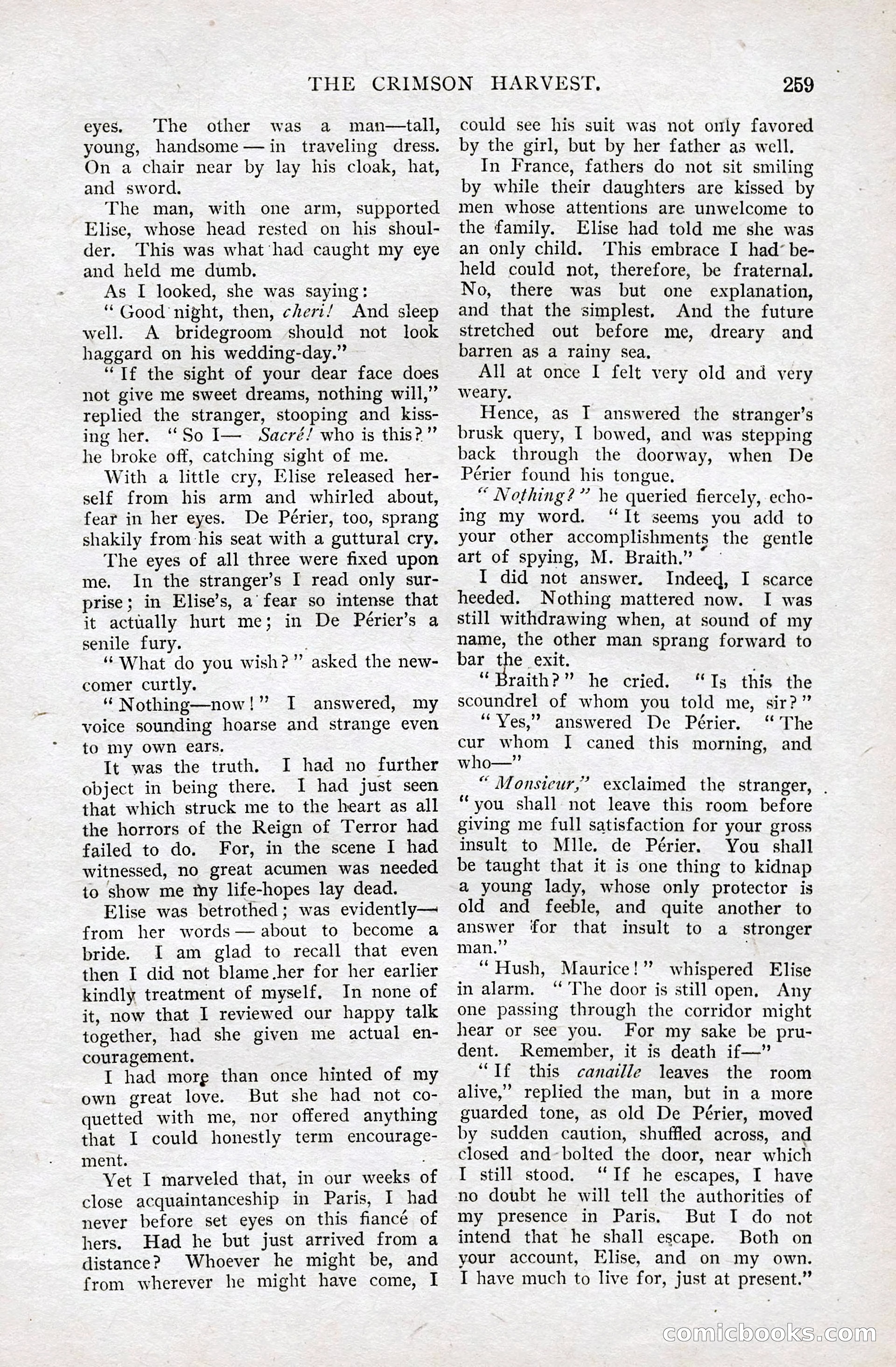
A restored page from Pulp Fiction, 1909. Page through the whole issue in the reader above.
📄 Transcribed text from this page (OCR, searchable)
Machine-transcribed from the original scan — historical spelling and the odd misread are preserved.
THE CRIMSON eyes. The other was a man—tall, young, handsome —in traveling dress. On a chair near by lay his cloak, hat, and sword. The man, with one arm, supported Elise, whose head rested on his shoul- der. This was what had caught my eye and held me dumb. As I looked, she was saying: “ Good night, then, chert! And sleep well. A bridegroom should not look haggard on his wedding-day.” ‘Tf the sight of your dear face does not give me sweet dreams, nothing will,” replied the stranger, stooping and kiss- ing her. ‘‘So I— Sacré! who is this?” he broke off, catching sight of me. With a little cry, Elise released her- self from his arm and whirled about, fear in her eyes. De Périer, too, sprang shakily from-his seat with a guttural cry. The eyes of all three were fixed upon me. In the stranger’s I read only sur- prise; in Elise’s, a’ fear so intense that it actually hurt me; in De Perier’s a senile fury. “What do you wish?” asked the new- comer curtly. ‘“ Nothing—now!” I answered, my voice sounding hoarse and strange even to my own ears. It was the truth. I had no further object in being there. I had just seen that which struck me to the heart as all the horrors of the Reign of Terror had failed to do. For, in the scene I had witnessed, no great acumen was needed to show me my life-hopes lay dead. Elise was betrothed; was evidently— from her words— about to become a bride. I am glad to recall that even then I did not blame.her for her earlier kindly treatment of myself, In none of it, now that I reviewed our happy talk together, had she given me actual en- couragement. I had morg than once hinted of my own great love. But she had not co- quetted with me, nor offered anything that I could honestly term encourage- ment. ; Vet I marveled that, in our weeks o close acquaintanceship in Paris, I had never before set eyes on this fiancé of hers. Had he but just arrived from a distance? Whoever he might be, and from wherever he might have come, I HARVEST. 259 could see his suit was not omly favored by the girl, but by her father as well. In France, fathers do not sit smiling by while their daughters are kissed by men whose attentions are unwelcome to the family. Elise had told me she was an only child. This embrace I had“ be- held could not, therefore, be fraternal. No, there was but one explanation, and that the simplest. And the future stretched out before me, dreary and barren as a rainy sea, All at once I felt very old and very weary. Hence, as I answered the stranger’s brusk query, I bowed, and was stepping back through the doorway, when De Périer found his tongue. “ Nothing?” he queried fiercely, echo- ing my word. “It seems you add to your other accomplishments the gentle art of spying, M. Braith.” I did not answer. Indeed, I scarce heeded. Nothing mattered now. I was still withdrawing when, at sound of my name, the other man sprang forward to bar Ree “ Braith?” he cried. ‘Is this the scoundrel of whom you told me, sir?” “Yes,” answered De Périer. ‘ The cur whom J] caned this morning, and who—” “ Monsieur,’ exclaimed the stranger, . ‘you shall not leave this room before giving me full satisfaction for your gross insult to Mlle. de Périer. You shall be taught that it is one thing to kidnap a young lady, whose only protector is old and feeble, and quite another to answer ‘for that insult to a stronger man.” “Hush, Maurice!” whispered Elise in alarm. “ The door is still open, Any one passing through the corridor might hear or see you. For my sake be pru- dent. Remember, it is death if—” “If this canaille leaves the room alive,’ replied the man, but in a more guarded tone, as old De Périer, moved by sudden caution, shuffled across, and closed and-bolted the door, near which I still stood. “If he escapes, I have no doubt he will tell the authorities of my presence in Paris. But I do not intend that he shall escape. Both on your account, Elise, and on my own. I have much to live for, just at present.” Co@nnicloookxs (CO)