
Pulp Fiction, 1909 · page 66 of 227
The Argosy for May — page 66: what you’re looking at
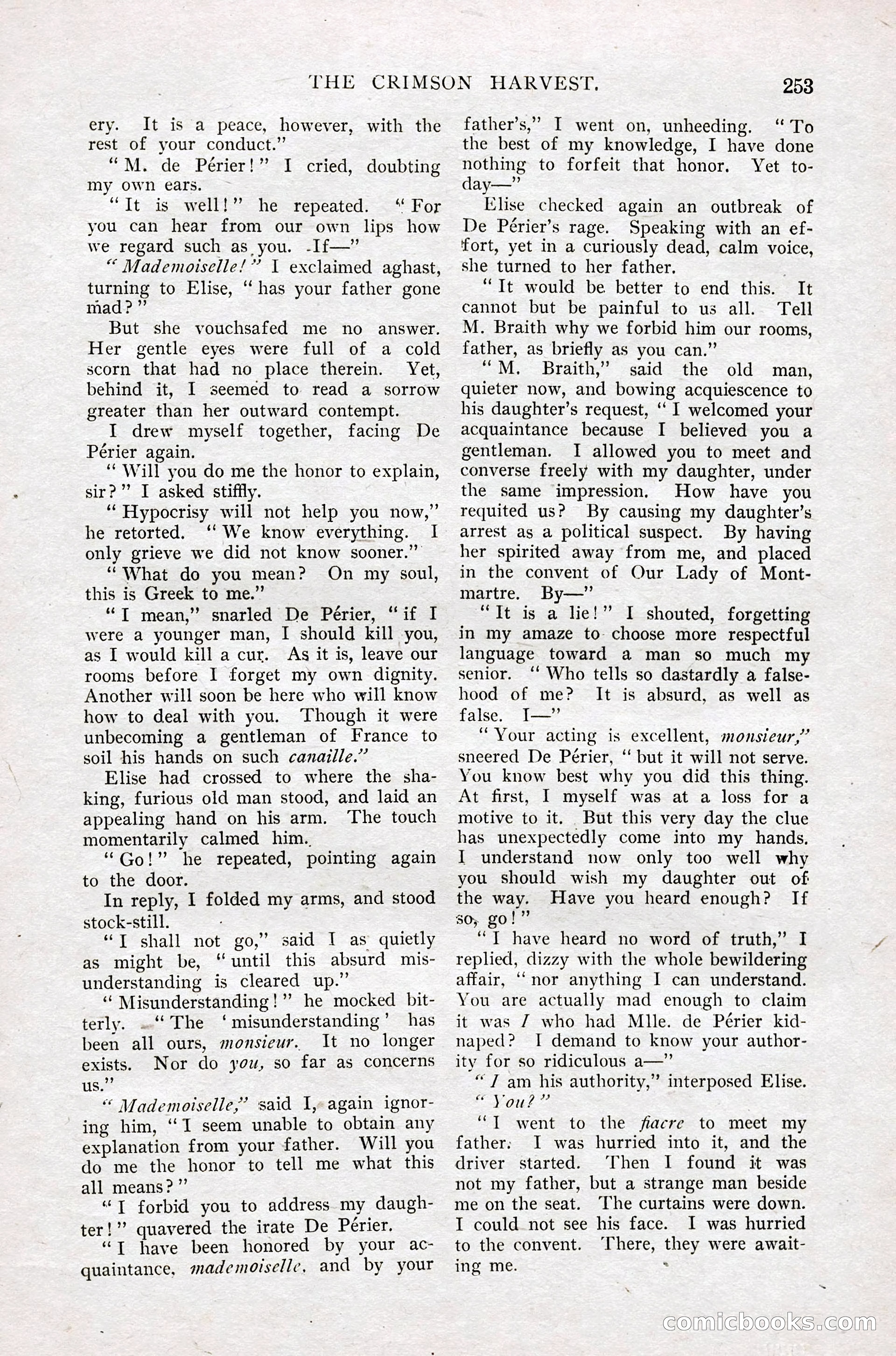
A restored page from Pulp Fiction, 1909. Page through the whole issue in the reader above.
📄 Transcribed text from this page (OCR, searchable)
Machine-transcribed from the original scan — historical spelling and the odd misread are preserved.
THE CRIMSON ery. It is a peace, however, with the rest of your conduct.” ‘“M. de Périer!” I cried, doubting my own ears. “It is well!” he repeated. “ For you can hear from our own lips how we regard such as you. -If—” “ Mademoiselle!’ 1 exclaimed aghast, turning to Elise, “has your father gone mad?” But she vouchsafed me no answer. Her gentle eyes were full of a cold scorn that had no place therein. Yet, behind it, I seemed to read a sorrow greater than her outward contempt. I drew myself together, facing De Peérier again. “Will you do me the honor to explain, sir?’ I asked stiffly. “Hypocrisy will not help you now,” he retorted. ‘‘ We know everything. I only grieve we did not know sooner.” ‘What do you mean? On my soul, this is Greek to me.” “T mean,” snarled De Périer, “if I were a younger man, I should kill you, as I would kill a cur. As it is, leave our rooms before I forget my own dignity. Another will soon be here who will know how to deal with you. Though it were unbecoming a gentleman of France to soil his hands on such canaille.” Elise had crossed to where the sha- king, furious old man stood, and laid an appealing hand on his arm. The touch momentarily calmed him. “Go!” he repeated, pointing again to the door. In reply, I folded my arms, and stood stock-still. “T shall not go,’ said I as quietly as might be, “until this absurd mis- understanding is cleared up.” ‘ Misunderstanding!” he mocked bit- terly. .‘‘ The ‘misunderstanding’ has been all ours, monsieur. It no longer exists. Nor do you, so far as concerns us.”’ “ Mademoiselle,’ said 1, again ignor- ing him, “1 seem unable to obtain any explanation from your father. Will you do me the honor to tell me what this all means? ”’ “T forbid you to address my daugh- ter!’ quavered the irate De Perier. ‘“T have been honored by your ac- quaintance, mademoiselle, and by your HARVEST. 253 father’s,” I went on, unheeding. “To the best of my knowledge, I have done nothing to forfeit that honor. Yet to- day—” Elise checked again an outbreak of De Périer’s rage. Speaking with an ef- fort, yet in a curiously dead, calm voice, she turned to her father. | “It would be better to end this. It cannot but be painful to us all. Tell M. Braith why we forbid him our rooms, father, as briefly as you can.” “M. Braith,” said the old man, quieter now, and bowing acquiescence to his daughter’s request, ‘‘ I welcomed your acquaintance because I believed you a gentleman. I allowed you to meet and converse freely with my daughter, under the same impression, How have you requited us? By causing my daughter’s arrest as a political suspect. By having her spirited away from me, and placed in the convent of Our Lady of Mont- martre. By—” “It is a lie!” I shouted, forgetting in my amaze to choose more respectful language toward a man so much my senior. ‘' Who tells so dastardly a false- hood of me? It is absurd, as well as false. I—” “ Your acting is excellent, monsieur,” sneered De Périer, “‘ but it will not serve. You know best why you did this thing. At first, I myself was at a loss for a motive to it. But this very day the clue has unexpectedly come into my hands, I understand now only too well why you should wish my daughter out of the way. Have you heard enough? If so, go!” ‘“T have heard no word of truth,” I replied, dizzy with the whole bewildering affair, “nor anything I can understand. You are actually mad enough to claim it was 7 who had Mlle. de Périer kid- naped? I demand to know your author- ity for so ridiculous a—”’ “7 am his authority,” interposed Elise. “You? ? “IT went to the fiacre to meet my father: I was hurried into it, and the driver started. ‘Then I found it was not my father, but a strange man beside me on the seat. The curtains were down. I could not see his face. I was hurried to the convent. ‘There, they were await- ing me. . 1OOOL< (C@