
Pulp Fiction, 1909 · page 40 of 227
The Argosy for May — page 40: what you’re looking at
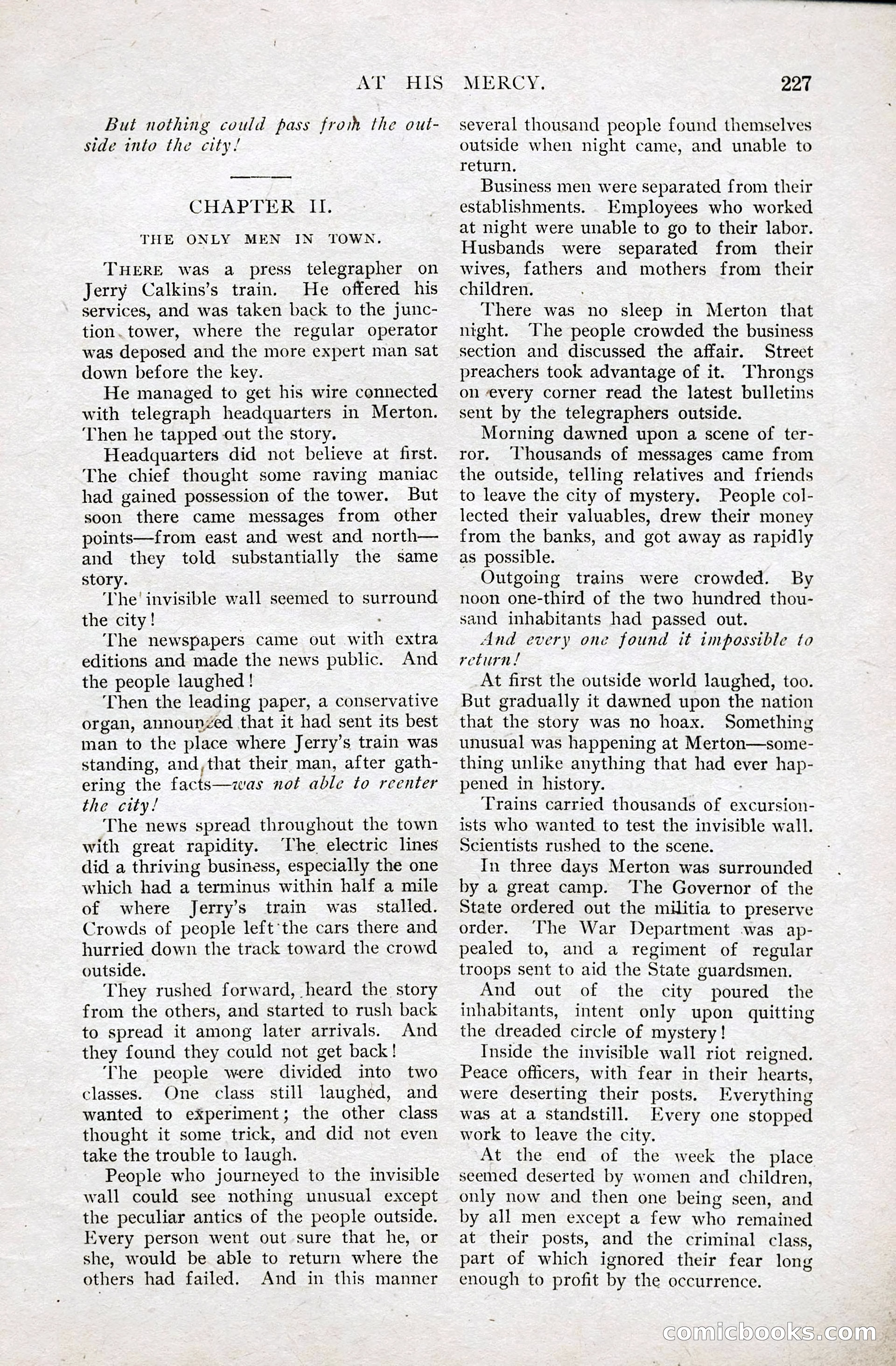
A restored page from Pulp Fiction, 1909. Page through the whole issue in the reader above.
📄 Transcribed text from this page (OCR, searchable)
Machine-transcribed from the original scan — historical spelling and the odd misread are preserved.
AY -HIS But nothing could pass from the out- side into the city! ——— ———__. —— CHAPTER II. THE ONLY MEN IN TOWN. THERE was a press telegrapher on Jerry Calkins’s train. He offered his services, and was taken back to the junc- tion. tower, where the regular operator was deposed and the more expert man sat down before the key. He managed to get his wire connected with telegraph headquarters in Merton. Then he tapped out the story. Headquarters did not believe at first. The chief thought some raving maniac had gained possession of the tower. But soon there came messages from other points—from east and west and north— and they told substantially the same story. The' invisible wall seemed to surround the city! The newspapers came out w ith extra editions and made the news public. And the people laughed ! ‘Then the leading paper, a conservative organ, announzed that it had sent its best man to the place where Jerry’s train was standing, and, that their man, after gath- ering the fac ts—as not able to reenter the city! The news spread throughout the town with great rapidity. The electric lines did a thriving business, especially the one which had a terminus within half a mile of where Jerry’s train was stalled. Crowds of people left’the cars there and hurried down the track toward the crowd outside. They rushed forward, heard the story from the others, and started to rush back to spread it among later arrivals. And they found they could not get back! ‘The people were divided into two classes. One class still laughed, and wanted to experiment; the other class thought it some trick, and did not even take the trouble to laugh. People who journeyed to the invisible wall could see nothing unusual except the peculiar antics of the people outside. ‘very person went out sure that he, or she, would be able to return where the others had failed. And in this manner MERCY. 227 several thousand people found themselves outside when night came, and unable to return. Business men were separated from their establishments. Employees who worked at night were unable to go to their labor. Husbands were separated from their wives, fathers and mothers from their children. There was no sleep in Merton that night. The people crowded the business section and discussed the affair. Street preachers took advantage of it. Throngs on every corner read the latest bulletins sent by the telegraphers outside. Morning dawned upon a scene of ter- ror. ‘Thousands of messages came from the outside, telling relatives and friends to leave the city of mystery. People col- lected their valuables, drew their money from the banks, and got away as rapidly as possible. — Outgoing trains were crowded. By noon one-third of the two hundred thou- sand inhabitants had passed out. And every one found it impossible to return! At first the outside world laughed, too. But gradually it dawned upon the nation that the story was no hoax. Something unusual was happening at Merton—some- thing unlike anything that had ever hap- pened in history. Trains carried thousands of excursion- ists who wanted to test the invisible wall. Scientists rushed to the scene. In three days Merton was surrounded by a great camp. ‘The Governor of the State ordered out the militia to preserve order. The War Department was ap- pealed to, and a regiment of regular troops sent to aid the State guardsmen. And out of the city poured the inhabitants, intent only upon quitting the dreaded circle of mystery! Inside the invisible wall riot reigned. Peace officers, with fear in their hearts, were deserting their posts. Everything was at a standstill. Every one stopped work to leave the city. At the end of the week the place seemed deserted by women and children, only now and then one being seen, and by all men except a few who remained at their posts, and the criminal class, part of which ignored their fear long enough to profit by the occurrence. Gomichbook (C@)