
Pulp Fiction, 1909 · page 171 of 227
The Argosy for May — page 171: what you’re looking at
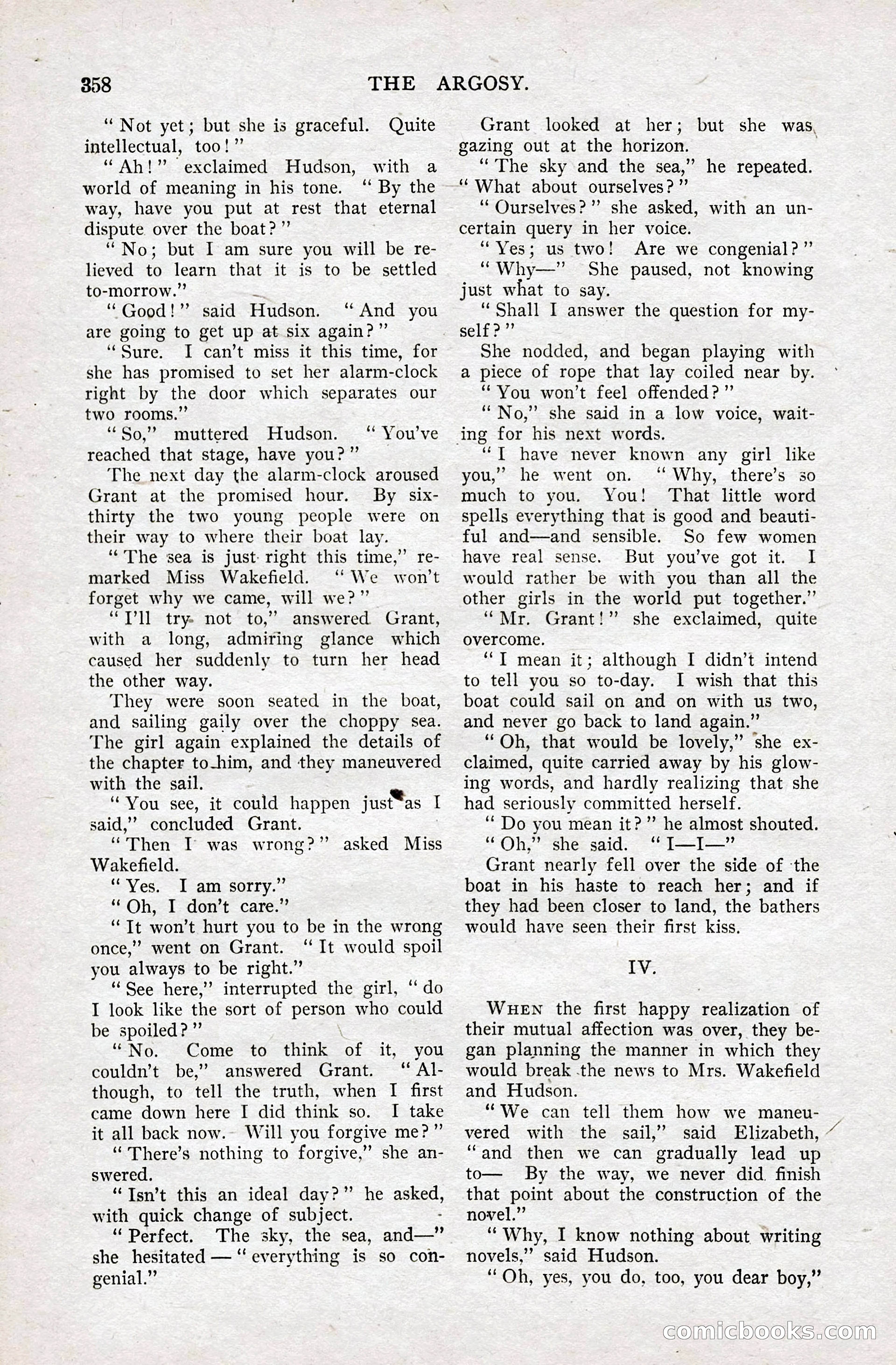
A restored page from Pulp Fiction, 1909. Page through the whole issue in the reader above.
📄 Transcribed text from this page (OCR, searchable)
Machine-transcribed from the original scan — historical spelling and the odd misread are preserved.
38 ‘Not yet; but she is graceful. Quite intellectual, too!” “Ah!” exclaimed Hudson, with a world of meaning in his tone. ‘“ By the way, have you put at rest that eternal dispute over the boat?” “No; but I am sure you will be re- lieved to learn that it is to be settled to-morrow.” “Good!” said Hudson. “And you are going to get up at six again?” ‘Sure. I can’t miss it this time, for she has promised to set her alarm-clock right by the door which separates our two rooms.” ‘*So,”’ muttered Hudson. reached that stage, have you?”’ The next day the alarm-clock aroused Grant at the promised hour. By six- thirty the two young people were on their way to where their boat lay. ‘The sea is just: right this time,” re- marked Miss Wakefield. ‘“‘ We won't forget why we came, will we?” “T'll try- not to,” answered Grant, with a long, admiring glance which caused her suddenly to turn her head the other way. They were soon seated in the boat, and sailing gaily over the choppy sea. The girl again explained the details of the chapter to_him, and they maneuvered with the sail. “You see, it could happen just®as I said,’’ concluded Grant. “Then I was wrong?” asked Miss Wakefield. “Yes. I am sorry.” “Oh, I don’t care.” “Tt won’t hurt you to be in the wrong once,” went on Grant. “It would spoil you always to be right.” “See here,” interrupted the girl, “do I look like the sort of person who could be spoiled?” \ “No. Come to think of it, you couldn’t be,’ answered Grant. “ Al- though, to tell the truth, when I first came down here I did think so. I take it all back now.- Will you forgive me?” “There’s nothing to forgive,” she an- swered. “Tsn’t this an ideal day?” he asked, with quick change of subject. - “Perfect. The sky, the sea, and—’ she hesitated — ‘‘ everything is so con- genial.” ‘* You’ve THE ARGOSY. Grant looked at her; but she was, gazing out at the horizon. ‘The sky and the sea,’ he repeated. —“ What about ourselves? ”’ “Ourselves?” she asked, with an un- certain query in her voice. “Yes; us two! Are we congenial?” “ Why—” She paused, not knowing just what to say. ‘Shall I answer the question for my- self?” She nodded, and began playing with a piece of rope that lay coiled near by. ‘You won't feel offended? ”’ “No,” she said in a low voice, wait- ing for his next words. ‘“T have never known any girl like you,” he went on. ‘ Why, there’s so much to you. You! That little word spells everything that is good and beauti- ful and—and sensible. So few women have real sense. But you've got it. I would rather be with you than all the other girls in the world put together.” “Mr. Grant!” she exclaimed, quite overcome. “I mean it; although I didn’t intend to tell you so to-day. I wish that this boat could sail on and on with us two, and never go back to land again.” “Oh, that would be lovely,” she ex- claimed, quite carried away by his glow- ing words, and hardly realizing that she had seriously committed herself. “Do you mean it?” he almost shouted. “Oh,” she said. ‘“* I—I—” Grant nearly fell over the side of the boat in his haste to reach her; and if they had been closer to land, the bathers would have seen their first kiss. IV. WHEN the first happy realization of their mutual affection was over, they be- gan planning the manner in which they would break the news to Mrs. Wakefield and Hudson. “We can tell them how we maneu- vered with the sail,” “and then we can gradually lead up to— By the way, we never did. finish that point about the construction of the novel.” “Why, I know nothing about writing novels,”’ said Hudson. ‘Oh, yes, you do, too, you dear boy,” MICLOOO© (C S said Elizabeth, - (C@