
Pulp Fiction, 1909 · page 154 of 227
The Argosy for May — page 154: what you’re looking at
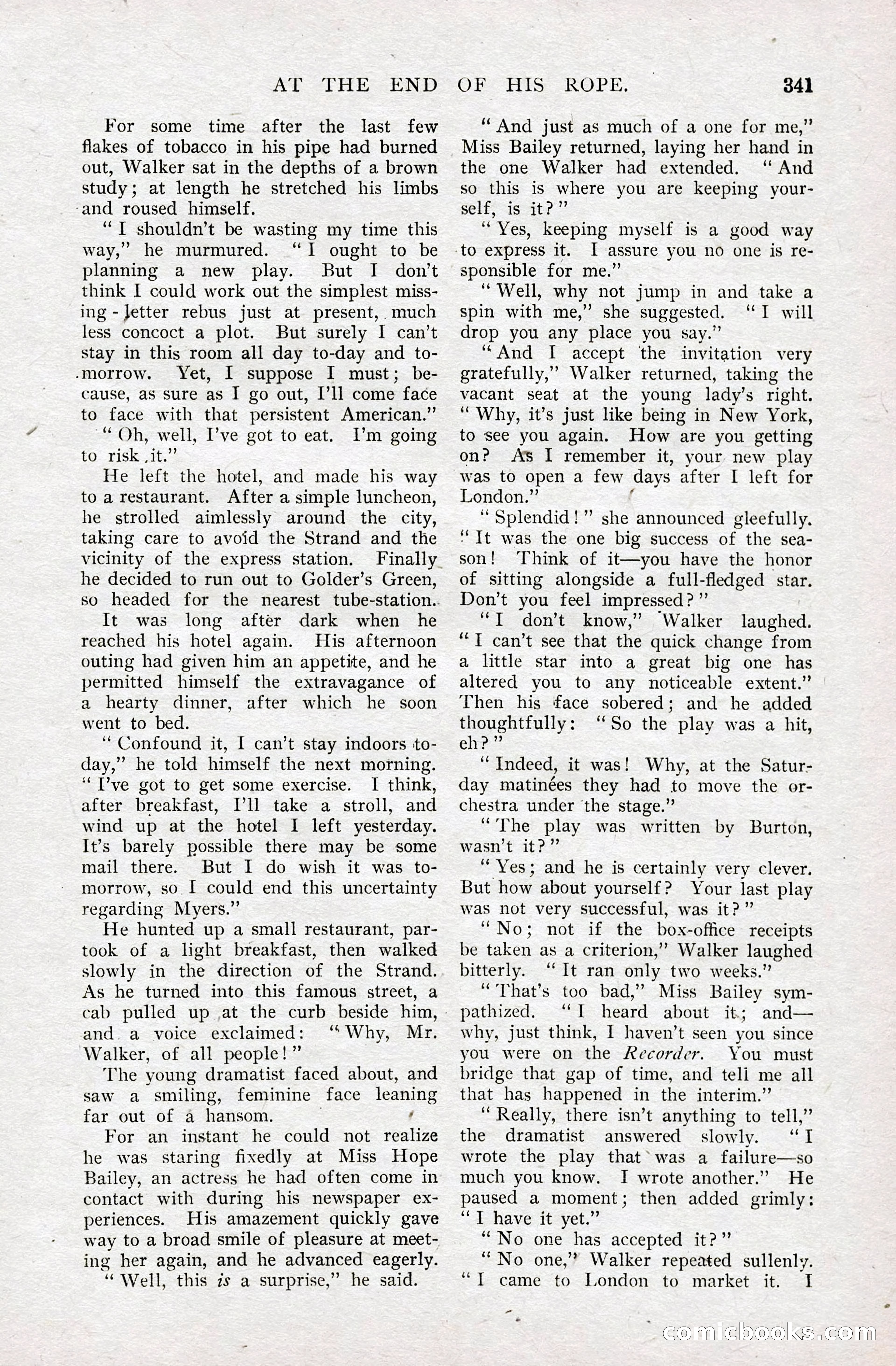
A restored page from Pulp Fiction, 1909. Page through the whole issue in the reader above.
📄 Transcribed text from this page (OCR, searchable)
Machine-transcribed from the original scan — historical spelling and the odd misread are preserved.
AT THE END For some time after the last few flakes of tobacco in his pipe had burned out, Walker sat in the depths of a brown study; at length he stretched his limbs ‘and roused himself. ‘“T shouldn’t be wasting my time this way,’ he murmured. “I ought to be planning a new play. But I don't think I could work out the simplest miss- ing - Jetter rebus just at present, much less concoct a plot. But surely I can’t stay in this room all day to-day and to- -morrow. Yet, I suppose I must; be- cause, as sure as I go out, I’ll come face to face with that persistent American.” “Oh, well, I’ve got to eat. I’m going to risk ,it.” He left the hotel, and made his way to a restaurant. After a simple luncheon, he strolled aimlessly around the city, taking care to avoid the Strand and the vicinity of the express station. he decided to run out to Golder’s Green, so headed for the nearest tube-station.. It was long after dark when he reached his hotel again. His afternoon outing had given him an appetite, and he permitted himself the extravagance of a hearty dinner, after which he soon went to bed. ‘Confound it, I can’t stay indoors to- day,” he told himself the next morning. ‘“T’ve got to get some exercise. I think, after breakfast, Vl take a stroll, and wind up at the hotel I left yesterday. It’s barely possible there may be some mail there. But I do wish it was to- morrow, so I could end this uncertainty regarding Myers.” He hunted up a small restaurant, par- took of a light breakfast, then walked slowly in the direction of the Strand. As he turned into this famous street, a cab pulled up at the curb beside him, » and. a voice exclaimed: Walker, of all people!” The young dramatist faced about, and saw a smiling, feminine face leaning far out of a hansom. | , For an instant he could not realize he was staring fixedly at Miss Hope Bailey, an actress he had often come in contact with during his newspaper ex- periences. His amazement quickly gave way to a broad smile of pleasure at meet- ing her again, and he advanced eagerly. “Well, this zs a surprise,” he said. “Why, Mr. ‘to express it. Finally OF HIS ROPE. 341 “And just as much of a one for me,” Miss Bailey returned, laying her hand in the one Walker had extended. ‘‘ And so this is where you are keeping your- self, is it?” ‘Yes, keeping myself is a good way I assure you no one is re- sponsible for me.” “Well, why not jump in and take a spin with me,” she suggested. “I will drop you any place you say.” “And I accept the invitation very gratefully,” Walker returned, taking the vacant seat at the young lady’s right. “Why, it’s just like being in New York, to see you again. How are you getting on? As I remember it, your new play was to open a few days after I left for London.” f Splendid!” she announced gleefully. “It was the one big success of the sea- son! ‘Think of it—you have the honor of sitting alongside a full-fledged star. Don’t you feel impressed? ”’ “T don’t know,” Walker laughed. ““T can’t see that the quick change from a little star into a great big one has altered you to any noticeable extent.” Then his face sobered; and he added thoughtfully: “So the play was a hit, eh: ‘Indeed, it was! Why, at the Satur- day matinées they had to move the or- chestra under the stage.” “The play was written by Burton, wasn’t it?” “Yes; and he is certainly very clever. But how about yourself? Your last play was not very successful, was it?” “No; not if the box-office receipts be taken as a criterion,’’ Walker laughed bitterly. “‘ It ran only two weeks.” “'That’s too bad,” Miss Bailey sym- pathized. “I heard about it; and— why, just think, I haven’t seen you since you were on the Recorder. You must bridge that gap of time, and teli me all that has happened in the interim.” “Really, there isn’t anything to tell,” the dramatist answered slowly. “I wrote the play that’ was a failure—so much you know. I wrote another.” He paused a moment; then added grimly: “I have it yet.” “No one has accepted it?” “No one,” Walker repeated sullenly. “I came to London to market it. I - ~ connicbooks G (CO)